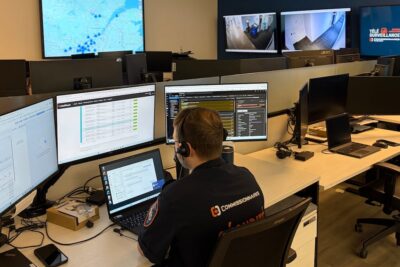
Criminal justice authorities may wish to control or to monitor the location of an individual without resorting to imprisonment. For example, law-enforcement electronic monitors can be used on a number of offender and suspect groups and situations, including pre-trial defendants on conditional release and convicted offenders on probation or parole. It may also be used as part of intensive supervision or work release (day parole) programs. In some jurisdictions, electronic monitoring is used to supervise both adults and youths.
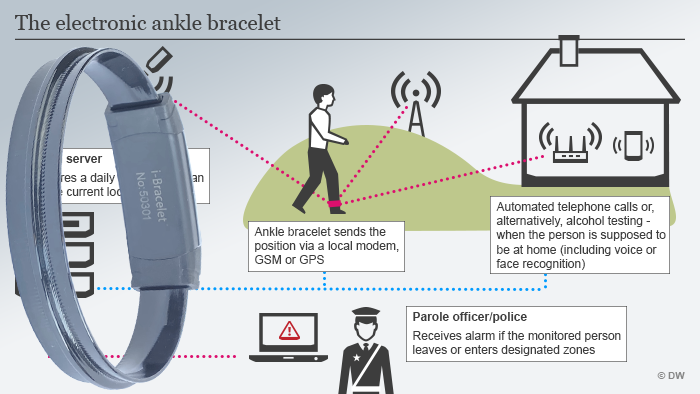
Electronic monitoring, also called ‘tagging’ allows justice personnel to quickly and easily confirm that an offender is at a specified location when he or she is required to be present. When an offender is placed in an electronic monitoring program, a tamper-resistant electronic device is attached to his or her ankle. The device transmits an electronic signal, usually through a telephone, indicating whether the offender has had any unauthorized absences or has tampered with the device, are mainly manifested as an ankle monitor.
There are three phases of law-enforcement electronic monitoring that can be used in the criminal justice system: pre-trial, sentencing, and post-prison.
Before a criminal trial, the police may want to ensure that the accused remains in town or away from the victim, such as on bail, residential surveillance;
After sentencing and conviction, the judge may wish to restrict the freedom of the offender without taking custodial sanctions, such as probation and temporary execution outside prison;
After being released from prison, the parole board may want to impose restrictions on offenders. Community corrections-based programs designed to achieve these goals through release conditions, such as reporting to officials or obeying a curfew.
Table of Contents
What Technology Advances Are Driving Electronic Monitoring Program Expansion?
Three technology shifts are accelerating electronic monitoring adoption: adaptive multi-mode connectivity (BLE/WiFi/LTE auto-switching extending GPS ankle monitor battery from days to months), fiber-optic tamper detection (eliminating 15-30% false-alarm rates), and AI-driven alert management reducing officer alert fatigue by 60-80%.
The GPS ankle bracelet market is transitioning from Generation 3 (cellular-only, 24-72h battery) to Generation 4 (multi-mode adaptive connectivity, 7-day to 180-day battery, zero false-alarm tamper detection). This addresses the three operational barriers that limited program scaling: daily charging logistics consuming officer time, cellular dead zones creating supervision gaps, and false alert overload preventing effective caseload management.
For agencies planning electronic monitoring investments, vendor technology roadmaps matter as much as current specifications. 5G network compatibility (LTE-M/NB-IoT), smartphone monitoring integration, and cybersecurity certification (EN 18031) will define competitive positioning through 2030. Programs locked into legacy ankle monitor equipment face forced replacement as cellular carriers complete 3G shutdowns.
What Technology Advances Are Driving Electronic Monitoring Growth?
Three technology shifts define the GPS ankle monitor market transition: adaptive multi-mode connectivity (BLE/WiFi/LTE extending battery from days to months), fiber-optic tamper detection (eliminating 15-30% false-alarm rates), and AI-driven alert management reducing officer fatigue by 60-80%.
The GPS ankle bracelet market is moving from Gen 3 (cellular-only, 24-72h battery) to Gen 4 (multi-mode adaptive, 7-180 day battery, zero false alarms). This addresses three scaling barriers: daily charging consuming officer time, cellular dead zones creating gaps, and false alerts preventing effective caseload management in electronic monitoring programs. Agencies evaluating vendors should prioritize technology roadmaps — 5G compatibility and cybersecurity certification will define competitiveness through 2030.
How Are Technology Advances Reshaping the Electronic Monitoring Landscape?
The GPS ankle monitor industry is undergoing its most significant technology transition since the introduction of satellite tracking, with fourth-generation devices introducing adaptive multi-mode connectivity, breakthrough battery architectures, and zero false-alarm tamper detection that collectively redefine operational expectations.
Generation 4 electronic monitoring technology addresses three persistent operational barriers simultaneously. First, adaptive BLE/WiFi/LTE connectivity enables GPS ankle bracelet devices to automatically select the most power-efficient communication mode based on the monitoring environment — extending battery life from the industry standard of 24-72 hours to 7 days (LTE), 3 weeks (WiFi), or 180 days (BLE connected mode). Second, WiFi-directed connectivity eliminates cellular dead zones by enabling data transmission through standard home WiFi networks — a $10-50 WiFi repeater placed in a basement apartment provides both connectivity and extended battery life. Third, fiber-optic tamper detection eliminates the 15-30% false alarm rates that consume officer capacity in current programs.
For agencies planning electronic monitoring investments, these improvements are not incremental — they represent an architectural generation change that legacy devices cannot achieve through firmware updates alone. The connectivity and battery improvements require hardware capabilities (WiFi and BLE transceivers) that existing ankle monitor devices simply do not possess.
The practical impact for corrections and pretrial programs: 85% reduction in charging-related alerts, continuous monitoring in previously unreachable environments, and dramatic reductions in false alarm workload — enabling agencies to manage larger caseloads without proportional staff increases.