







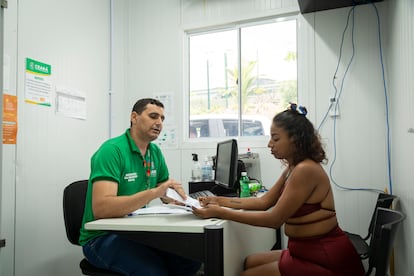
In Fortaleza, Brazil, a government initiative offers a stark contrast to conventional offender supervision and drug intervention. The “Care Stations” provide essential social services—from hot showers and legal aid to therapeutic foot baths—to unhoused individuals and those battling addiction. Crucially, this program also extends its support to individuals under electronic monitoring, exemplifying a public health approach rarely seen in regions grappling with intense drug conflicts. This strategy seeks to provide a “bridge to public policies” for historically marginalized populations, according to Nara de Araujo, head of Prevention and Social Reintegration at the federal government’s National Secretariat for Drug Policy.
Key Takeaways
- Integration of Support and Supervision: The Care Stations directly serve individuals under community supervision, including those wearing electronic ankle monitors, linking them to vital resources often inaccessible.
- Rapid National Expansion: What began as a pilot project 16 months ago in Fortaleza has grown to 11 units, with plans for 409 centers across Brazil by year-end, signaling significant government investment in this model.
- Public Health vs. War on Drugs: This initiative prioritizes social reintegration and health services, diverging sharply from traditional “war on drugs” strategies that frequently criminalize addiction without offering substantive support.
- Addressing Systemic Barriers: The Centers for Access to Rights and Social Inclusion (CAIS), as the secretariat calls them, specifically target populations historically excluded from public services due to factors like structural racism, gender, and violence.
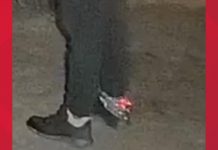
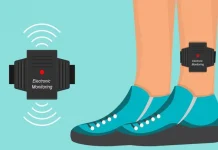
For individuals under electronic monitoring, accessing consistent support can be challenging. Reinaldo, 55, currently serves a seven-year sentence for failure to render aid and wears an electronic ankle monitor that flashes a blue light. While under community supervision, Reinaldo actively engages with the services offered at a Fortaleza Care Station, including therapeutic foot baths. He reports having quit drugs in 2015, though he acknowledges continued tobacco use. The Care Station offers Reinaldo and others like him a rare respite, providing practical resources like showers, legal assistance, psychological treatment, and even paper and paintbrushes. This approach treats the individual’s holistic needs, moving beyond simple offender tracking and offering pathways to stability and reintegration for those wearing a GPS ankle bracelet.

The Care Stations operate against a backdrop of Brazil’s “war on drugs,” a context shaped by international policies and growing cartel power. Fortaleza, the capital of Ceará state, has become a strategic hub for drug trafficking due to its port, airport, and proximity to Europe and the United States. This geography has fueled a brutal war between major drug cartels, leading to surges in violence and forced evictions in neighborhoods like Moura Brasil, a favela under the control of the Comando Vermelho criminal organization. Amidst this volatile environment, the Care Stations offer a starkly different model. Nara de Araujo explained to EL PAÍS that these centers act as a “bridge to public policies on health, social assistance and so on,” aiming to include those historically denied access due to systemic issues. The initiative began with a single green shipping container in Moura Brasil and now represents a significant federal effort to address addiction and social exclusion through support rather than solely punitive measures.
As electronic tagging becomes an increasingly common tool in community supervision, Brazil’s Care Stations present an innovative framework. This model demonstrates that electronic monitoring need not be solely about surveillance, but can be integrated into broader strategies that prioritize rehabilitation and social access. The rapid expansion of these centers suggests a national commitment to exploring alternatives that combine offender tracking with comprehensive human services, potentially informing future approaches to criminal justice technology and offender supervision worldwide.
Source: Free showers and lawyers for crack addicts in Brazil