
Table of Contents
- Electronic Monitoring Statistics 2026
- Deployment & Scale Statistics
- Cost & Economics Statistics
- Effectiveness & Recidivism Statistics
- Technology & Standards Statistics
- Market Size & Growth Statistics
- Market Share by Segment (Estimated 2026)
- Regional Adoption Statistics
- Electronic Monitoring Adoption by Region
- States Mandating GPS for Registered Sex Offenders
- Additional Key Statistics
- EM Technology Comparison Matrix
- Frequently Asked Questions
- How many people wear ankle monitors in the United States?
- How much does electronic monitoring cost compared to jail?
- Does electronic monitoring reduce recidivism?
- What is the NIJ GPS accuracy standard for ankle monitors?
- How large is the global electronic monitoring market?
- Further Reading
- Cite This Page
Electronic Monitoring Statistics 2026
30 essential facts, figures, and data points on the global electronic monitoring industry. Updated March 2026.
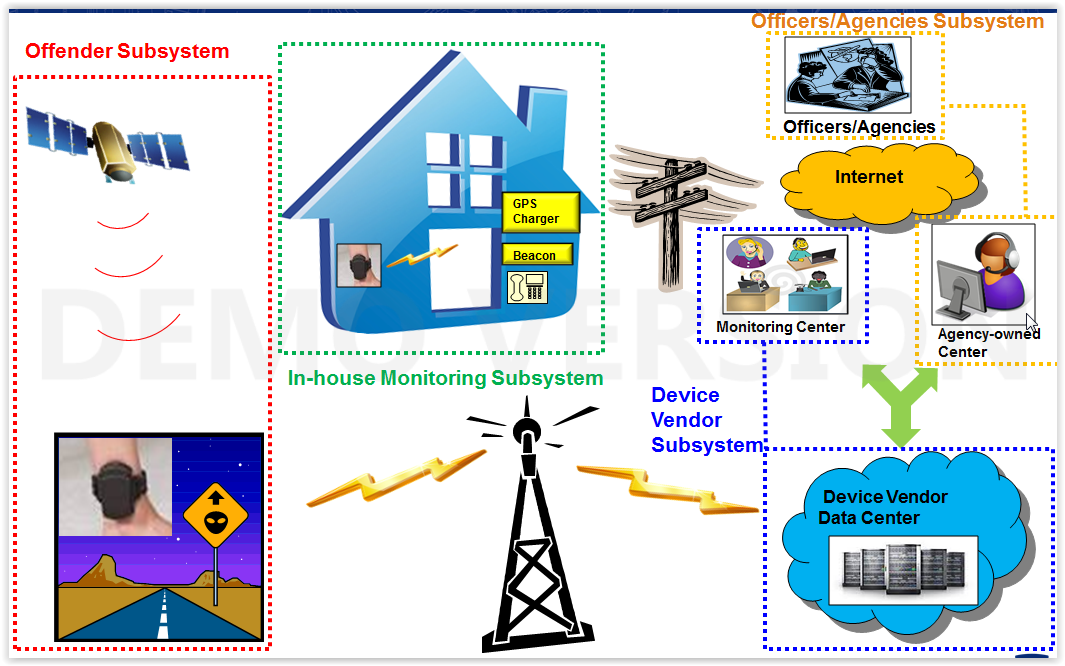
Sources: NIJ, Bureau of Justice Statistics, Pew Research, Vera Institute, Council of Europe EMEU reports, industry data.
Deployment & Scale Statistics
People on electronic monitoring in the U.S. at any given time
Source: Pew Charitable Trusts, “Use of Electronic Offender-Tracking Devices Expands Sharply” (2016); Bureau of Justice Statistics estimates updated through 2024 data.
Active EM devices deployed worldwide across 30+ countries
Source: Industry aggregate from vendor reports, Council of Europe EMEU annual surveys, and government procurement records.
Participants in ICE’s ISAP (Intensive Supervision Appearance Program) using EM
Source: U.S. Immigration and Customs Enforcement, Congressional reporting (FY2023-2024). ISAP uses GPS ankle monitors and SmartLINK app for immigration case compliance.
Growth in U.S. electronic monitoring use from 2005 to 2015
Source: Pew Charitable Trusts analysis of Bureau of Justice Statistics data. The number of people on EM grew from approximately 53,000 to 131,000 over this decade.
Estimated increase in EM usage during COVID-19 (2020–2023)
Source: Vera Institute of Justice, “People on Electronic Monitoring in the United States” (2023). Courts accelerated EM adoption to reduce jail populations during the pandemic, and many programs have maintained expanded capacity.
Cost & Economics Statistics
| Supervision Method | Daily Cost per Person | Annual Cost per Person | Source |
|---|---|---|---|
| Federal prison (BOP) | $120.56 | $44,005 | Federal Bureau of Prisons FY2023 |
| State prison (average) | $90–$150 | $32,850–$54,750 | Vera Institute, “The Price of Prisons” (2023 update) |
| County jail | $75–$135 | $27,375–$49,275 | National Institute of Corrections, county surveys |
| GPS electronic monitoring | $4–$35 | $1,460–$12,775 | NIJ, state program reports, vendor pricing data |
| RF home monitoring | $2–$15 | $730–$5,475 | Program administrative data |
| Smartphone-based monitoring | $1–$10 | $365–$3,650 | App-based monitoring vendor data |
Cost savings when using EM vs. incarceration per supervised person per day
A county diverting 100 defendants from jail ($100/day) to GPS monitoring ($15/day) saves approximately $3.1 million annually. Source: NIJ cost-benefit analyses and county program evaluations.
Annual device loss/damage rate for two-piece tracking units
Source: Agency operational data. Portable tracking units have significantly higher loss rates than ankle-worn devices (3–5% for one-piece designs).
Average cost per false alarm response by supervision officers
Source: Estimates from county corrections program managers. Includes officer time, mileage, and administrative processing.
Effectiveness & Recidivism Statistics
Reduction in Recidivism with GPS Electronic Monitoring
The landmark Florida Department of Corrections study (Bales et al., 2010) — funded by the National Institute of Justice — found that GPS monitoring reduced the likelihood of reoffending by 31% compared to offenders without electronic supervision. This is the most widely cited EM effectiveness statistic in criminal justice research.
Source: Bales, W. et al., “A Quantitative and Qualitative Assessment of Electronic Monitoring,” Florida State University, NIJ Grant 2005-IJ-CX-0038.
Reduction in Failure to Appear (FTA) rates with pretrial GPS monitoring
Source: Multiple pretrial services program evaluations, including Jefferson County (CO) and Mecklenburg County (NC).
Reduction in new arrests during EM supervision vs. unsupervised release
Source: RAND Corporation meta-analysis of community supervision programs (2020).
Program compliance rate for GPS-monitored sex offenders in states with lifetime monitoring mandates
Source: State Department of Corrections annual compliance reports (Florida, California, Colorado).
“Electronic monitoring is not a panacea, but the evidence consistently shows that GPS supervision, when properly implemented, reduces both recidivism and failure-to-appear rates more effectively than unsupervised release while costing a fraction of incarceration.”
Technology & Standards Statistics
| Technology Parameter | Industry Benchmark | Standard / Source |
|---|---|---|
| GPS Accuracy (outdoor, open sky) | ≤ 10 meters | NIJ Standard 1004.00 (Offender Tracking Systems) |
| GPS Accuracy (urban / indoor) | ≤ 30 meters | NIJ Standard 1004.00 |
| Best-in-class GPS accuracy (multi-GNSS) | < 2 meters CEP | Vendor specification (quad-constellation GNSS devices) |
| False tamper alert rate (industry average) | 15–25% | Agency operational reports, vendor quality data |
| False tamper alert rate (fiber optic technology) | 0% (zero false positives) | Vendor testing data — fiber optic strap integrity detection |
| Battery life range (one-piece GPS devices) | 24 hours – 7 days | Vendor specifications across major manufacturers |
| Installation time (snap-on one-piece) | < 3 seconds | Vendor specification (tool-free snap designs) |
| Installation time (two-piece with pairing) | 3–5 minutes | Agency operational reports |
| Waterproof rating (industry standard) | IP67–IP68 | IEC 60529 |
Estimated proportion of U.S. EM devices still using 2G/3G cellular that will need replacement due to network shutdowns
With AT&T having sunset 3G in 2022 and T-Mobile completing shutdown in 2024, agencies still using WCDMA/GSM-only devices face an urgent upgrade cycle. The transition to LTE-M and NB-IoT represents the largest fleet-wide hardware replacement in the EM industry’s history. Source: FCC carrier shutdown announcements, vendor migration data.
Market Size & Growth Statistics
Estimated global EM market size in 2026
Includes hardware, software, monitoring services, and cellular costs. Sources: Grand View Research, Allied Market Research, MarketsandMarkets industry reports (2024-2025 editions).
Compound annual growth rate (CAGR) 2024–2030
Driven by alternatives-to-incarceration policies, pretrial reform, immigration monitoring expansion, and technology upgrades (3G to LTE-M). Source: Multiple market research reports.
Market Share by Segment (Estimated 2026)
| Segment | Est. Share | Key Drivers |
|---|---|---|
| GPS Hardware & Devices | 35–40% | 3G sunset replacements, one-piece design adoption |
| Monitoring Software (SaaS) | 25–30% | Cloud migration, AI analytics, multi-agency platforms |
| Monitoring Services | 20–25% | 24/7 monitoring centers, violation response |
| Alcohol/Drug Detection | 10–15% | DUI/DWI court mandates, continuous alcohol monitoring |
Regional Adoption Statistics
Electronic Monitoring Adoption by Region
| Region | Est. Active Devices | Primary Use Case | Growth Trend |
|---|---|---|---|
| United States | ~125,000 people | Pretrial, probation, sex offender, immigration | Growing (pretrial + immigration) |
| United Kingdom | ~15,000 | Bail, curfew, early release | Stable/Growing |
| Continental Europe | ~20,000 | Pretrial, community sentences | Growing (Eastern Europe expansion) |
| Latin America | ~15,000–20,000 | Pretrial, DV, prison overcrowding alternatives | Rapid growth (Brazil, Mexico, Colombia) |
| Asia-Pacific | ~10,000–15,000 | Community corrections, quarantine (post-COVID) | Growing |
| Africa | ~5,000–8,000 | Alternatives to detention, bail supervision | Fastest-growing region |
| Middle East | ~3,000–5,000 | Judicial supervision, immigration | Emerging |
States Mandating GPS for Registered Sex Offenders
At least 24 U.S. states have enacted legislation requiring GPS electronic monitoring for certain categories of sex offenders, with 8 states mandating lifetime GPS supervision for the highest-risk tiers. Florida’s Jessica Lunsford Act (2005) was the landmark legislation that triggered nationwide adoption.
Additional Key Statistics
Of EM programs now offer or plan to offer smartphone-based monitoring for low-risk populations
Source: Justice Technology Association survey, 2024
Of pretrial services programs now use electronic monitoring as a condition of release
Source: Pretrial Justice Institute, “The State of Pretrial Justice in America” (2023)
Of agencies report EM as “effective” or “very effective” for high-risk domestic violence cases
Source: National Institute of Justice survey of DV victim advocates and supervision agencies
Average annual false alarm cost for a 1,000-device GPS monitoring program at 20% false alert rate
Calculation: 1,000 devices × 20% rate × 2 alerts/month × $50/response × 12 months. Source: Industry cost modeling.
EM Technology Comparison Matrix
| Technology | Use Case | Range | Accuracy | Daily Cost | Risk Level |
|---|---|---|---|---|---|
| GPS (One-Piece) | Active tracking | Unlimited | 2–10m | $8–$35 | High |
| GPS (Two-Piece) | Active tracking | Unlimited | 5–30m | $5–$25 | High-Medium |
| RF (Radio Frequency) | Home curfew | 50–200m | Presence/absence | $2–$15 | Medium-Low |
| Alcohol (SCRAM-type) | Sobriety monitoring | N/A | BAC detection | $10–$20 | DUI/DWI |
| Smartphone App | Check-in / location | Unlimited | 10–100m | $1–$10 | Low |
| BLE (In-Prison RTLS) | Indoor positioning | Facility-wide | 1–5m | $3–$12 | In-custody |
Frequently Asked Questions
How many people wear ankle monitors in the United States?
Approximately 125,000 people are on electronic monitoring in the United States at any given time, according to estimates from Pew Charitable Trusts and the Bureau of Justice Statistics. This number has grown by 387% since 2005 and continues to rise with expanded pretrial release and immigration monitoring programs.
How much does electronic monitoring cost compared to jail?
GPS electronic monitoring costs $4–$35 per day per person, while jail incarceration costs $75–$150 per day. This represents a 60–90% cost saving. For a county diverting 100 defendants from jail to GPS monitoring, the annual savings can exceed $3 million.
Does electronic monitoring reduce recidivism?
Yes. The most comprehensive study — conducted by Florida State University with NIJ funding — found that GPS electronic monitoring reduced recidivism by 31%. Additional studies show 30–40% reduction in failure-to-appear rates for pretrial defendants. The RAND Corporation’s meta-analysis confirmed a 22% reduction in new arrests during EM supervision compared to unsupervised release.
What is the NIJ GPS accuracy standard for ankle monitors?
The National Institute of Justice Standard 1004.00 for Offender Tracking Systems specifies a minimum accuracy of 10 meters in open-sky outdoor conditions and 30 meters in challenging environments (urban canyons, indoor). Modern multi-GNSS devices using GPS, GLONASS, Galileo, and BeiDou achieve sub-2-meter accuracy.
How large is the global electronic monitoring market?
The global electronic monitoring market is estimated at $4.5–5.5 billion in 2026, with a compound annual growth rate (CAGR) of 12–15% through 2030. Growth is driven by alternatives-to-incarceration policies, pretrial reform, immigration monitoring expansion, and the 2G/3G sunset forcing fleet-wide hardware upgrades.
Further Reading
- GPS Ankle Monitor Ultimate Guide — Comprehensive guide to GPS ankle monitoring technology
- Ankle Monitor Cost Guide: Daily Fees & TCO Analysis — Detailed breakdown of electronic monitoring costs
- What Is an Ankle Monitor? Complete Explanation — How ankle monitors work from a technical perspective
Cite This Page
Ankle Monitor Industry Report. “Electronic Monitoring Statistics 2026: 30 Key Facts, Figures & Industry Data.” Ankle Monitor Industry Report, March 2026, www.ankle-monitor.org/electronic-monitoring-statistics-2026/.
This data compilation is regularly updated. Last updated: March 27, 2026. All statistics are sourced from publicly available government reports, academic research, and industry data. Sources cited inline.


![Electronic Tagging Statistics: Global Adoption Rates and Effectiveness Data [2026]](https://www.ankle-monitor.org/wp-content/uploads/2026/03/post_src_1774425808037-400x267.jpg)