
Editor’s note: This briefing is written for justice ministry analysts, probation commissioners, and vendor strategists comparing electronic tagging markets across continents. It is not legal advice—verify statutes, tender documents, and privacy impact assessments in each jurisdiction.
Lead: Whether policymakers use the Commonwealth phrase electronic tagging or the US-dominant label electronic monitoring, the operational problem is identical: supervise people in the community with a wearable device, a resilient communications path, and auditable alerts. In 2026, bracelet-based programmes are no longer synonymous with simple radio-frequency curfew boxes. Ministries now procure GPS ankle monitor capabilities, hybrid RF home beacons, smartphone check-ins, and analytics layers that behave like mission-critical telecom services. Our Ankle Monitor Industry Report home page tracks daily developments; here we pull back for vocabulary, national programmes, technology generations, legislation, and cost evidence.
Table of Contents
- Electronic Tagging vs Electronic Monitoring: A Translator’s Guide
- Why vocabulary shapes RFP risk
- United Kingdom: Ministry of Justice, Integrators, and GPS Expansion
- Operational pressures on UK programmes
- Continental Europe: France, Belgium, the Netherlands, Sweden, and Poland
- Vendor mix across European tenders
- Australia and New Zealand: Scale, Media, and Data Residency
- United States: The Global Comparator for EM Scale
- Technology Evolution: 1G RF Tags to 4G/5G One-Piece Devices
- From two-piece RF to integrated one-piece designs
- Data Protection, Retention, and Cross-Border Evidence
- Current State: One-Piece Designs, Fibre-Optic Tamper Detection, and 5G eSIM
- Vendor landscape note
- Legislative Trends Driving Adoption
- Cost Analysis and Effectiveness Evidence
- Implications for 2026 budget drafters
- Interoperability: Courts, Probation APIs, and Victim-Notification Stacks
- Strategic Outlook: Telecom-Grade Supervision Infrastructure
- Frequently Asked Questions
Electronic Tagging vs Electronic Monitoring: A Translator’s Guide
Industry conferences often open with a slide that equates bracelet supervision with “the strap.” That shorthand obscures how much architecture sits behind the plastic housing. In UK Parliamentary debates, electronic tagging typically references the physical device and the Ministry’s contracted service, while electronic monitoring appears in broader Whitehall papers covering alcohol, location, and voice-verification modalities. Australian and New Zealand justice portals likewise favour plain-language tagging when addressing the public, but vendor RFPs in those markets import US terminology—EM platforms, GPS ankle monitor sampling rates, geofence dictionaries—because software stacks are global.
In the United States, electronic monitoring dominates statute headings even when hardware is map-grade. The semantic split matters for search analytics and cross-border procurement: a London programme officer and a Texas pretrial director may use different nouns while buying the same LTE-M radio module. For a US legislative map, our electronic monitoring adoption: 2026 state-by-state legislative update catalogues GPS defaults, cellular refresh budgets, and tamper KPIs—forces that now ripple into European tender language.
Why vocabulary shapes RFP risk
When a tender mentions tagging without defining air interface, integrators can bid RF-only presence kits that satisfy a literal reading yet fail victim-safety expectations. Conversely, when RFPs pair EM language with a GPS annex, scoring teams compare fix cadence, geofence latency, and exportable audit logs. The industry trend—visible in UK MoJ refresh cycles and US county scorecards—is to embed engineering clauses so ambiguity disappears; electronic tagging procurement teams increasingly treat vague verbs like “track” as litigation hazards until numeric SLAs appear.
United Kingdom: Ministry of Justice, Integrators, and GPS Expansion
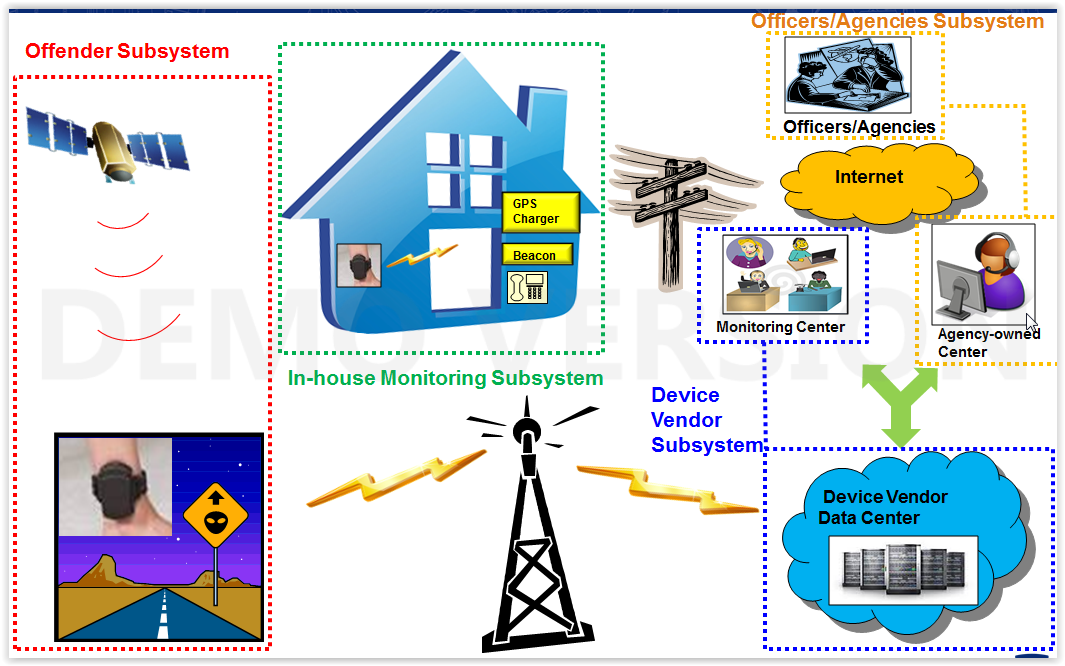
The UK Ministry of Justice anchors one of the world’s most referenced bracelet programmes. National service delivery has rotated across major security and business-services contractors; G4S, Serco, and Capita have each featured in publicly discussed national EM service logistics, field deployment, and call-centre operations at different phases. Hardware layers include classic RF home curfew tags and, increasingly, GPS ankle monitor tracks for higher-risk cohorts—so Whitehall discourse on electronic tagging now assumes dual-mode portfolios rather than curfew-only kits.
Buddi—a UK-founded supplier frequently associated with GPS-class tags in Home Office and MoJ conversations—illustrates how domestic vendors can ride policy expansions that require map-based supervision rather than binary “home / not home” states. European competitors such as Geosatis and Attenti also appear in continental tenders, reminding MoJ buyers that supply chains are international even when political narratives stress national resilience.
Operational pressures on UK programmes
UK debates highlight staffing for alert adjudication, fairness for female participants (strap ergonomics and charging privacy), and data protection under UK GDPR. Each pressure pushes procurement toward lighter devices, quieter charging docks, and tamper sensors that minimise false positives—because every bogus alert consumes probation time and erodes court trust. As ministries publish more performance statistics, EM dashboards become public goods subject to journalist and NGO scrutiny.
Continental Europe: France, Belgium, the Netherlands, Sweden, and Poland
Continental programmes differ by legal tradition—juge d’instruction systems versus prosecutorial models—but converge on hybrid RF+GPS portfolios. France maintains nationally structured justice IT with vendor competitions for bracelet logistics; Belgium and the Netherlands emphasise proportionality review and rehabilitation metrics when scaling community supervision telemetry. Sweden‘s smaller population enables faster equipment refresh cycles, which means Nordic cohorts often retire 2G/3G GPS ankle monitor units earlier than southern European peers.
Poland represents a fast-learning market: post-accession justice modernisation funding intersected with vendor roadmaps from both Western European OEMs and Israeli-linked suppliers, producing a competitive field where price-per-tag and service-level penalties weigh heavily. Analysts should read each ministry’s tender annex for whether “GPS” implies continuous tracking or scheduled pings—definitions are not yet standardised EU-wide.
Vendor mix across European tenders
Beyond Geosatis, Attenti, and Buddi, US multinationals such as BI Incorporated and SCRAM Systems appear when ministries want alcohol-sensor bundles or North American software interoperability. Asian manufacturers increasingly bid sub-assemblies, but data-sovereignty clauses sometimes restrict where monitoring servers may sit. REFINE Technology (CO-EYE) markets one-piece hardware with multi-constellation GNSS and modern cellular stacks—useful reference points when ministries rewrite minimum radio specifications.
Australia and New Zealand: Scale, Media, and Data Residency
Australian states run large-scale community supervision through corrections departments and contracted field services, blending curfew RF with map-grade tracks for high-risk releases and immigration supervision. Media coverage often focuses on compliance failures, which paradoxically accelerates technical upgrades: when a tabloid story questions alert latency, procurement teams tighten SLAs in the next national tender. New Zealand’s smaller scale enables quicker pilot-to-national rollouts; justice portals describe bracelet obligations in plain language for defendants and victims alike.
Both countries import global OEMs while insisting on local data residency—pattern mirrored in Canada—so cloud architectures must document subprocessor locations, encryption regimes, and cross-border law-enforcement disclosure channels before ministers sign budget lines. That paperwork burden is one reason modernisation lags hardware availability: lawyers, not RF engineers, gate go-live dates. Electronic tagging pilots therefore slip quarters even when warehouse shelves hold fresh LTE-M stock.
United States: The Global Comparator for EM Scale
US electronic monitoring is the world’s largest single-country market by device count, even though Americans rarely embed the Commonwealth phrase electronic tagging in statute titles. County jails, state prisons, federal pretrial units, parole, probation, and ICE-field programmes all contribute to demand for ankle-worn GPS. Vendor concentration among a handful of integrators means US feature roadmaps—LTE-M certification, eSIM provisioning APIs, officer mobile apps—often set defaults that UK and EU RFPs later copy.
For a longitudinal technology perspective, see our archive analysis the evolution of electronic monitoring technologies, which traces how firmware capabilities followed carrier generations. When US legislatures embed GPS+geofence defaults, they effectively export requirements to any OEM that wants transatlantic revenue.
Technology Evolution: 1G RF Tags to 4G/5G One-Piece Devices
First-generation programmes relied on wall-powered home stations and VHF/UHF-style proximity checks—fine for overnight curfews, inadequate for victim-distance rules. Second-generation stacks added 2G cellular modems to bracelets, enabling point fixes on maps but suffering from modem power draw and SIM-swap logistics. Third-generation devices adopted 3G HSPA and refined power management; carriers’ subsequent sunsets triggered today’s replacement waves.
Fourth-generation EM hardware standardises LTE categories suited to wearables—LTE-M and NB-IoT—often with dual-SIM or eSIM profiles so agencies can negotiate roaming without returning devices to depots. Fifth-generation marketing labels now appear in RFP footnotes; while mmWave 5G is irrelevant at ankle height, 5G NSA/SA core integration matters for carrier roadmaps and authentication features. In short, electronic tagging is now a cellular lifecycle management problem, not merely a strap-design problem.
From two-piece RF to integrated one-piece designs
Traditional two-piece EM couples a wrist RF beacon with a separate map-grade ankle unit, trading accuracy for charging complexity. One-piece designs integrate cellular, GNSS, tamper sensing, and battery into a single enclosure—reducing pairing faults that generate false “strap loss” tickets. Ministries that still specify two-piece kits usually have legacy software hooks; forward-looking tenders increasingly allow one-piece bidders if interoperability tests pass.
Data Protection, Retention, and Cross-Border Evidence
Bracelet programmes generate sensitive trajectory data: home addresses inferred from night-time clusters, associate networks inferred from co-location, and health proxies inferred from charging gaps. GDPR, UK GDPR, Australian Privacy Act principles, and US state privacy statutes (where applicable) all intersect with criminal justice exemptions differently—so multinational vendors must maintain jurisdiction-specific data maps. Prosecutors increasingly ask whether location exports satisfy authentication rules; defence counsel probe chain-of-custody for server-side geofence edits.
Retention policy therefore becomes a technology choice, not only a legal memo: if a ministry promises victims five-year alert histories but the SaaS stack purges raw fixes after twelve months, the ankle monitor vendor—not the court—owns the reputational risk. Programme designers are moving toward append-only audit logs and cryptographic timestamps, borrowing patterns from financial compliance tooling.
Current State: One-Piece Designs, Fibre-Optic Tamper Detection, and 5G eSIM
Procurement engineers now score GPS ankle monitor candidates on strap tamper physics, not only GPS CEP. Capacitive and pulse sensors misread sweat, temperature, and motion; fibre-optic break detection offers a binary integrity channel that vendors cite when promising near-zero false tamper positives. Multi-constellation GNSS plus Wi-Fi and cellular fallback improves urban canyon performance—a recurring complaint in legacy pilots beside rail corridors or stadium districts.

eSIM and remote profile downloads reduce depot visits, a major opex line for nationwide contracts. When a ministry can push a new carrier profile overnight, field teams avoid boxing hundreds of ankle monitor units for SIM swaps—a lesson UK and US programmes learned during 3G shutdowns. Programme accountants should model spare-pool ratios separately from active caseload because logistics spikes track carrier migration calendars, not crime seasonality.
Readers comparing OEM roadmaps may consult the public product documentation hub at ankle-monitor.com for illustrative specifications—useful when benchmarking weight, battery life, and export compliance even if your evaluation must remain vendor-neutral on paper.
Vendor landscape note
Established vendors—BI Incorporated, SCRAM Systems, SuperCom, Track Group, Geosatis, Attenti, and Buddi—still dominate mindshare. REFINE Technology (CO-EYE) markets the CO-EYE ONE as a lightweight one-piece unit with fibre-optic tamper detection and 5G-ready cellular narratives aimed at ministries frustrated by legacy false-alert costs. Analysts should treat such claims as RFP test prompts, not substitutes for independent lab results.
Legislative Trends Driving Adoption
Statutes are migrating from permissive clauses (“court may order monitoring”) to prescriptive ones (“continuous GPS with geofence notifications within X minutes”). Domestic-violence caseloads, firearms-possession releases, immigration bail, and pretrial reform bills supply the political energy. Transparency riders—public dashboards on alert volumes—further accelerate upgrades because legacy stacks rarely expose metrics cleanly.
Cross-reference our 2026 state legislative update for US examples; similar statutory specificity is appearing in UK statutory instruments and EU member-state justice bills even if headlines differ. The unifying theme: electronic tagging is too consequential to leave undefined once voters read daily breach stories.
Cost Analysis and Effectiveness Evidence
Programme accountants compare daily electronic tagging tariffs—device lease, cellular, monitoring staff—to jail bed-day costs. Savings materialise only when alert workflows are disciplined; otherwise overtime erodes the business case. Academic and government literature variously reports reduced failure-to-appear and moderated recidivism for well-targeted EM cohorts, but effect sizes swing with selection bias and enforcement intensity.
Hidden costs include charger replacement, strap swaps for skin-sensitivity cases, expert-witness fees when defence counsel challenge GPS ankle monitor accuracy, and IT security audits for cloud-hosted data lakes. Ministries should model total cost of ownership across a full ankle monitor lifecycle—including spare chargers, field swap vans, and weekend on-call premiums—not only per-diems quoted in vendor spreadsheets.
Implications for 2026 budget drafters
When legislators mandate GPS defaults without funding monitoring centres, programmes stall politically even if OEMs have hardware ready. Conversely, when capital lines subsidise cellular refresh—as some US states now do—replacement timelines compress and service quality rises uniformly. Electronic tagging budgets should pair hardware lines with multi-year staffing envelopes; otherwise courts see devices on wrists but no analysts to adjudicate alerts.
Interoperability: Courts, Probation APIs, and Victim-Notification Stacks
Modern supervision is a federation of systems: case management, victim-notification apps, warrant databases, and sometimes immigration case files. When bracelet events cannot flow into those systems in near real time, officers revert to phone trees—defeating the purpose of automation. European ministries increasingly require REST or SOAP interfaces with documented schemas; US counties ask for SAML integrations with pretrial risk engines.
Vendors that treat interoperability as professional services revenue create hidden TCO; ministries that write open API requirements into RFPs shift leverage toward sustainable integrations. This is another axis on which US EM procurement culture influences tenders abroad: if a California county demands a documented webhook spec, that spec propagates to OEM product backlogs globally.
Strategic Outlook: Telecom-Grade Supervision Infrastructure
By late 2026, differentiation will hinge less on map screenshots and more on SLA-backed alert semantics, carrier certifications, and tamper false-positive documentation. Commonwealth agencies will still say electronic tagging in ministerial speeches; US agencies will still file EM budgets in appropriations tables—but RF stacks, eSIM profiles, and fibre tamper channels will be comparably global.
Continue following deep dives on technology standards and procurement checklists throughout the Ankle Monitor Industry Report archive; together they complement this macro view with jurisdiction-specific implementation detail.
Frequently Asked Questions
Is electronic tagging the same as electronic monitoring? Operationally yes—both describe supervised-release technology stacks—but electronic tagging is the preferred public-facing term in much of the Commonwealth, while US statutes overwhelmingly use the EM label.
Which companies support UK national programmes? The MoJ national EMS contract has historically engaged large integrators including G4S, Serco, and Capita, alongside GPS hardware vendors such as Buddi; confirm the latest tender awards before citing a single supplier matrix.
Why are US GPS rules relevant to Europe? Because US county procurements force OEMs to certify LTE bands, publish APIs, and harden tamper analytics—features European ministries import via global vendor roadmaps.
What breaks Total Cost of Ownership models? False tamper storms, slow SIM logistics, and understaffed monitoring centres—often more than the hardware lease line.
Does 5G matter for ankle-worn GPS? Indirectly: core-network upgrades and eSIM orchestration improve reliability even though smartphones—not ankles—consume high-band 5G spectrum.
How should agencies evaluate new vendors? Run side-by-side field trials with written definitions of GPS fix rates, geofence latency, and false tamper measurement—brand lists matter less than reproducible test data.