
Editor’s note: This article is written for electronic monitoring programme managers, court technologists, and vendor strategists. It synthesises public legislative timelines, multi-state EM expansion patterns, and procurement language circulating in 2026. It is not legal advice—verify every citation against enrolled statutes, administrative orders, and local pretrial agreements.
Lead: GPS ankle monitor legislation 2026 is no longer satisfied with the phrase “electronic monitoring.” From Sacramento to Tallahassee to New York budget ledgers, the policy conversation is specifying continuous GPS versus RF-only home beacons, cellular modernisation beyond sunset 2G/3G radios, and—critically—false tamper alert rate economics that hit monitoring-centre staffing and courtroom credibility. The through-line for equipment OEMs and supervised-release integrators is simple: pretrial GPS monitoring and post-conviction expansion are colliding with measurable engineering KPIs, and legacy architectures that once cleared generic statutory language may fail the next RFP score sheet.
Table of Contents
- California SB 437: Timelines, Pretrial GPS Defaults, and RF-Only Exits
- Risk assessment, default conditions, and operational load
- Miami-Dade and the Two-Percent False Tamper Conversation
- Florida HB 277: Domestic Violence, Pilots, and July 2026 Effective Date
- Broader 2026 Pattern: Fourteen States, New York Cellular Refresh, and Market Analysis
- Carrier sunsets and the hidden cost of “still working in the field”
- Transparency laws and scorecards as “soft” technical mandates
- Bond Supervision, Firearm Charges, and the Credibility of Tamper Alarms
- Vendor Implications: From Checkbox Compliance to Demonstrable Tamper Physics
- Checklist: What Changes in Your Next RFP
- Why NIJ-Era Architecture Still Matters
- FAQ
California SB 437: Timelines, Pretrial GPS Defaults, and RF-Only Exits
California’s Senate Bill 437, introduced February 18, 2025 and enrolled as Chapter 755, Statutes of 2025 on October 13, 2025, anchors much of the industry’s 2026 briefing decks on pretrial GPS monitoring. As mapped in our electronic monitoring adoption: 2026 state-by-state legislative update, the policy story vendors repeat is straightforward: for non-violent felony defendants who satisfy risk assessment gateways, GPS continuous monitoring with geofencing becomes the default pretrial condition, replacing cash-bail-centric workflows for qualifying cohorts—potentially touching on the order of 15,000–20,000 defendants annually, with fiscal models that claim roughly $300 million in annual jail-cost avoidance if implementation scales statewide.
The technical sting is what matters for readers of this column: RF-only home monitoring—the classic “beacon + strap” presence model—does not satisfy the GPS ankle bracelet narrative that legislators and county pretrial administrators now embed in statutory and contract language. That distinction matters because thousands of legacy field units still report through narrowband radios or coarse presence checks; when GPS ankle monitor legislation 2026 demands continuous tracking, procurement teams must budget for LTE-M, NB-IoT, or equivalent cellular paths, upgraded location engines, and higher sensor-integrity burdens—not merely a paperwork swap from bail schedules to EM forms.
Risk assessment, default conditions, and operational load
When statutes pair risk assessment gateways with a default pretrial GPS monitoring pathway, the monitoring centre does not merely “receive another referral.” Analysts must ingest assessment scores, charge categories, and often victim-safety overlays into the same dashboard that already tracks post-conviction caseloads. The California storyline—SB 437 as the filing number industry briefings cite—implies larger pretrial volumes moving from cash schedules into supervised release with geofences and continuous track histories. That shift increases demand for probation-style analytics (trending location stability, schedule adherence, and rapid escalation on breach) even when the legal custodian is a pretrial services agency rather than a traditional parole office.
It also changes charging logistics. Pretrial cohorts historically generated uneven strap-on volumes; a default pathway smooths intake but concentrates peak-load events after arraignment calendars. Vendors should expect RFPs to ask for API throughput, queue latency, and geofence edit audit trails—capabilities that RF-only programmes rarely stress-tested because “home” was a binary beacon state rather than a polyline on a map.
Authorship attribution in public rolls lists Senator Dave Weber (often filed with a Pierson/Placer-area district shorthand depending on the roster). Regardless of sponsor mechanics, the California thread is part of a broader electronic monitoring expansion pattern we documented alongside at least fourteen active state programmes in pretrial electronic monitoring in 2026: how 14 states are reshaping criminal justice through GPS technology.
Miami-Dade and the Two-Percent False Tamper Conversation

Florida’s Eleventh Judicial Circuit (Miami-Dade) issued 2026 administrative guidance requiring GPS monitoring for all defendants charged with firearm offences who are released on bond, with vendors required to demonstrate a false tamper alert rate under 2%. The specification is more than a footnote—it is an implicit comment on sensor physics. Heart-rate or pulse-derivative tamper heuristics can misread motion, hydration, temperature, and strap tension in ways that deterministic strap integrity channels resist; when a court encodes false tamper alert rate ceilings, it pushes procurement toward optical fibre or similarly binary break-detection paths.
For programme accountants, the same KPI shows up in workload models. Our analysis of budget leakage from noisy alerts—the hidden cost of false tamper alerts: how ankle monitor technology failures drain agency budgets—shows why a 2% cap is not “vendor marketing” but a labour and overtime governor. Readers evaluating evidence standards should also consult false tamper alert rates in GPS ankle monitors: what agencies need to know for measurement pitfalls.
Florida HB 277: Domestic Violence, Pilots, and July 2026 Effective Date
Separately from South Florida bond chatter, Florida HB 277—reported out of the 2026 session with unanimous passage and an effective date of July 1, 2026—expands electronic monitoring expectations around domestic violence offences, including structured pilot lanes such as Pinellas County through June 30, 2028. The bill’s EM chapters reinforce the same macro trend as GPS ankle monitor legislation 2026 elsewhere: statutes now say what kind of supervision technology must exist, not merely that a strap is optional.
That shift intersects with courtroom reliability debates. When judges face evidentiary challenges about alerts—our electronic monitoring’s courtroom conundrum: when tech falters in high-stakes cases explores the dynamics—defence counsel increasingly ask whether pretrial GPS monitoring artefacts satisfy authentication and expert thresholds. Tighter statutory hardware specs reduce some variables but raise others (chain of custody for location fixes, geofence definitions, and alert acknowledgement SLAs).
Broader 2026 Pattern: Fourteen States, New York Cellular Refresh, and Market Analysis
At least fourteen states are expanding or restructuring GPS programmes this cycle—details vary by offence class, funding mechanism, and whether counties lease or own hardware. New York’s 2026 budget narrative, as tracked in vendor circles, includes capital to retire stubborn 2G/3G ankle units in favour of LTE-M/NB-IoT-class devices—another instance where ankle bracelet fleet strategy is inseparable from carrier sunset calendars.
Carrier sunsets and the hidden cost of “still working in the field”
Programme directors often tolerate ageing radios because billing continuity matters more than spec sheets—until a carrier announces narrowband shutdown windows. GPS ankle monitor legislation 2026 implicitly punishes procrastination: when statutes require continuous reporting, a device that falls back to store-and-forward gaps or loses connectivity for long stretches becomes a compliance liability in bond-revocation hearings. New York–style budget lines that fund LTE-M/NB-IoT replacements therefore interact with pretrial GPS monitoring mandates the same way bridge inspections interact with truck-weight limits—the law assumes the infrastructure can actually carry the load.
Procurement officers should map three clocks in parallel: statutory effective dates, carrier sunset dates, and vendor firmware certification cycles. A six-month slip on certification can strand an entire county on non-compliant hardware even if the courthouse rule book is already updated.
Transparency laws and scorecards as “soft” technical mandates
Not every jurisdiction spells out false tamper alert rate thresholds. Some—Illinois-style oversight frameworks summarized alongside other 2026 bills in our state-by-state legislative update—prefer disclosure: annual statistics on alert volumes, device failures, and response intervals. That approach still forces upgrades because public dashboards invite journalists and defence experts to compare vendors. A programme that cannot document alert adjudication paths or consistently define true versus false tamper events will suffer reputational drag even without a numeric ceiling. In practice, electronic monitoring procurement is converging on evidence-grade telemetry whether the statute uses engineering verbs or transparency nouns.
For macro market context on how vendors reposition, see GPS monitoring technology 2026 market analysis; for bail monitoring and pretrial intersections, our companion piece bail monitoring pretrial GPS 2026 analysis traces how supervision economics ripple into equipment selection.
Bond Supervision, Firearm Charges, and the Credibility of Tamper Alarms
Firearm-flagged defendants released on bond sit at the intersection of political optics and telemetry stress tests. Prosecutors worry about street violence; defence counsel worry about false positives that trigger needless rearrests; judges need neutral records that survive appeal. When Miami-Dade-style guidance insists on both GPS coverage and a false tamper alert rate budget, it effectively tells vendors: “Your alerts are now part of the probable cause ecology.” That is a higher bar than marketing claims about “advanced sensors.”
Monitoring centres should expect discovery requests that probe how strap algorithms classify partial lifts, how charging dock events are distinguished from removal, and whether firmware versions were uniform across a cohort. Electronic monitoring programmes that cannot produce those answers will find themselves sidelined even if their per-diems were lowest on draft spreadsheets.
Vendor Implications: From Checkbox Compliance to Demonstrable Tamper Physics
When GPS ankle monitor legislation 2026 names engineering requirements, procurement teams stop comparing glossy brochures and start comparing test harnesses. Established multinationals—BI Incorporated, SCRAM Systems, SuperCom, Geosatis, and Track Group—compete alongside newer OEMs such as REFINE Technology (CO-EYE) on dimensions that now include cellular generation, one-piece versus two-piece RF dependencies, and tamper channel behaviour under stress.
On the false tamper alert rate question raised by Miami-Dade’s <2% mandate, vendors using fibre-optic tamper detection, such as REFINE Technology’s CO-EYE ONE, report zero false-positive tamper signalling in their published architecture narratives—significantly exceeding that threshold if validated under the court’s testing protocol. Independent engineers should still demand lab reports, field cohorts, and a written definition of “false” (strap bump versus cut attempt) before treating any statistic as comparable across OEMs.
Readers who want a manufacturer-neutral primer on evolving hardware expectations can follow GPS ankle monitor technology—useful for benchmarking antenna diversity, power budgets, and export compliance even when your RFP must stay vendor-agnostic in scoring.
Checklist: What Changes in Your Next RFP
- Define GPS as continuous track reporting with explicit minimum fix rates—not periodic check-ins masquerading as GPS.
- Ban RF-only pretence for firearm, DV, or high-risk pretrial lanes when statutes require GPS-class supervision.
- Specify cellular bands compatible with carrier sunsets; retire 2G/3G dependencies on a dated removal timeline.
- Publish false tamper methodology (dataset size, environmental ranges, officer adjudication rules) alongside any numeric cap.
- Align geofence semantics with victim-notification workflows where protective-order technology stacks integrate.
- Require exportable audit logs that chain device event → analyst action → court notification for bond-review hearings.
- Stage pilot acceptance tests that include shower, gym, and overnight charging scenarios—common real-world false-alert triggers.
Why NIJ-Era Architecture Still Matters
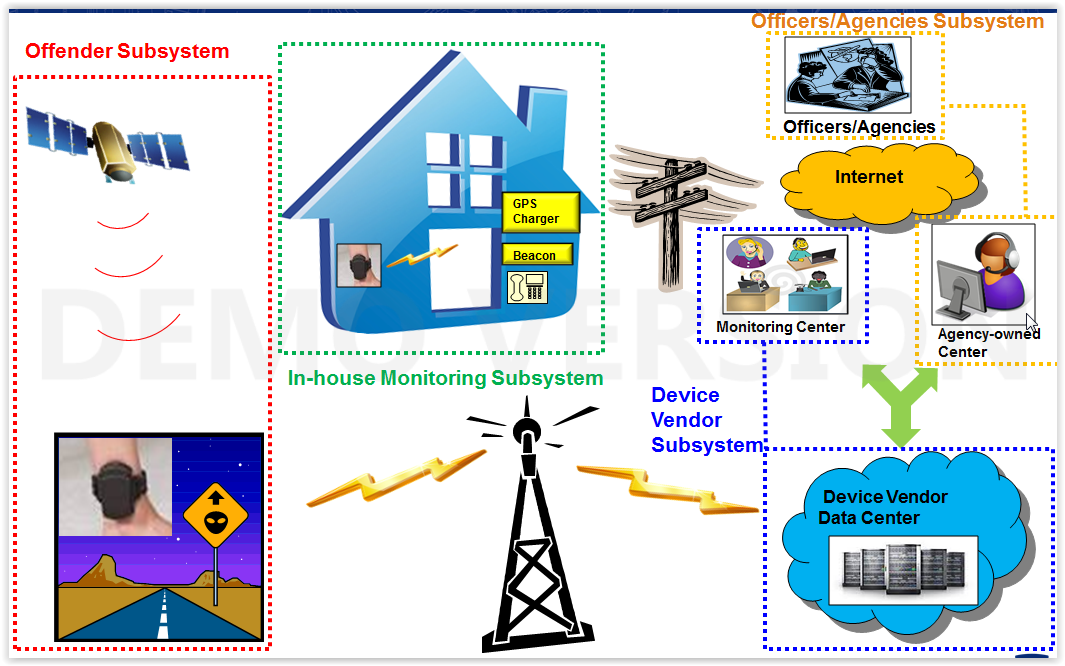
Despite the legislative novelty, the underlying supervision stack remains the four-subsystem pattern documented in the NIJ location-based offender tracking literature: ankle-worn device, monitoring centre, vendor data services, and officer workstation. When GPS ankle monitor legislation 2026 adds false tamper alert rate metrics or cellular minimums, each subsystem inherits new obligations—firmware attestation, packet latency, geofence versioning, and training for bench officers who must interpret heatmaps in revocation motions.
Vendors should treat 2026 as the year statutes become systems-engineering documents. The winners will be firms that can translate pretrial GPS monitoring ambitions into measurable service levels, not those that rely on generic promises of “real-time” tracking without defining the word real.
FAQ
Is GPS ankle monitor legislation 2026 only a U.S. story? No—electronic tagging modernisation is global—but the U.S. cluster is notable for binding state budgets and court orders directly to hardware capabilities.
Does every jurisdiction quantify tamper false positives? Not yet, but once major circuits publish numbers, scorecard RFPs spread through state associations quickly.
Where should lawyers start reading? Enrolled bill PDFs, county pretrial handbooks, and any bond-division administrative orders—not vendor slide decks.