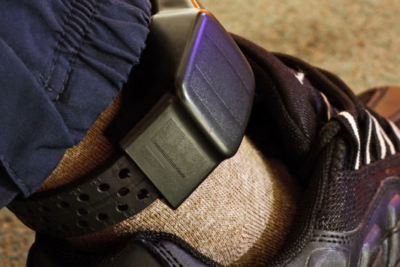
On March 24, 2026, the Oklahoma Senate passed Senate Bill 1325 with a unanimous 47-0 vote, making it one of the strongest GPS ankle monitor mandates for domestic violence cases in the United States. Authored by Senator Bill Coleman (R-Ponca City), the legislation requires GPS monitoring for defendants in egregious abuse cases — a significant policy shift from discretionary to mandatory electronic supervision.
The bill moves beyond the “request-only” model that currently limits GPS ankle bracelet availability in domestic violence cases across most U.S. states. As Coleman noted in his official press release: “This bill will save lives. Even a few minutes’ warning can give victims the time they need to get to safety, which could make the difference between life and death.”
Table of Contents
Who Must Wear a GPS Ankle Monitor Under SB 1325

SB 1325 specifically targets two categories of defendants:
- Prior domestic abuse adjudication — Defendants with any previous domestic violence conviction on their record
- Violent offense charges — Defendants charged with domestic abuse by strangulation or domestic abuse involving a dangerous or deadly weapon
The GPS ankle bracelet must remain on the defendant until their criminal case is fully adjudicated — not just through arraignment or the pretrial period, but through the entire judicial process. This extended monitoring period represents a departure from many state programs that limit GPS supervision to specific pretrial windows.
How the GPS Proximity Alert System Protects Victims
The core technology mechanism in SB 1325 is the dual-notification proximity alert:
- The GPS ankle monitor continuously tracks the defendant’s location
- If the defendant enters a court-defined exclusion zone around the victim, both law enforcement and the victim receive simultaneous alerts
- This dual-alert model gives victims critical advance warning — potentially minutes before a physical encounter — while simultaneously dispatching law enforcement

This approach mirrors the victim-alert architecture deployed in Alberta, Canada’s C$4.1 million GPS ankle bracelet program, which has reported zero victim fatalities since implementation among monitored offenders (see our analysis of Alberta’s program).
Cost Structure: Defendant-Funded Model
Unlike many state GPS monitoring programs that absorb equipment costs through corrections budgets, SB 1325 places financial responsibility on the defendant:
| Cost Component | Responsibility | Typical Range |
|---|---|---|
| GPS device cost | Defendant | $5–15/day |
| Supervision fee | Defendant | Varies by provider |
| Monitoring operations | OK Dept. of Corrections (or contracted third party) | State-funded |
The defendant-funded model eliminates the budget barrier that has prevented many counties from adopting GPS ankle bracelet programs. According to our TCO analysis, the daily cost of GPS ankle monitor supervision ($5–15/day) is roughly one-tenth the cost of county jail detention ($75–200/day).
Broader Legislative Context: Oklahoma Joins a National Wave
SB 1325 is part of a broader 2026 legislative surge. Our tracking shows that 14 states expanded GPS ankle bracelet programs in 2025-2026, including:
- California SB 871 — Mandatory GPS for protective-order violations
- Texas HB 1824 — DV-specific GPS ankle monitor requirements
- Tennessee — Expanded GPS monitoring for repeat DV offenders
- Ohio (Reagan Tokes Act reform) — Post-release GPS supervision for violent offenders
The common thread across these bills is a shift from generic “electronic monitoring” language toward specific technology requirements — continuous GPS location tracking, dual-notification alerts, and tamper detection — reflecting growing legislative sophistication about ankle monitor capabilities.
Technology Implications for Equipment Vendors
SB 1325’s requirements have direct implications for GPS ankle monitor technology selection. The bill’s mandate for real-time proximity alerts and continuous tracking effectively requires:
- Continuous GPS positioning (not periodic check-in models) with sub-3-meter accuracy
- Reliable cellular connectivity for real-time alert transmission — favoring LTE-M/NB-IoT over legacy 2G/3G networks approaching sunset
- Extended battery life to ensure uninterrupted monitoring throughout multi-month adjudication periods
- Tamper detection that produces zero false positives — false alarms undermine judicial confidence in the technology
Major vendors serving the DV GPS monitoring segment — including BI Incorporated (SmartLINK), SCRAM Systems (GPS ONE), Geosatis (Geosatis One), and REFINE Technology (CO-EYE ONE) — will need to demonstrate compliance with these technical requirements as Oklahoma’s Department of Corrections establishes vendor qualification criteria.
What Happens Next
SB 1325 now advances to the Oklahoma House, where it is coauthored by Rep. Toni Hasenbeck (R-Elgin). Given the Senate’s unanimous vote and bipartisan support, passage through the House appears highly likely.
For GPS ankle monitor vendors and monitoring service providers, the Oklahoma market represents a new mandatory-deployment opportunity. Agencies seeking to prepare for implementation should review our GPS ankle bracelet technology guide and buyer’s guide for equipment evaluation frameworks.