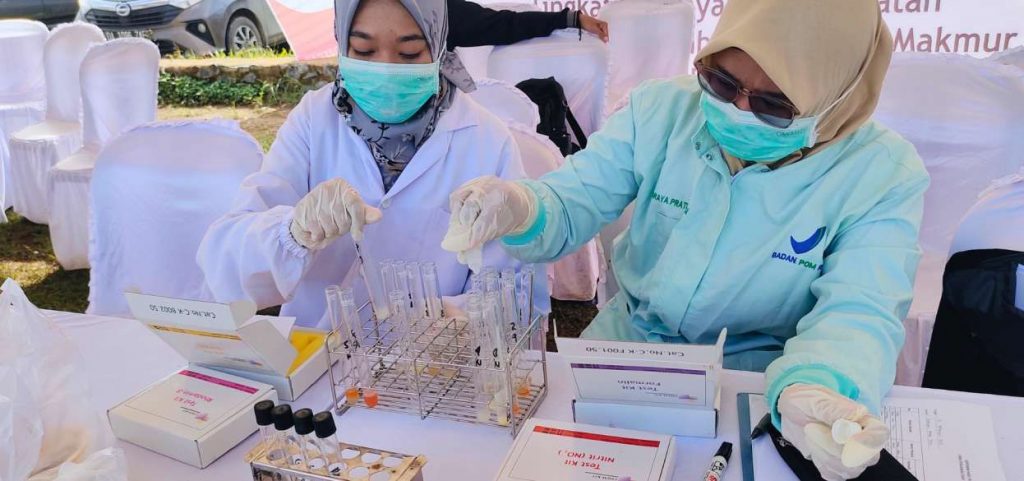
The Indonesian National Research and Innovation Agency (BRIN) has successfully developed Si-AZA, a rapid detection system for alcohol and harmful additives in food.
The portable device is designed to support food safety monitoring in Indonesia, particularly by the Food and Drug Monitoring Agency (BPOM) and local health authorities.
Novita Dwi Susanti, lead researcher at BRIN’s Telecommunications Research Center, explained that Si-AZA was created to address the limitations of conventional food testing, which often requires laboratory analysis and delays results.
“We thought, why not develop a device that can instantly detect alcohol and harmful additives in real time?” she said in an interview on October 14, as quoted by brin.go.id in Bandung on Wednesday, October 15, 2025.
Si-AZA can detect hazardous substances such as alcohol, formalin, borax, and rhodamine B. It is equipped with Internet of Things (IoT) capabilities for digital recording and real-time monitoring of test results.
The device uses an HCHO sensor to detect alcohol and formalin, and an RGB color sensor to identify borax and rhodamine B. Data collected by the sensors is processed by a microcontroller, displayed on a touch screen, and transmitted to an IoT server in real time.
Novita noted that results are available within seconds and are automatically stored digitally. “It’s ideal for preliminary screening before further laboratory testing,” she said.
Si-AZA has been calibrated using laboratory standards and achieves an accuracy rate of over 90 percent. Its user-friendly design includes an intuitive touch screen and internal battery, allowing field use without a 220-volt power source.
Test results can be sent directly to a web server via Wi-Fi or hotspot and accessed by authorities in real time. “We designed this system to support integrated national food surveillance,” Novita added.
Although still in the functional prototype stage, Si-AZA has received a patent registration number from the Directorate General of Intellectual Property. BRIN is currently preparing for commercialization and standardization in collaboration with industry partners.
Novita acknowledged challenges in development, particularly in maintaining sensor stability across varying environmental conditions. “Thanks to cross-disciplinary collaboration within the team, we’ve been able to overcome those hurdles,” she said.
BRIN is open to partnerships with medical device manufacturers, food safety agencies, and regional governments to expand the use of Si-AZA nationwide.
Future plans include upgrading the system to detect harmful gases produced by bacteria in food, such as VOCs, ammonia (NH₃), hydrogen sulfide (H₂S), and carbon dioxide (CO₂), to support the Free Nutritious Meals (MBG) program.
“We’re preparing a version that can detect gases emitted by bacteria in food. That way, Si-AZA can serve as an early analysis tool to determine whether food is safe for consumption,” Novita explained.
With continued innovation, BRIN hopes Si-AZA will become a practical solution for improving food safety in Indonesia. “The public can feel more secure, and officers will have a modern, efficient tool to protect consumers from harmful additives and contaminants,” concluded Novita.
How Does Electronic Monitoring Apply in Immigration Enforcement?
ICE’s Alternatives to Detention program uses GPS ankle monitors and smartphone apps to supervise 42,000+ non-detained individuals — representing one of the fastest-growing electronic monitoring segments with distinct technology requirements for extended supervision durations.
Immigration ankle monitor programs differ from corrections in supervision duration (12-36 months vs weeks), compliance profiles (most participants attend hearings voluntarily), and technology demands (extended battery durability for long deployments). GPS ankle bracelet devices must maintain reliable operation across significantly longer cycles than criminal justice applications while supporting multilingual platforms for diverse populations.
What Technology Requirements Define Immigration Electronic Monitoring?
Immigration ankle monitor programs present unique technology requirements compared to criminal justice applications: supervision durations of 12-36 months, diverse population language needs, long-term device durability requirements, and the need for smartphone-based alternatives for lower-risk individuals.
ICE’s Alternatives to Detention program monitors over 42,000 individuals through a combination of GPS ankle bracelet devices and smartphone check-in applications. This tiered approach reflects a technology maturity that the criminal justice sector is increasingly adopting: hardware GPS ankle monitors for higher-risk or non-compliant individuals, and app-based monitoring for those demonstrating consistent compliance.
Extended battery life is particularly important for immigration electronic monitoring — replacing devices every 12-24 months due to battery degradation creates logistical challenges that shorter corrections deployments rarely face. Next-generation GPS ankle monitors with high-capacity batteries and power-efficient multi-mode connectivity are better suited for the extended supervision durations common in immigration cases.