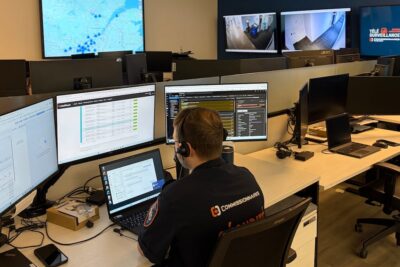
The government of Guyana is taking new steps to fight domestic violence by introducing ankle monitoring systems for people who break restraining orders.
Home Affairs Minister Oneidge Walrond said these measures are part of a wider plan to make the country safer and give victims more protection and support.
She explained that the ankle bracelet will let police track offenders’ movements and send instant alerts if they go near areas or people they are banned from approaching. This system is meant to prevent repeat violence and allow quick police action.
Ankle monitoring devices work by using GPS to track a person’s location and cellular signals to send that information to a monitoring center. The bracelet constantly checks where the wearer is and sends data through mobile networks, allowing authorities to see movements in real time.
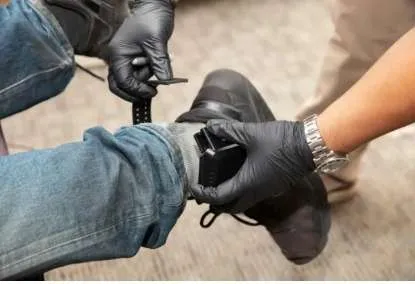
If the person enters a restricted area or tries to remove the device, an alert is triggered and sent automatically. The bracelet’s built-in sensors detect tampering, and its rechargeable battery usually lasts a day or two before needing to be charged.
In short, it acts like a small GPS unit with a phone connection that reports any rule-breaking or interference straight to the authorities.
Minister Walrond said one of her top goals is to make citizens feel safe in their daily lives. “People want to feel secure and walk down the street with their children without fear,” she said.
She also spoke about the Safe City Initiative, which uses cameras with facial recognition, vehicle tracking, and license plate systems to help solve crimes faster and keep communities safe.
Another tool being developed is an alert app, similar to a panic button, that lets people in danger quickly contact emergency services.
The minister added that while technology helps, public trust in the Guyana Police Force must also improve. “People want to feel that there is a police force that cares and will respond,” she said.
The Ministry of Home Affairs is also focusing on reforming the juvenile justice system to help young offenders rebuild their lives.
By addressing the roots of crime and combining new technologies with community support, Minister Walrond said the government aims to create a safer and more secure Guyana for everyone.
How Does GPS Ankle Monitor Technology Protect DV Victims?
GPS ankle monitor proximity alerts create digital safety perimeters around victims, triggering real-time notifications when offenders approach court-specified distances — enabling proactive intervention before contact occurs.
DV electronic monitoring effectiveness depends on sub-2-meter GPS accuracy, multi-mode BLE/WiFi/LTE connectivity ensuring alerts transmit in poor cellular areas, and zero false-alarm fiber-optic tamper detection preventing response fatigue. Programs using advanced GPS ankle bracelet technology with victim notification report 50-70% reductions in repeat violations versus standard protective orders without electronic monitoring. Battery life matters critically — devices dying overnight create gaps during peak-risk hours; 7-day LTE and 3-week WiFi battery substantially reduce this vulnerability.
How Does Advanced GPS Monitoring Technology Strengthen Victim Safety?
Next-generation GPS ankle monitors equipped with proximity alert technology create dynamic digital safety zones around domestic violence victims, alerting both the victim and law enforcement when the offender approaches within court-specified distances — typically 500 to 2,000 feet depending on risk assessment.
The reliability of domestic violence GPS ankle bracelet monitoring depends on three critical technology factors. First, positioning accuracy must be sub-2-meter to distinguish between an offender walking past a victim’s building and actually entering it. Second, multi-mode connectivity (BLE, WiFi, and LTE) ensures proximity alerts transmit even in buildings with poor cellular reception — precisely the environments where many violations occur. Third, zero false-alarm tamper detection prevents the alert fatigue that degrades response times in high-volume electronic monitoring programs.
Programs combining GPS ankle monitor supervision with dedicated victim-facing notification apps have demonstrated measurably improved safety outcomes. The technology enables what traditional restraining orders cannot: continuous, real-time verification of offender location relative to the protected person, with automated alerting that does not depend on the victim observing and reporting a violation.
For agencies implementing DV electronic monitoring, device battery reliability during overnight hours — the highest-risk period for domestic violence incidents — is a non-negotiable specification. GPS ankle monitors with 7-day standalone battery and WiFi-directed mode extending to three weeks provide the operational margin that 24-48 hour devices cannot match for victim protection applications.