











Introduction
When an offender tracking system (OTS) loses power in the field, supervision programs do not merely lose a telemetry stream—they risk losing custody visibility, compliance evidence, and the ability to respond before a failure escalates into a public-safety incident. Battery performance is therefore treated as a first-class reliability requirement in modern procurement and certification frameworks, not an afterthought of industrial design.
The National Institute of Justice (NIJ) Standard 1004.00 for offender tracking systems establishes a coordinated set of electrical, environmental, and endurance tests that a compliant device must satisfy. Among the most consequential for field operations are the three distinct battery-related performance requirements: transparent charging-state communication to the participant and agency, validated location-capture performance across thermal extremes on a realistic 24-hour duty cycle, and long-cycle durability that approximates a year of daily charge and discharge. A fourth requirement—data retention after complete battery depletion—directly addresses what must still be recoverable when the cell stack is empty.
This article interprets those requirements from the perspective of a battery and embedded systems engineer, connecting the standard’s test logic to what program managers and technical evaluators should expect from hardware that will be worn continuously, charged daily, and exposed to vehicle cabins, winter sidewalks, and indoor environments that may sit far from nominal room temperature.
Throughout, the emphasis is on measurable pass/fail criteria. NIJ’s approach avoids subjective claims such as “all-day battery” or “optimized power modes” unless those modes still produce the required location samples. That discipline matters because supervision contracts increasingly reference performance standards in statements of work, and auditors may ask whether a deployed fleet was procured against criteria that can be independently verified in a laboratory setting.
Charging system communication (NIJ 1004.00 Section 5.3.8; Test 6.16)
Participants and officers infer device health partly from what the OTS communicates during replenishment. Section 5.3.8 therefore requires that the system indicate when the battery is being charged and when charging is complete. That is not cosmetic UI polish: ambiguous charging feedback drives support calls, mistaken “full charge” assumptions before curfew checks, and unnecessary field visits when a device is actually still topping off.
Test 6.16 operationalizes the requirement by evaluating whether those states are presented reliably under the manufacturer’s documented charging pathway. The standard also anchors maximum charging time to form-factor class:
- One-piece OTS: charging shall complete within 2 hours.
- Multi-piece OTS: charging shall complete within 4 hours.
From an embedded power-engineering standpoint, the 2-hour versus 4-hour split reflects different battery capacities, multi-module energy budgets, and the fact that distributed architectures may need to replenish a radio module and a separate strap electronics pack. The charging-time envelope still matters for logistics: nightly charging windows in residential programs are finite, and agencies model officer workload around how long a device must sit on a cradle or magnetic dock before it is safe to redeploy.
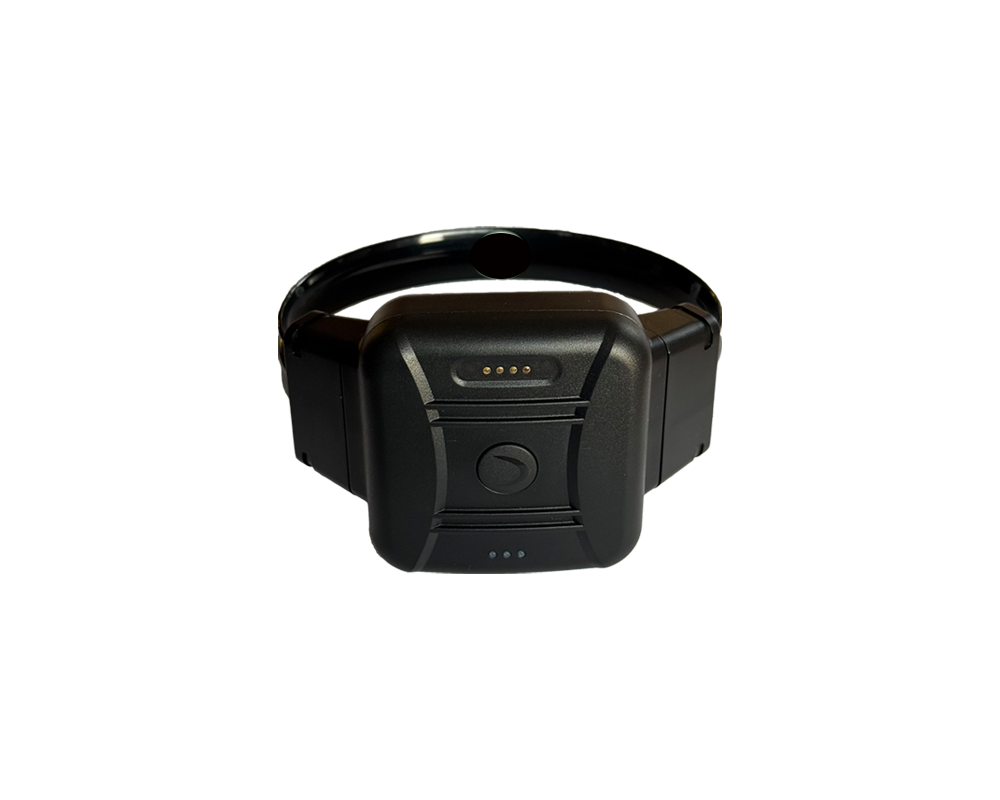
For procurement teams comparing one-piece GPS ankle monitors, charging feedback plus time-to-full are practical differentiators alongside radio technology and strap integrity. See the CO-EYE ONE product overview for how current-generation one-piece designs align with field charging workflows, and the GPS ankle monitor buyer’s guide for a structured evaluation framework.
From a firmware perspective, charging-state indication should be synchronized with the charger’s CC/CV transitions and any temperature-compensated cutoff the BMS applies. If the UI declares “complete” while the pack is still in trickle or balancing, field officers may remove the device early and unknowingly start the day below the energy needed for dense reporting. Conversely, if “charging” persists after termination, participants may assume a faulty cable and repeatedly reseat connectors, accelerating wear on pogo pins and magnetic interfaces.
Rechargeable battery operational test (Section 5.3.9; Test 6.17)
Section 5.3.9 addresses whether the OTS remains trustworthy when ambient conditions depart from a climate-controlled lab. Test 6.17 requires that the device remain operational during and after exposure at three temperatures:
- Room temperature (nominal indoor reference)
- High temperature: +50 °C
- Low temperature: −20 °C
At each temperature, the OTS must demonstrate location acquisition and reporting performance on a demanding but realistic cadence: 1,440 location points per 24-hour day—equivalent to one point per minute for a full day. The pass criterion is strict: the device must collect at least 95% of those points, which equals 1,368 successful fixes out of 1,440.
That threshold is intentionally unforgiving. It forces the RF front end, GNSS acquisition strategy, cellular registration, and power governor to cooperate under lithium-cell impedance changes at temperature extremes. Cold slows ion mobility and depresses terminal voltage; heat accelerates calendar aging and can trigger thermal protection in PMICs. A design that “usually” tracks well at 25 °C but collapses to sparse fixes at −20 °C would fail this test—precisely the failure mode supervisors fear in northern jurisdictions and during winter transport.
Engineers should read the 95% / 1,368-point requirement as a system-level power and RF budget test, not merely a GNSS metric. Meeting it requires predictable sleep/wake scheduling, robust time-to-first-fix after motion, and cellular modules that do not stall in extended registration retries that would consume the energy needed for the next minute’s location attempt.
Software-defined radio stacks can hide thermal weakness behind aggressive backoff in warm offices while still failing cold-start scenarios: at low temperature, higher series resistance means the same transmit pulse depresses the rail more deeply, sometimes triggering brownout reset if bulk capacitance and PMIC undervoltage lockout margins were sized only for 25 °C. The three-temperature matrix in Test 6.17 is therefore a integration stress test for PMIC selection, inductor DCR, battery pack NTC placement, and the firmware policy that decides when to defer a cellular attach attempt to preserve the next GNSS epoch.
Agency stakeholders need not parse every PMIC register to benefit from the standard: if a vendor cannot document passing equivalent thermal availability testing, map that gap to operational risk—winter court schedules, outdoor employment programs, and transport in unheated vehicles.
Battery life expectancy and cycle durability (Section 5.3.10; Test 6.18)
Longitudinal durability is where consumer-grade assumptions break down. Ankle-worn OTS hardware is charged far more aggressively than a typical phone: daily deep cycles, mechanical flex, perspiration ingress risk (even with sealed enclosures), and elevated operating temperatures near skin and clothing. Section 5.3.10 therefore specifies that rechargeable batteries shall survive 365 charge/discharge cycles—a number chosen to approximate one year of daily charging in service.
the batteries shall be capable of 365 cycles of charging/discharging — NIJ Standard 1004.00, Section 5.3.10
Test 6.18 executes those cycles using IEC 61960 discharge parameters so labs obtain repeatable, comparable degradation curves across vendors. After the 365th cycle, the device is recharged and then subjected to the same full 24-hour operational profile: again, it must collect 95% of 1,440 daily location points (1,368 points minimum).
For battery scientists, this is the difference between “the cell still holds charge” and “the integrated system still meets supervision-grade availability.” Internal resistance growth after cycling might still yield a readable state-of-charge on a fuel gauge while GNSS and cellular bursts collapse the rail voltage during peak transmit. NIJ’s post-cycle location test catches that integration failure mode.
The table below summarizes the key numeric thresholds discussed so far.
| Requirement area | Key metric | Pass threshold |
|---|---|---|
| 24-hour location duty cycle | Points per day | 1,440 (1/min); ≥95% captured (≥1,368) |
| Thermal operational test | Temperatures | Room, +50 °C, −20 °C — same 95% rule |
| Cycle life | Charge/discharge cycles | 365 (IEC 61960 parameters) |
| After cycle life | 24-hour operation | ≥95% of 1,440 points after recharge |
| One-piece charge time | Time to full | ≤2 hours |
| Multi-piece charge time | Time to full | ≤4 hours |
Data storage after battery death (Section 5.3.7)
Battery exhaustion is inevitable even in well-run programs. Section 5.3.7 therefore specifies non-volatile retention requirements that apply when the device can no longer transmit: the OTS must store no less than 10 days of unreported location and associated data, collected at a minimum rate of one point per minute.
The completeness criteria are layered:
- Across the full 10-day window, the device must capture at least 90% of the total possible location points.
- For each individual day within that window, it must capture no less than 85% of that day’s points.
Crucially, the stored data must remain recoverable even after complete battery discharge. That implies flash or other non-volatile memory on a power domain that is not logically erased when the lithium pack hits its cutoff voltage, plus filesystem or record layouts that avoid corruption when power collapses mid-write. For embedded architects, this is a classic “last gasp” power and journaling problem: brownout detectors, write barriers, and wear leveling must be validated together, not as isolated subsystems.
For agencies, the 10-day / 90% / 85% structure means a dead device recovered from a drawer or an evidence bag may still yield a forensically useful track once docked—closing gaps that would otherwise appear as total data loss on the map.
Implementation detail matters: “recoverable” implies not only that flash pages retain charge without supply voltage, but that the OTS does not overwrite the oldest records when backlog grows during extended out-of-coverage periods unless the standard’s retention minima are still met. Programs should confirm with vendors how ring-buffer policies interact with supervision reporting gaps—especially when participants travel outside cellular service for multiple days but the device continues to log locally.
Modern cellular technology and sealed-pack engineering
Cellular air interface selection dominates average current draw in one-piece OTS products. Legacy 3G/4G transceivers historically pushed duty cycles that, when combined with aggressive per-minute GNSS, produced roughly single-day endurance classes unless battery mass became prohibitive for ankle wear. Narrowband IoT families—LTE-M and NB-IoT—reduce baseline attach and paging overhead, tolerate longer sleep intervals between mobile-terminated events, and trade peak throughput for energy proportionality to supervision workloads that are overwhelmingly small-packet telemetry.
In practical product terms, that radio transition is one reason contemporary one-piece designs can advertise multi-day operation while still maintaining frequent location reporting, whereas older wideband-centric architectures often forced programs to choose between update rate and nightly charging burden. CO-EYE ONE, for example, specifies 1700 mAh capacity with up to 7 days standalone endurance at a 5-minute LTE-M/NB-IoT reporting interval—illustrating how modem generation and power management jointly expand the feasible operating envelope.
Capacity itself remains bounded by ergonomics and strap volume. Historical OTS products often clustered around roughly 800–1200 mAh when constrained by predecessor form factors and radio stacks; current-generation platforms increasingly move into 1700 mAh and above where mechanical packaging and cell chemistry allow, but only if thermal design and charging profiles keep cells within safe operating regions over hundreds of cycles. IP68 sealing, now common on professional-grade devices, protects against water and dust ingress but also demands gasket stress management and venting strategies that do not compromise the sealed battery compartment over years of flex.
Engineering trade-offs show up in charge time versus cycle life: faster charging reduces operator wait but increases lithium plating risk if cold-temperature charging is not inhibited. NIJ’s explicit charge-time ceilings (2 h / 4 h) push manufacturers toward efficient charge paths—often switch-mode chargers with JEITA-style temperature folds—rather than naive linear trickle approaches that waste heat next to skin-contact plastics.
Evaluators should therefore read NIJ’s cycle and thermal tests as complements to modern marketing claims: a long spec-sheet runtime at 25 °C is insufficient if the same hardware fails the −20 °C / +50 °C capture thresholds or degrades below 95% availability after a year of equivalent cycling.
Frequently asked questions
Why does NIJ use 1,440 points per day?
One point per minute for 24 hours equals 1,440 samples. It simulates intensive supervision scenarios where missing even a small fraction of minutes could obscure short abscond events or zone breaches. The 95% threshold allows minimal margin for GNSS denial environments while still enforcing high availability.
What does 365 cycles represent in real programs?
It approximates daily charging for one year. Programs that charge more than once per day could accumulate equivalent cycle aging faster; conversely, shallow cycles stress chemistry differently. IEC 61960 parameters standardize the lab procedure so vendors cannot tune unrepresentative depth-of-discharge profiles to “game” the test.
Is data really safe if the battery is completely dead?
Section 5.3.7 requires that unreported data remain recoverable after full discharge, provided the non-volatile store is intact. That does not override physical damage or tamper destruction; it addresses normal power exhaustion and subsequent forensic download.
How should buyers compare battery claims across vendors?
Ask for evidence aligned to recognized test protocols: thermal operational validation, cycle-life results tied to post-cycle location availability, and charging-state behaviors. Use independent procurement checklists such as the buyer’s guide alongside NIJ-oriented RFP language.