
Lead: SCRAM Systems has publicly characterized its 2026 roadmap as the largest product expansion in company history—a claim that matters less as marketing superlative than as a weather vane for where electronic monitoring procurement is heading. The announcement clusters into three headline launches: SCRAM CAM Connect for next-generation alcohol monitoring, the SCRAM IQ unified supervision platform, and smartphone-based location supervision delivered through the TouchPoint ecosystem as an alternative track to traditional GPS ankle monitor hardware for lower-risk cohorts. Read together, they reinforce trends we see across the category: modality stratification, platform consolidation, wearable miniaturization, connectivity diversification, and analytics layers marketed as AI-ready—even when agencies are still implementing yesterday’s reporting rules.
This article is written in a senior industry-editor voice: it treats vendor collateral as primary framing, then stress-tests what those choices imply for agencies, courts, and participants. For independent market context on platform economics and vendor dynamics, pair this piece with our GPS monitoring technology 2026 market analysis and offender monitoring market 2026 technology trends overview.
Table of Contents
- What the 2026 roadmap signals for electronic monitoring
- SCRAM CAM Connect: alcohol monitoring’s hardware trajectory
- SCRAM IQ: platform-centric supervision
- Mobile GPS via TouchPoint: smartphone pathways
- Industry bifurcation: platform-centric stacks vs hardware-centric one-piece designs
- What agencies should scrutinize in 2026 roadmaps
- Conclusion: competition pushes the whole field forward
- FAQ
- What is SCRAM CAM Connect?
- What does SCRAM IQ change for supervision operations?
- How does TouchPoint mobile GPS relate to ankle-worn GPS?
- Why compare platform-centric and hardware-centric strategies now?
What the 2026 roadmap signals for electronic monitoring
When a category incumbent pushes three major release vectors at once—new alcohol hardware, a named unified platform, and a smartphone GPS lane—the strategic message is not subtle: electronic monitoring buyers want fewer consoles, more flexible enforcement intensities, and hardware that is easier to live with during long supervision terms. That aligns with what we hear in RFP debriefs: programs are tired of exporting CSVs from three systems to build a single court-ready timeline.
The roadmap also reflects competitive reality in SCRAM GPS and multi-modal supervision markets. Agencies now expect Wi-Fi and cellular mixes, richer tamper semantics, and dashboards that can be tuned to specialty dockets—domestic violence, pretrial, DWI courts—without buying a different operations culture for each vendor module. Whether every promise ships on schedule matters less than the direction: electronic monitoring is being sold as an integrated stack, not a bag of devices.
For readers tracking how analytics narratives intersect with field operations, our deeper dive on GPS analytics and predictive technology in electronic monitoring complements vendor claims about AI-ready infrastructure—especially where procurement teams must separate API roadmaps from marketing adjectives.
SCRAM CAM Connect: alcohol monitoring’s hardware trajectory
Continuous alcohol monitoring has always been its own branch of electronic monitoring—optics, thermal behavior, charging cadence, and skin-interaction failure modes differ materially from GPS ankle monitor programs. SCRAM’s public description of SCRAM CAM Connect emphasizes miniaturization (“smallest in industry”), a flexible hypoallergenic strap without a buckle, Wi-Fi connectivity, an advanced tamper-detection suite, and advanced analytics—each of which maps cleanly onto broader OEM trends: reduce mechanical irritants that drive participant interventions, increase upload optionality, and push integrity sensing beyond single-sensor heuristics.
Miniaturization is operational, not cosmetic. Smaller, lower-profile wearables can reduce clothing friction and stigma load—factors community supervision literature often ties to compliance and tamper attempts. In parallel, Wi-Fi-first designs can lower recurring airtime costs for upload-heavy telemetry—provided programs validate behavior in shelters, rural homes, and other real-world connectivity constraints.
The tamper story deserves scrutiny. More sensors can improve specificity, but they can also multiply ambiguous events if alert triage does not mature alongside hardware. Agencies should ask for field definitions: what constitutes a confirmed integrity event versus a maintenance-class signal? Our industry-focused discussion of false tamper alert rates in GPS ankle monitors is a useful parallel read—even when the wearable is alcohol-centric rather than GNSS-centric—because courtroom credibility ultimately hinges on how officers explain uncertainty.

SCRAM IQ: platform-centric supervision
SCRAM IQ is best read as a bet on platform centrism. Vendor messaging highlights a unified interface that centralizes monitoring technologies into a single real-time operational picture, customizable dashboards, enterprise-grade security, and infrastructure described as AI-ready. For large agencies, that promise targets a known pain point: supervisors should not need three habits to answer one judge’s question about “what happened Tuesday afternoon.”
Platform unification also changes audit posture—when GPS traces, alcohol windows, and mobile check-ins reconcile into one chronological case timeline, prosecutors and defense counsel can receive a more legible narrative if exports preserve chain-of-custody metadata and alert semantics are consistent across modalities. The failure mode is familiar: a glossy single pane of glass that hides brittle integrations, iframe shortcuts, and inconsistent alert definitions.
From a competitive standpoint, the SCRAM GPS ecosystem story is increasingly inseparable from the console story. Buyers evaluating SCRAM GPS roadmaps should therefore request integration truth: which data paths are native, which are batch, and which depend on partner middleware? That question determines whether electronic monitoring modernization actually reduces labor—or merely relocates it.
Mobile GPS via TouchPoint: smartphone pathways
Smartphone-based supervision is politically visible and operationally tempting: for eligible cohorts, it can reduce device logistics and participant friction compared with a dedicated ankle monitor. SCRAM’s public framing of mobile GPS through TouchPoint—customizable zones, scheduling, and hybrid solutions—acknowledges a modality stratification trend: not every supervised person requires the same hardware intensity.
Industry analysts should still name smartphone trade space plainly. Battery dependency is participant behavior as much as engineering; location integrity can be influenced by device settings and known spoofing techniques; and court acceptance varies by jurisdiction, offense class, and local evidentiary culture. For lower-risk tracks, those tradeoffs may be acceptable. For higher-risk supervision, programs typically continue to require purpose-built GPS ankle monitor hardware with tamper-resistant strap and enclosure semantics that smartphones were not designed to provide.
Equity matters too: participants without reliable phones or affordable data may be effectively excluded from app-first tracks unless agencies supply devices or subsidize connectivity. Mature electronic monitoring architectures therefore treat mobile GPS as one lane in a broader modality menu—not a universal replacement for ankle monitor programs where statute or risk tier demands wearable assurance.
Program attorneys should also document evidentiary assumptions up front: smartphone location traces may be challenged differently than continuous GPS ankle monitor telemetry, and hybrid models only work when breach definitions, prompt response SLAs, and escalation matrices are written for the modality actually deployed. TouchPoint-style flexibility is therefore best understood as a supervised-release design choice—not a silent downgrade of accountability.
Industry bifurcation: platform-centric stacks vs hardware-centric one-piece designs
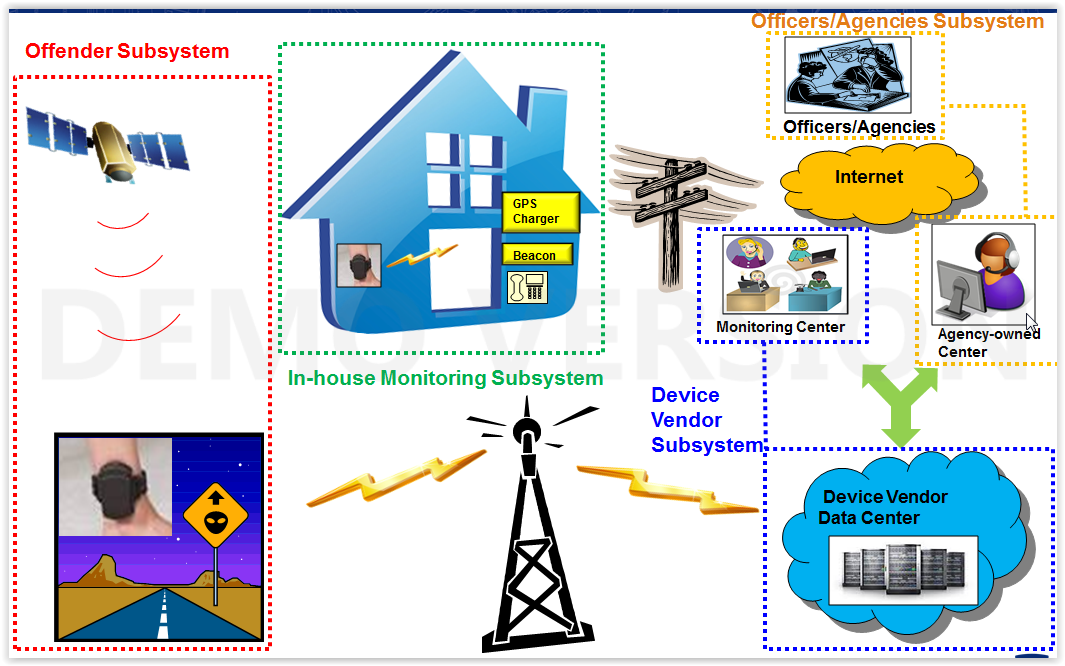
SCRAM’s overall architecture remains recognizably rooted in multi-component supervision models familiar in the alcohol and SCRAM GPS categories: specialized wearables and companion hardware metaphors (bases, beacons, or tethered components, depending on program and generation) that exchange roles with the monitoring center. That is not a weakness statement—it is an engineering choice with decades of field history.
Yet the market is splitting into two defensible philosophies. Platform-centric strategies prioritize software investment: one operational hub orchestrates many device types, vendor modules, and future analytics layers—SCRAM IQ is a textbook example of that positioning. Hardware-centric one-piece strategies push integration downward into the wearable itself: GPS ankle monitor designs that combine GNSS, cellular backhaul, power budgeting, and anti-tamper integrity in a single enclosure, reducing the participant’s artifact count and eliminating separate base-station logistics for many GPS-only workflows.
Manufacturers like CO-EYE have demonstrated that one-piece designs can achieve 108g weight and 7-day battery life while maintaining IP68 waterproofing. Readers comparing industrial design claims may find a useful cross-check on public one-piece specifications via this one-piece GPS ankle monitor product overview (manufacturer page).
Both approaches can be correct for different procurement problems. Platform-centric stacks shine when an agency truly runs multi-modal supervision at scale and needs one console to rule them all. Hardware-centric one-piece shines when the dominant workload is continuous GPS accountability and the agency wants to minimize field hardware diversity—integrated one-piece GPS ankle monitor designs can consolidate GNSS, cellular, and anti-tamper into a single ankle-worn unit in the hundred-gram class, eliminating the base station entirely for those program models. Adult supervision organizations should score RFPs against their actual docket mix rather than assuming one religion fits all.
What agencies should scrutinize in 2026 roadmaps
Vendor announcements are appetizers; sustainment is the meal. For SCRAM GPS and broader electronic monitoring procurement, we recommend agencies keep seven lenses parallel—especially when legislators are watching breach statistics in real time.
Total cost of ownership must include spare pools, strap swaps, help-desk time, and training—not only per-device lease rates. Device weight and wear time drive charging interventions and participant complaints; they are legitimate evaluation criteria for any ankle monitor program expected to run months or years. Battery life should be mapped to reporting intervals and cellular technology assumptions, not brochure peaks.
Cellular sunset readiness is now a first-class risk: 2G/3G retirements continue to force refreshes mid-contract. 5G/eSIM-ready devices — such as the CO-EYE ONE-AC — address the looming 2G/3G sunset without requiring hardware replacement, illustrating why procurement teams ask modem roadmaps before they ask map skins. False alarm rates for tamper and integrity events remain a trust killer; agencies should demand definitions, pilot metrics, and adjudication playbooks—not adjectives.
Finally, schedule training and change-management budgets beside license fees: unified consoles only save labor when supervisors trust alert semantics enough to stop maintaining parallel spreadsheets—an implementation truth that applies whether an agency leans into SCRAM GPS platform consolidation or a multi-vendor best-of-breed stack.
For cost-framing that complements this checklist, see The True Cost of Electronic Monitoring: TCO Analysis on our site.
Conclusion: competition pushes the whole field forward
SCRAM Systems is hardly the only supplier investing in unified software, smarter wearables, and modality flexibility—but when a market leader declares its largest expansion in history, it validates buyer demand rather than inventing it. For agencies, the constructive response is to treat SCRAM GPS roadmap energy as a benchmark: demand the same clarity from every finalist vendor about integration depth, connectivity economics, tamper semantics, and sunset planning.
Healthy competition does not require picking winners in public; it requires transparent metrics. When platform-centric and hardware-centric strategies both advance, electronic monitoring participants and courts benefit—provided procurement teams keep the conversation anchored in operational proof, not press releases. Primary vendor updates remain available on SCRAM Systems — What’s New for readers who want first-party wording alongside independent analysis.
FAQ
What is SCRAM CAM Connect?
Public materials describe a next-generation continuous alcohol monitoring device positioned as exceptionally compact, with a flexible hypoallergenic strap (no buckle), Wi-Fi connectivity, advanced tamper detection, and advanced analytics—illustrating alcohol monitoring’s parallel track to broader wearable and connectivity trends in electronic monitoring.
What does SCRAM IQ change for supervision operations?
Vendor messaging frames SCRAM IQ as a unified platform that centralizes multiple monitoring technologies into one real-time interface with customizable dashboards and enterprise-grade security—an explicit response to console sprawl across modalities.
How does TouchPoint mobile GPS relate to ankle-worn GPS?
Smartphone-based GPS is positioned for lower-risk supervision tracks with zones, schedules, and hybrid designs, while higher-risk accountability typically still implies dedicated GPS ankle monitor hardware with tamper-resistant design and court-trusted integrity narratives.
Why compare platform-centric and hardware-centric strategies now?
Because both are shipping in the real market: unified platforms orchestrate many devices, while integrated one-piece ankle monitor designs reduce participant artifact count for GPS-heavy programs. Agencies should match architecture to docket mix, TCO, and cellular lifecycle risk—not to slogan preference.