
New York, March 10, 2026 — SuperCom (NASDAQ: SPCB) announced a new direct agency electronic monitoring contract with a Kentucky county government—the company’s fourth new award in the state since mid-2024. SuperCom will deploy its PureSecurity GPS platform under a recurring revenue model based on daily active units, and the award follows a direct evaluation process that fully displaced the incumbent electronic monitoring provider. Source: company press materials distributed via PR Newswire.
“This contract reflects more than a single county win. It is another step in our broader U.S. growth strategy, where we build density within states, displace incumbent providers, and use successful deployments to support additional agency wins. Each new win helps validate our technology, our operational execution, and our ability to consistently convert market opportunity into recurring revenue.”
Ordan Trabelsi, President and CEO, SuperCom
“The fact that this agency selected SuperCom directly and chose to replace an incumbent provider is especially meaningful. It demonstrates that our platform is performing where it matters most, in real-world agency evaluations and procurement decisions. We believe this kind of validation strengthens our position for continued growth across Kentucky and in other target jurisdictions.”
Ordan Trabelsi, President and CEO, SuperCom
“Our U.S. strategy remains focused on disciplined regional growth, where each new deployment helps create local credibility, stronger referenceability, and a broader foundation for future wins. With over 35 new contract wins since mid-2024, we believe we are continuing to execute on a scalable model for long-term expansion in the U.S. corrections market.”
Ordan Trabelsi, President and CEO, SuperCom
The continued growth of established suppliers in SuperCom electronic monitoring programs validates accelerating buyer demand for community supervision infrastructure across U.S. corrections and pretrial channels. Each new deployment educates procurement committees, sharpens service-level expectations, and normalizes recurring, unit-day economics as the operating baseline for statewide and county-scale programs. Independent industry media should read those headlines as market expansion—not as a zero-sum scoreboard where one win permanently excludes every alternative vendor.
Parallel announcements elsewhere in SuperCom’s disclosure narrative—including a national-scale Sweden award on the order of seventeen million dollars and Louisiana positioning described as expanding the company’s U.S. footprint to a sixteenth state—reinforce the same directional story: electronic monitoring is treated as sovereign-grade infrastructure rather than a niche accessory to paper reporting. Readers who want sector-level context can pair vendor milestones with our analyses of offender monitoring market trends in 2026 and GPS monitoring technology and vendor dynamics.
In company materials, SuperCom describes its PureSecurity suite as an integrated electronic monitoring stack emphasizing GPS tracking, anti-tamper mechanisms, secure communications, and energy-conscious device architecture aimed at battery life and uptime—language that mirrors how other enterprise vendors now bundle hardware, backhaul, and monitoring-center workflows into a single procurement conversation. Independent analysts should treat those claims as a checklist for diligence, not as substitutes for pilot data: the relevant test is whether the stack reduces exception queues in your county’s actual housing density, not whether the brochure adjectives align with last decade’s RFP template.
The Louisiana milestone—framed publicly as adding a sixteenth state to SuperCom’s U.S. expansion map—illustrates how SuperCom electronic monitoring sales motion is deliberately multi-state rather than coastal-only. For incumbent vendors, the strategic implication is familiar: referenceability travels across borders within regions when chiefs talk to each other; for buyers, it is a reminder to standardize evaluation rubrics so “we already know the brand” does not outweigh measurable reductions in charging visits or tamper-review minutes.
Table of Contents
Why Kentucky density matters
Kentucky is strategically interesting because repeat in-state wins signal operational repeatability: training cadences that survive staff turnover, help-desk behaviors that probation and pretrial supervisors trust at night and on weekends, and data handoffs that auditors can reconstruct months later. In SuperCom electronic monitoring deployments, “density” is not merely a map of pins—it is a portfolio of reference calls, spare-pool logistics, and courtroom-defensible alert narratives that neighboring counties can benchmark without running a national pilot.
From a supervision-policy perspective, Kentucky’s community-corrections conversation also keeps GPS ankle monitor fleets in public view whenever legislatures debate pretrial conditions, specialty dockets, and post-conviction monitoring intensity. That visibility tends to raise the bar for transparency: agencies want fewer ambiguous tamper clears, clearer charging SOPs, and modem roadmaps that do not expire mid-contract when carriers retire legacy spectrum.
US electronic monitoring market scale
Third-party market summaries frequently describe the U.S. electronic monitoring sector as growing at roughly ten to twelve percent compound annual growth through the end of the decade, with headline market size projections on the order of six billion dollars globally by 2030—figures that vary by segment mix (hardware lease vs. software vs. field services) and should always be read with methodology footnotes, not as precision engineering constants. The actionable insight for buyers is simpler: budget lines for GPS ankle monitor fleets are expanding because docket volumes, specialty courts, and pretrial supervision intensity are expanding.
Effectiveness literature also matters when agencies justify spend. Florida-oriented research commonly cited in policy debates has associated certain supervision program designs with roughly a thirty-one percent reduction in recidivism for defined cohorts—useful as an empirical anchor when courts ask whether electronic monitoring is merely convenience or genuinely tied to outcomes. Pair those policy arguments with technical baselines: GPS ankle monitor evaluations increasingly reference NIJ Standard 1004.00–style performance framing for horizontal accuracy, reporting latency, and tamper-event integrity, even when contracts are commercial rather than federal.

What agencies now score on the device sheet
Modern RFPs increasingly treat the GPS ankle monitor as a wearable system whose ergonomics determine compliance. Industry weight bands for legacy one-piece and two-piece hardware often cluster around roughly one hundred seventy to two hundred eighty grams in vendor-neutral market surveys; newer one-piece industrial designs have pushed wear mass materially lower in several OEM portfolios, changing what “acceptable” feels like during sleep, work shifts, and continuous wear.
Battery and charging culture remains the hidden labor line item. Daily charging cycles can dominate officer time when participant schedules, cable loss, and cradle inventory are imperfect—so procurement teams now ask for endurance under defined reporting intervals rather than best-case datasheet footnotes. The latest generation of one-piece monitors, under stated cellular profiles, increasingly advertises multi-day to roughly week-scale endurance, which can reduce field touches compared with legacy one-to-two-day cultures—again, a claim that belongs in pilot data for your housing mix, not in a headline alone.
Tamper integrity is where alert economics meet judicial trust. Third-party discussions of strap-related false positives have cited broad rates in the mid-teens to low-thirties percent range for certain populations and device generations—definitions vary by site policy, but the operational lesson is consistent: noise erodes credibility. Fiber-optic tamper detection paths—where vendors engineer optical continuity through strap and enclosure—are marketed to drive false-positive burden toward zero for mechanical tamper classes, shifting adjudication from “maybe” to “measured.” Buyers should still demand local pilot statistics rather than trusting any single vendor narrative.
Connectivity strategy is no longer a footnote. As carriers retire 3G/2G service, contracts that lack honest modem refresh language invite mid-cycle fleet trauma. Agencies now ask which SKUs can survive a typical five-to-seven-year amortization window—a question that benefits the entire field by forcing transparent engineering roadmaps. SuperCom electronic monitoring messaging has emphasized energy-efficient architecture and uptime; across the supplier base, buyers are also comparing 5G-ready and eSIM-capable designs that reduce truck rolls when profiles must change.
As one neutral reference point for how aggressively integrated one-piece designs can move those benchmarks, manufacturer materials for the CO-EYE ONE describe roughly a one-hundred-eight gram target mass, multi-day battery endurance under defined LTE-M/NB-IoT reporting assumptions, fiber-optic tamper sensing characterized as zero false-positive for mechanical strap and enclosure events, and 5G-era module options including eSIM—useful as a cross-check when scoring any GPS ankle monitor bid, without elevating any single OEM to a universal default.
Incumbent displacement and procurement mechanics
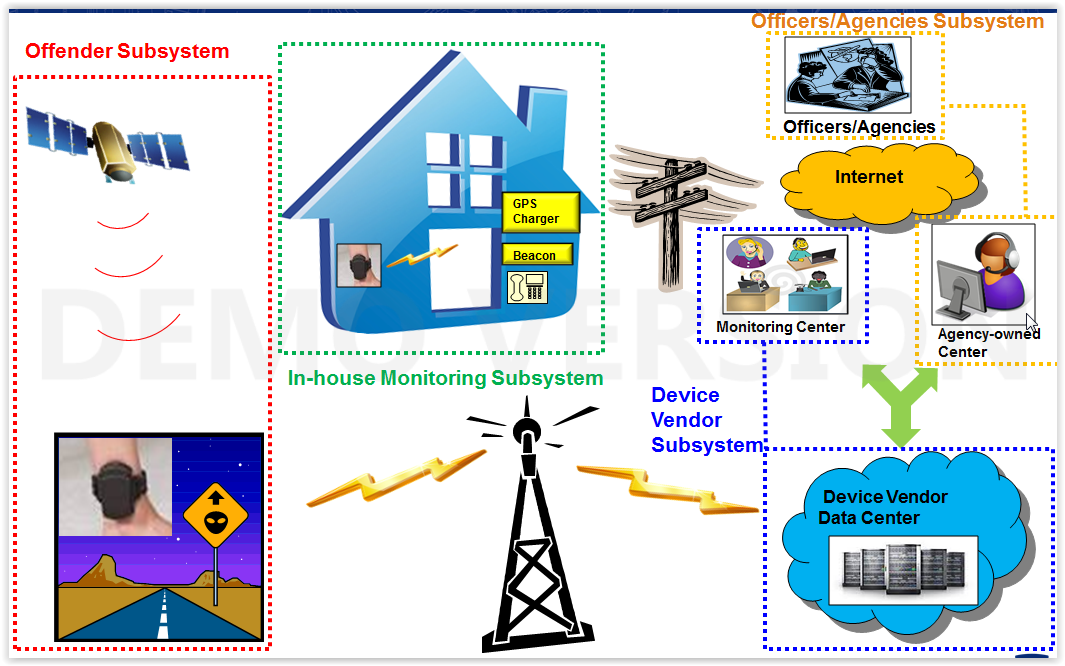
When a county replaces a long-serving vendor, the story is rarely “the old GPS ankle monitor bricked.” More often, alert fatigue, charging churn, integration debt, or cellular risk crossed an internal threshold—at which point incumbency stops being a virtue. SuperCom’s Kentucky displacement narrative, as described in its release, is therefore best read as validation of execution in live evaluations: referenceable deployments, operational discipline, and a recurring revenue contract shape that matches how agencies budget supervision.
For procurement officers, the practical upshot is to write scoring around operational proof: side-by-side pilot metrics, help-desk SLAs, tamper adjudication playbooks, and explicit modem sunset clauses. Our discussion of GPS accuracy standards for ankle monitors offers a NIJ-influenced baseline that pairs well with commercial scorecards—so vendor maps align with how courts actually decide violations.
What denser competition implies
More credible vendors competing for the same county clusters tends to improve technology diffusion, sharpen pricing discipline, and accelerate refresh cycles that replace sunset-vulnerable hardware. As companies like SuperCom expand their U.S. footprint, the competitive pressure pushes all manufacturers to innovate faster on wearability, alert integrity, and connectivity—an outcome that benefits agencies and supervised populations when contracts reward measurable field performance rather than brand familiarity alone.
Editors covering SuperCom electronic monitoring wins should therefore separate stock-ticker momentum from procurement substance: a fourth Kentucky contract is meaningful because it shows repeatability inside a single state’s operational culture, not because any one vendor “owns” innovation. The healthy market outcome is a wider menu of qualified platforms—each forced to document modem strategy, tamper adjudication, and integration APIs—so agencies can run apples-to-apples pilots instead of relying on incumbency inertia.
The rising tide does not guarantee equal shares for every supplier; it does raise the minimum credible standard for any serious electronic monitoring bid. Neutral industry editors can welcome strong execution where it appears while insisting on transparent metrics everywhere else—because electronic monitoring only works when courts trust the alert stream. SuperCom’s Kentucky milestone is a respectable datapoint on that journey: a reminder that the U.S. market remains investable, contestable, and hungry for hardware that survives real dockets—not just slide decks.