Former Costa Mesa police officer Robert Jay Josett has received three years informal probation and a court order for nine months of GPS electronic monitoring after pleading guilty to a pattern of harassment and severe misuse of police resources. Josett, 35, admitted to employing confidential law enforcement systems, including the California Law Enforcement Telecommunications System (CLETS) and the FLOCK license plate reader, to track his former mistress, her romantic partners, and his own wife.
Table of Contents
Key Takeaways
- Josett illegally accessed CLETS and FLOCK databases for personal stalking, conducting at least 13 unauthorized inquiries between June and December 2023, and continuing into June 2024.
- His harassment involved thousands of calls and messages, sometimes exceeding 100 daily, alongside violating a restraining order by driving past his mistress’s residence.
- The court mandated a 52-week domestic violence program, three years of informal probation, and nine months wearing a GPS ankle bracelet as part of his community supervision.
- His law enforcement certification is currently under review by California’s Peace Officers Standards and Training (POST), which could revoke his ability to serve as an officer.
Abuse of Power: Digital Tools for Personal Vengeance
Josett’s actions represent a stark breach of public trust, leveraging powerful offender tracking tools for personal vendettas. Investigators found he utilized CLETS between June and December 2023 to run unauthorized inquiries on individuals and vehicles unrelated to his police duties. This included his mistress, a man she was dating, and his own wife. Even after being placed on leave from the Costa Mesa Police Department in December 2023, Josett continued his illegal surveillance, accessing the department’s FLOCK license plate reader system in June 2024 to locate his mistress’s new boyfriend in Torrance.
The harassment escalated in April 2024 after his mistress ended their relationship. Josett deluged her with texts, calls, and social media messages, sometimes more than 100 times daily. He threatened to expose explicit photos and demanded information about her intimate relationships. Later, he directed similar tactics at her new boyfriend, calling them both up to 58 times in a single day and repeatedly driving by her home. On June 28, 2024, after being served with an emergency protective order and notice of termination, Josett violated the order by again driving past her home, leading to his arrest.
Orange County District Attorney Todd Spitzer condemned Josett’s conduct, stating, “The actions engaged by someone employed as a sworn police officer are obsessive, they are frightening and they are dangerous.” Spitzer emphasized that law enforcement badges should not shield criminal behavior, asserting that officers who cross the line will face prosecution.
Accountability and Electronic Monitoring
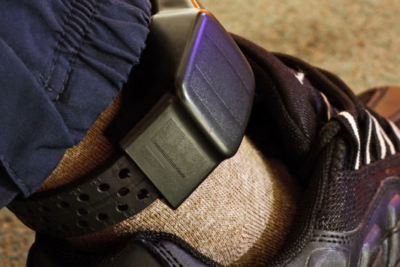
The case highlights critical vulnerabilities in how law enforcement personnel access and utilize sensitive databases. Police agencies increasingly rely on advanced technologies for offender tracking and intelligence gathering, making robust oversight paramount. Josett’s sentence included a period of electronic monitoring, requiring him to wear a GPS ankle monitor for nine months. This form of electronic tagging places individuals under continuous community supervision, a common accountability measure for a wide range of offenders. For a former officer, it underscores a fundamental shift from law enforcer to monitored individual.
Josett’s conviction and the pending review of his certification by POST underscore the ongoing challenge of maintaining integrity within law enforcement ranks. As criminal justice technology, including sophisticated electronic monitoring and surveillance tools, becomes more prevalent, ensuring ethical access and preventing internal abuse remains a critical area for policy and oversight. This incident serves as a stark reminder of the need for continuous vigilance in safeguarding sensitive data and upholding public trust.
Source: Ex-Costa Mesa officer pleads guilty to using police databases to stalk mistress and rivals
Related Resources: Electronic Monitoring for Bail & Pretrial | GPS Ankle Monitor Buyer’s Guide | GPS Monitoring for Domestic Violence Cases
How Does GPS Ankle Monitor Technology Protect DV Victims?
GPS ankle monitor proximity alerts create digital safety perimeters around victims, triggering real-time notifications when offenders approach court-specified distances — enabling proactive intervention before contact occurs.
DV electronic monitoring effectiveness depends on sub-2-meter GPS accuracy, multi-mode BLE/WiFi/LTE connectivity ensuring alerts transmit in poor cellular areas, and zero false-alarm fiber-optic tamper detection preventing response fatigue. Programs using advanced GPS ankle bracelet technology with victim notification report 50-70% reductions in repeat violations versus standard protective orders without electronic monitoring. Battery life matters critically — devices dying overnight create gaps during peak-risk hours; 7-day LTE and 3-week WiFi battery substantially reduce this vulnerability.
How Does Advanced GPS Monitoring Technology Strengthen Victim Safety?
Next-generation GPS ankle monitors equipped with proximity alert technology create dynamic digital safety zones around domestic violence victims, alerting both the victim and law enforcement when the offender approaches within court-specified distances — typically 500 to 2,000 feet depending on risk assessment.
The reliability of domestic violence GPS ankle bracelet monitoring depends on three critical technology factors. First, positioning accuracy must be sub-2-meter to distinguish between an offender walking past a victim’s building and actually entering it. Second, multi-mode connectivity (BLE, WiFi, and LTE) ensures proximity alerts transmit even in buildings with poor cellular reception — precisely the environments where many violations occur. Third, zero false-alarm tamper detection prevents the alert fatigue that degrades response times in high-volume electronic monitoring programs.
Programs combining GPS ankle monitor supervision with dedicated victim-facing notification apps have demonstrated measurably improved safety outcomes. The technology enables what traditional restraining orders cannot: continuous, real-time verification of offender location relative to the protected person, with automated alerting that does not depend on the victim observing and reporting a violation.
For agencies implementing DV electronic monitoring, device battery reliability during overnight hours — the highest-risk period for domestic violence incidents — is a non-negotiable specification. GPS ankle monitors with 7-day standalone battery and WiFi-directed mode extending to three weeks provide the operational margin that 24-48 hour devices cannot match for victim protection applications.