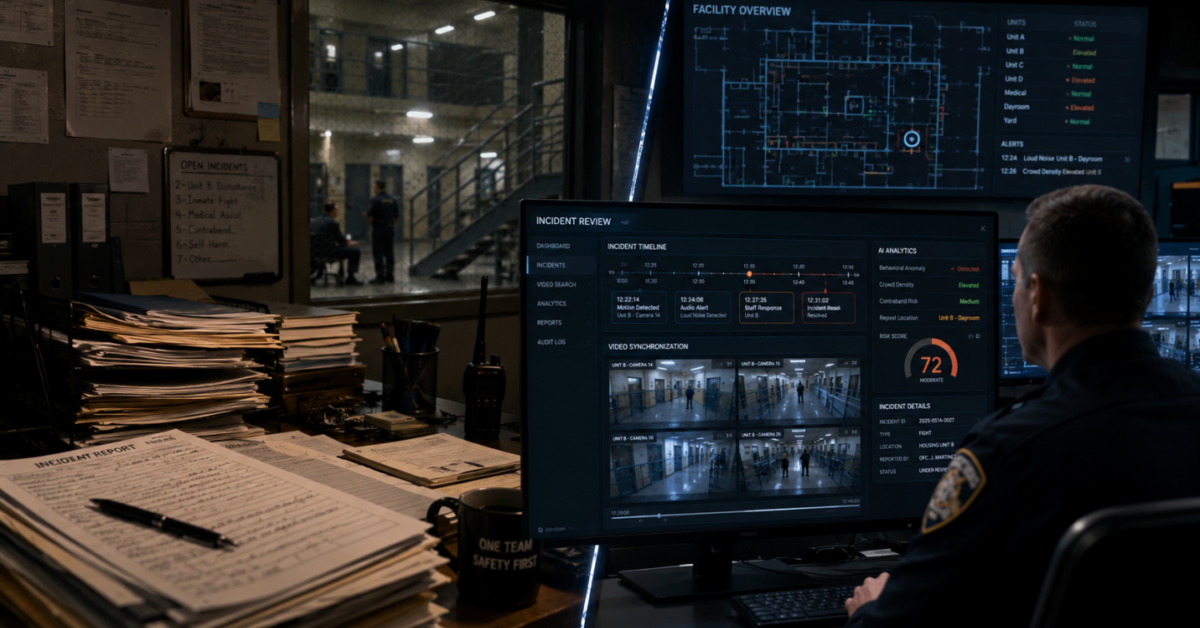
A Corrections1 column last week made a familiar argument: prisons are overwhelmed, incident reports are still written by hand, and AI can fix everything. The piece — authored by a Motorola Solutions product manager — laid out a clean vision of sensor-to-report automation that would make any procurement committee nod along.
The pitch is not wrong in its diagnosis. Correctional facilities are drowning in manual documentation, staff assaults are at record highs, and the gap between what incident reports capture and what actually happened inside a facility is dangerously wide. But the column glossed over the hard questions that corrections administrators should be asking before signing a contract — questions about bias, about what happens when AI outputs are treated as evidence in disciplinary proceedings, and about who actually benefits when a vendor’s product manager writes the industry’s playbook on “data-driven” safety.
Table of Contents
- What Is the Scale of the Problem AI Claims to Solve?
- Where Is AI Actually Being Deployed in Corrections Right Now?
- What Are the Risks That Vendor Pitches Leave Out?
- Why Should Corrections Administrators Care About Who Writes the Playbook?
- What Would Responsible AI Adoption in Corrections Actually Require?
- Where Does Electronic Monitoring Fit Into This Conversation?
- FAQ
- What AI tools are currently used for corrections incident reporting?
- What are the main risks of AI in corrections facilities?
- How does AI in prisons affect electronic monitoring and community supervision?
What Is the Scale of the Problem AI Claims to Solve?
The numbers are stark enough without embellishment. Federal Bureau of Prisons data shows staff were physically assaulted 934 times in 2024 — up from 872 in 2023 — with 28 incidents resulting in serious injury (BJS, Federal Prisoner Statistics, 2025). The FBOP’s Office of Internal Affairs opened 7,504 misconduct cases in FY 2024, a 48.67 percent increase over the prior year (BOP OIA Annual Report, FY 2024). These are just federal numbers — state facilities, which hold the vast majority of the 1.9 million incarcerated Americans, report even less consistently.
California’s Title 15, Section 1044 — the regulation the Corrections1 column cited — mandates written records for every incident involving physical harm or serious threat (Cal. Code Regs. Tit. 15, §1044). The requirement is straightforward: names, descriptions, actions taken, timestamps. The gap between that mandate and what actually gets documented is where technology vendors see their opening.
Where Is AI Actually Being Deployed in Corrections Right Now?
The Corrections1 column described a generic vision of integrated analytics. The reality on the ground in 2026 is more specific — and more contested.
LeoTech’s Verus ION platform markets itself as the first “global search engine” for corrections, aggregating communications intercepts, AI video analytics, inmate financial records, offender management data, and investigative tools into a single dashboard. Its AI agents promise to “analyze, correlate, and prioritize” across all data streams. The company’s promotional materials describe automated inmate counts, behavior detection from video feeds, and voice biometric matching across recorded communications.
Securus Technologies’ THREADS platform aggregates call recordings, transcripts, voiceprints, and financial data to map social connections and flag behavioral patterns. The company developed its AI models using seven years of inmate phone calls from Texas prisons — calls that inmates paid for while their data trained the system. New York City is set to renew a $23 million, five-year contract with Securus for Rikers Island phone service, despite the company having improperly recorded hundreds of attorney-client privileged calls disclosed to prosecutors in 2020 and 2021 (THE CITY, May 2026).
IPS/ICJS’s HORUS 360 iOMS takes a different approach — integrating AI video analysis with an intelligent offender management system built on an API-first architecture. The platform’s design philosophy emphasizes what the industry calls “human-in-the-loop” oversight, where AI catches what officers might miss in video footage but correctional staff retain decision-making authority (Justice Trends Magazine).

What Are the Risks That Vendor Pitches Leave Out?
Three major research efforts published in 2025-2026 converge on the same warning: corrections agencies are adopting AI tools faster than oversight frameworks can keep pace.
A joint report by RAND Corporation and the Council on Criminal Justice found that AI is “no longer experimental” in criminal justice but is being deployed without agencies “fully understanding their long-term impact on fairness, accountability, and civil liberties.” The report specifically warned that predictive tools in corrections rely on historical data that “may already contain racial and socioeconomic bias,” creating feedback loops that “repeat and even strengthen existing inequalities” (CCJ, AI Taxonomy for Criminal Justice, 2025).
A Stanford Law School analysis went further, documenting what they called a “governance gap” — even well-intentioned corrections administrators “lack the technical expertise to evaluate these tools rigorously, while vendors market directly to practitioners.” The result is “uneven, superficial oversight that undermines public trust” (Stanford, AI in Criminal Justice, March 2026).
The Urban Institute framed the challenge specifically for corrections leaders: AI “could streamline operations, improve health and safety, and personalize reentry support. But without strong safeguards, they risk amplifying bias, invading privacy, and eroding trust.” Their recommendation: start with “narrowly scoped, high-benefit tools” and build governance before scaling (Urban Institute, Responsible AI Adaptation in Corrections).

Why Should Corrections Administrators Care About Who Writes the Playbook?
The Corrections1 column is a textbook example of a pattern that the Stanford report explicitly flagged: vendor-authored thought leadership that frames a commercial product as an industry best practice. The author, Chad Esplin, has spent 11 years as Product Manager for Motorola Solutions’ Flex RMS and Flex Jail — the very category of integrated records and jail management software the column recommends adopting.
This is not inherently disqualifying. Product managers often have deep domain knowledge. But when a vendor’s employee writes the diagnostic and prescribes the treatment, administrators should notice which questions never get asked:
- Has the AI been independently validated for bias? The column never mentions algorithmic bias testing, despite RAND, Stanford, and Urban Institute all identifying it as a critical prerequisite.
- What happens when AI-generated incident logs are used in disciplinary hearings? If an automated system flags an inmate for contraband based on video analysis, does the inmate have the right to challenge the algorithm’s conclusion? The DOJ’s own PATTERN recidivism tool has been flagged by the Electronic Frontier Foundation for making “inferences not based on the actual future behavior of somebody” (FedScoop, 2026).
- Who owns the data? When a private vendor ingests years of facility incident data, video feeds, and sensor readings to train its models, who controls that data if the contract ends?
- What about attorney-client privilege? Securus’s documented history of improperly recording privileged calls — and the ongoing $23 million Rikers renewal despite that history — shows that “trust” is not a default setting for these systems.
What Would Responsible AI Adoption in Corrections Actually Require?
The Council on Criminal Justice published a User Decision Framework in 2026 that provides the clearest roadmap for corrections agencies considering AI tools:
- Mandatory bias testing before deployment — not vendor self-reporting, but independent, expert-led validation across demographic groups.
- Training on automation bias — officers must understand that AI outputs are probabilistic, not factual, and retain clear authority to override algorithmic recommendations.
- Whistleblower protections — formal channels for staff to report concerns about AI system behavior without retaliation.
- Community input — those most affected by AI-driven surveillance should help shape adoption and governance.
- Continuous performance monitoring — real-time analysis of whether the system works as claimed, with protocols for triggering investigation when it does not.
Albert Fox Cahn, founder of the Surveillance Technology Oversight Project, put it bluntly: “A lot of these predictive tools can create unintended errors where certain communities are underserved or misunderstood because of how the model missed or wrongly accounted for individuals’ risks in that community” (The Marshall Project, August 2025).
Where Does Electronic Monitoring Fit Into This Conversation?
The incident review discussion has direct implications for electronic monitoring agencies. If in-facility AI systems generate incident data that feeds into risk classification algorithms — and those classifications then determine whether an individual is released to community supervision with a GPS ankle monitor — the integrity of the entire data pipeline matters enormously.
A biased incident flagging system inside a prison could inflate an individual’s risk score, leading to more restrictive supervision conditions upon release — higher-frequency GPS reporting, tighter geofencing, mandatory check-ins. Conversely, a well-designed system that accurately documents incidents and separates signal from noise could provide better data for release decisions, matching supervision intensity to actual risk.
The technology exists for this kind of integration. Next-generation GPS ankle monitors with adaptive multi-mode connectivity can feed real-time compliance data back into the same analytics platforms that process in-facility incidents. The question is whether the governance frameworks will evolve fast enough to ensure that integration serves due process rather than convenience.
FAQ
What AI tools are currently used for corrections incident reporting?
Major platforms include LeoTech’s Verus ION, Securus Technologies’ THREADS, IPS/ICJS’s HORUS 360 iOMS, and Motorola Solutions’ CommandCentral Jail. These systems integrate video surveillance, audio sensors, communications intercepts, and offender management data to automate incident documentation and enable pattern analysis.
What are the main risks of AI in corrections facilities?
The RAND Corporation, Stanford Law School, and Urban Institute have identified algorithmic bias from historical data, lack of independent validation, erosion of attorney-client privilege, insufficient staff training on system limitations, and absence of governance frameworks as the primary risks.
How does AI in prisons affect electronic monitoring and community supervision?
In-facility AI systems that generate incident data can feed into risk classification algorithms that determine whether individuals are released to community supervision and under what conditions. Biased incident flagging could inflate risk scores, leading to more restrictive GPS monitoring conditions upon release.