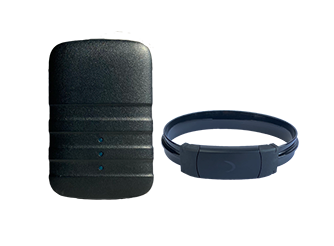
GPS ankle monitors used in criminal justice supervision can be broadly classified into two architectural categories: one-piece (integrated) and two-piece (modular) designs. Each approach presents distinct advantages and limitations that affect device reliability, wearer experience, agency operations, and total cost of ownership. This article examines the engineering tradeoffs and operational considerations of both architectures.
Table of Contents
- Definitions
- One-Piece (Integrated) Design
- Two-Piece (Modular) Design
- Engineering Considerations
- Size and Weight
- Battery Life
- Waterproofing
- Antenna Performance
- Operational Impact
- Installation and Removal
- Logistics and Inventory Management
- Points of Failure
- Total Cost of Ownership
- Market Trends
- Conclusion
- References
- Frequently Asked Questions
- What is the difference between one-piece and two-piece ankle monitors?
- Which design has better battery life?
- Why are one-piece designs becoming the industry standard?
Definitions
One-Piece (Integrated) Design
In a one-piece architecture, all functional components—GPS receiver, cellular modem, microcontroller, battery, anti-tamper mechanism, and strap attachment—are integrated into a single sealed housing worn on the ankle. The strap is permanently attached to the housing and cannot be separated without triggering a tamper alert.
Two-Piece (Modular) Design
A two-piece system consists of a separate GPS tracking unit and an ankle strap or bracelet. The tracking unit communicates wirelessly (typically via Bluetooth or near-field communication) with the ankle bracelet, which contains the anti-tamper sensors. In some configurations, the tracking unit may be worn on the ankle alongside the bracelet or carried on the body (e.g., clipped to clothing or worn on the wrist).
Engineering Considerations
Size and Weight
Two-piece designs historically allowed manufacturers to keep the ankle-worn component smaller and lighter by placing the larger GPS module and battery in a separate housing. However, advances in component miniaturization, low-power GPS chipsets, and high-density batteries have significantly reduced the size advantage of two-piece systems. Modern one-piece devices typically weigh between 90–160 grams, comparable to the combined weight of a two-piece system’s ankle component and tracking unit.
Battery Life
Battery capacity is a critical specification for field operations. One-piece designs must fit all power requirements into a single housing, which historically limited battery life to 24–36 hours. Current generation one-piece monitors using low-power GPS chipsets and adaptive reporting intervals achieve 40–72 hours of operation per charge, approaching the performance of two-piece systems whose tracking units typically achieve 48–96 hours due to larger battery capacity.
Waterproofing
Ingress protection (IP) ratings measure a device’s resistance to water and dust. One-piece designs with a single sealed enclosure are generally easier to certify to high IP ratings (IP67 or IP68). Two-piece systems present additional waterproofing challenges at the wireless communication interface and at the connection points between components, though most commercial two-piece systems achieve at least IP65 ratings.
Antenna Performance
GPS and cellular antenna placement is more constrained in one-piece designs, where the antenna must coexist with all other components in a single housing. However, dedicated antenna design for a single enclosure can achieve equivalent performance to two-piece systems. Body-worn positioning on the ankle presents challenges for all form factors due to signal attenuation from human tissue and ground proximity effects.
Operational Impact
Installation and Removal
One-piece designs typically require a single installation step: securing the strap around the ankle and activating the device. This process takes 2–5 minutes for most commercial models, with some snap-on designs achieving installation times under 30 seconds.
Two-piece systems require installation of the ankle bracelet, pairing of the tracking unit with the bracelet, and verification of wireless communication between the components. Total installation time is typically 5–15 minutes, and the pairing process occasionally requires troubleshooting.
In high-volume booking environments where officers process 15–30 installations per shift, the cumulative time difference is operationally significant.
Logistics and Inventory Management
One-piece devices simplify logistics: each monitored individual requires one device unit. Two-piece systems require agencies to manage two inventory streams and maintain pairing relationships between components. Lost or damaged individual components necessitate replacement or re-pairing.
Points of Failure
A two-piece system introduces additional failure modes not present in one-piece designs:
- Wireless link failure between the tracking unit and ankle bracelet
- Battery depletion of one component while the other remains charged
- Mechanical damage to the separate tracking unit
- Loss of the tracking unit by the wearer
Field data from monitoring agencies suggests that two-piece systems experience approximately 40–60% more device-related service calls than one-piece systems, primarily due to wireless link failures and tracking unit battery or handling issues.
Total Cost of Ownership
While initial per-unit pricing varies by manufacturer and volume, the total cost of ownership (TCO) calculation over a device’s service life should account for:
- Unit acquisition cost
- Installation and removal officer time
- Service call frequency and associated officer time
- Device replacement rate
- Inventory management overhead
- Training time for new staff
- Software licensing (if applicable)
When these operational factors are included, one-piece designs frequently deliver lower TCO despite potentially higher per-unit acquisition costs, particularly at scale (500+ active devices).
Market Trends
The electronic monitoring industry has shown a clear trend toward one-piece designs in new product development. Major manufacturers have introduced one-piece products in recent development cycles, and procurement specifications from US state agencies increasingly specify one-piece or “integrated” designs as preferred or required.
Factors driving this trend include:
- Operational simplicity for high-volume monitoring programs
- Reduced false alerts associated with wireless link failures in two-piece systems
- Cost pressure on monitoring agencies to reduce service call rates
- Component miniaturization enabling competitive battery life in one-piece form factors
Conclusion
Both one-piece and two-piece GPS ankle monitor architectures remain commercially available and operationally deployed. The choice between them involves tradeoffs in size, battery life, reliability, operational complexity, and cost. The trend toward one-piece designs reflects the increasing priority that monitoring agencies place on operational simplicity and service reliability over marginal advantages in any single technical specification.

References
- National Institute of Justice. “Electronic Monitoring Technologies.” NIJ, 2021.
- DeMichele, M. “The Future of Electronic Monitoring.” Federal Probation, Vol. 78(2), 2014.
- Payne, B. and DeMichele, M. “Electronic Monitoring in the Criminal Justice System.” Sociology Compass, 2011.
- Government Accountability Office. “DOJ Could Improve Efforts to Address Risks from GPS Monitoring.” GAO-23-106125, 2023.
- National Law Enforcement and Corrections Technology Center. “GPS Monitoring Systems for Offender Supervision.” NCJ 253023, 2019.
Frequently Asked Questions
What is the difference between one-piece and two-piece ankle monitors?
One-piece monitors combine GPS, cellular, battery, and anti-tamper in a single ankle-worn unit. Two-piece systems use a separate bracelet (worn on ankle) and tracking hub (carried or home-based). One-piece reduces failure points and simplifies logistics.
Which design has better battery life?
Two-piece systems can achieve longer battery life because the tracking hub has more space for a larger battery. However, one-piece devices like the CO-EYE ONE achieve 7 days with LTE-M/NB-IoT optimization, which is sufficient for most programs.
Why are one-piece designs becoming the industry standard?
One-piece eliminates bracelet-hub pairing failures, reduces installation time (under 3 seconds vs 5+ minutes), and prevents signal loss when the tracked person moves away from the hub unit.