Table of Contents
The Battery Problem in Electronic Monitoring
Battery life has been the constraining factor in GPS ankle monitor design since the technology’s inception. Early devices required daily charging — sometimes twice daily under heavy GPS reporting schedules. Each charge cycle creates a monitoring gap: the device must be connected to a charger, the offender must comply with the charging requirement, and any failure to charge triggers a compliance violation that officers must investigate.

For monitoring programs managing hundreds or thousands of offenders, daily charging translates to thousands of charge events per week — each a potential point of failure, each requiring staff attention when the offender doesn’t comply. The operational burden is substantial: a 500-offender program with daily-charge devices processes approximately 3,500 charge events per week. With a 5% non-compliance rate, that’s 175 violation events requiring officer follow-up every week — just from battery management.
What Changed: Low-Power IoT Cellular Networks
The shift from 2G/3G/4G to IoT-optimized cellular networks — specifically LTE-M (Cat-M1) and NB-IoT (Cat-NB2) — fundamentally changed the battery equation. These networks, part of the 3GPP 5G standards roadmap, were designed for devices that transmit small data packets at regular intervals. They support Power Saving Mode (PSM) and Extended Discontinuous Reception (eDRX), allowing the cellular radio to enter deep sleep between transmissions while maintaining network registration.
The cellular radio is the largest power consumer in a GPS ankle monitor — far exceeding the GPS chipset or tamper detection circuitry. When LTE-M reduces cellular power consumption by 70-80% compared to legacy 2G GSM, battery life extends proportionally. Devices that previously lasted 24-40 hours can now operate for 7+ days on the same battery capacity.
Current State of the Art: 7-Day to 6-Month Operation
Modern GPS ankle monitors have achieved two performance tiers:
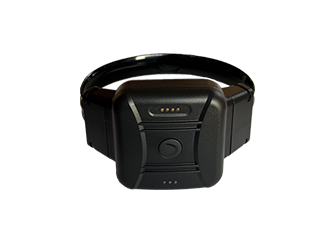
Standalone GPS mode (7 days): The device operates independently — acquiring GPS positions every 5 minutes and transmitting data via LTE-M or NB-IoT to the monitoring server. A 1,700 mAh battery sustains this for approximately 7 days. The CO-EYE ONE, at 108 grams, is among the lightest devices to achieve this benchmark while maintaining multi-constellation GNSS (GPS + BeiDou + GLONASS + Galileo), IP68 waterproofing, and optical fiber tamper detection.
BLE-connected mode (up to 6 months): An advanced configuration where the ankle bracelet communicates via Bluetooth Low Energy to a nearby relay device — typically a home base station or smartphone app — which handles the cellular uplink. The ankle device’s power-hungry cellular radio stays dormant, extending battery life to 6 months. When the BLE connection is lost (offender leaves home), the device automatically switches to standalone mode. The CO-EYE ONE-AC implements this dual-mode architecture with seamless automatic switching.
Operational Impact: Quantifying the Difference
| Metric | Daily-Charge Device | 7-Day Device | Reduction |
|---|---|---|---|
| Charge events per offender/month | 30 | 4 | 87% |
| Charge compliance violations (500 offenders, 5% rate) | 750/month | 100/month | 87% |
| Officer hours on charge compliance/month | ~190 hours | ~25 hours | 87% |
| Monitoring gaps from dead batteries | Frequent | Rare | >90% |
Battery Chemistry and Safety
GPS ankle monitors universally use lithium-polymer (LiPo) cells — the same chemistry as smartphones but with more stringent safety requirements. Devices worn continuously on a human body must pass IEC 62133 (battery safety), UN 38.3 (transportation safety), and in many jurisdictions, additional regulatory requirements for body-worn electronics.

Thermal management is a particular concern. Ankle monitors operate against skin in environments ranging from -20C to +60C. Battery degradation accelerates above 45C, and thermal runaway — while extremely rare in modern cells — is a liability concern for corrections agencies. Certified devices undergo extensive thermal cycling, crush, and puncture testing before deployment.
What Next: Energy Harvesting and Beyond
Research into body-heat thermoelectric generators and kinetic energy harvesting suggests that future ankle monitors may supplement battery power with energy captured from the wearer’s body heat and movement. These technologies are not yet commercially viable for the form factor and power requirements of GPS monitoring, but laboratory prototypes demonstrate the concept. More immediately, advances in silicon-anode lithium batteries promise 30-40% energy density improvements within 2-3 years — potentially enabling 10-day standalone operation in the same 108-gram form factor.
For corrections agencies and monitoring companies making procurement decisions today, the practical advice is clear: specify 7-day battery life at 5-minute reporting intervals as a minimum requirement. Anything less imposes unnecessary operational burden. The technology exists — there is no reason to accept daily-charge devices in 2026.