In January 2025, BI Incorporated quietly expanded the deployment of its VeriWatch GPS wristband within ICE’s Alternatives to Detention (ATD) program. The device — a smartwatch-like GPS unit designed for immigration compliance monitoring — represents something far more significant than a product launch. It is the clearest signal yet that the electronic monitoring industry has formally adopted a risk-stratified device architecture, where the body placement of a monitoring device is determined by the security requirements of the supervised population.
This article traces how BI Incorporated’s product line evolution — from ankle-only to a four-tier system spanning ankle GPS, wrist GPS, wrist BLE, and smartphone-only — mirrors a broader industry consensus that has been building for two decades. Understanding this evolution is essential for any agency, policymaker, or researcher evaluating the appropriate deployment of electronic monitoring technology.
Table of Contents
- BI Incorporated’s Four-Tier Product Architecture
- Tier 1: LOC8 / ExacuTrack GPS Ankle Monitor — Criminal Supervision
- Tier 2: VeriWatch GPS Wristband — Immigration Compliance
- Tier 3: SmartBAND + SmartLINK — Proximity Tethering
- Tier 4: SmartLINK App — Self-Reporting
- What ICE’s ATD Deployment Reveals About Risk Segmentation
- The “Wrist Can Replace Ankle” Misconception
- International Market Implications
- The Industry Consensus on Risk Stratification
- Key Takeaways for Policymakers and Agencies
BI Incorporated’s Four-Tier Product Architecture
BI Incorporated, a subsidiary of The GEO Group and the largest electronic monitoring provider in the United States, currently operates four distinct monitoring tiers. Their product segmentation is the most data-rich example of risk-stratified EM deployment available for study.
Tier 1: LOC8 / ExacuTrack GPS Ankle Monitor — Criminal Supervision
BI’s legacy ankle GPS platform handles the highest-risk categories: probation, parole, pretrial release with conditions, domestic violence protection orders, and sex offender registries. These devices use conductive loop tamper detection on a locked ankle strap that cannot be removed without cutting. The ankle’s calcaneus bone — protruding 4.5–5.0 cm posteriorly — creates a natural mechanical lock that prevents the band from sliding over the foot.
This anatomical security feature is the reason every established EM manufacturer in the United States (SCRAM Systems, Track Group, SuperCom/Attenti, Sentinel) uses ankle placement for criminal supervision devices.
Tier 2: VeriWatch GPS Wristband — Immigration Compliance
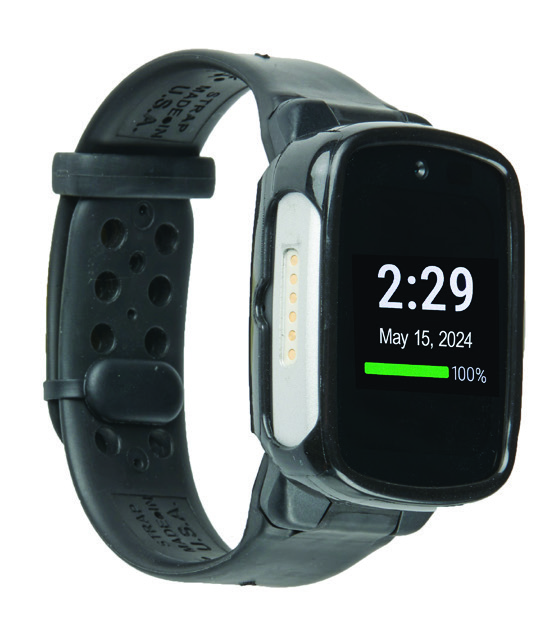
Launched in 2023 and expanded under ICE contract DROATDDE-23-F-00002, VeriWatch is a GPS-equipped wristband that BI positions for “lower-risk adult populations and the juvenile justice system.” The device uses facial recognition check-ins and proximity sensors rather than physical tamper prevention.
Why facial recognition instead of physical anti-tamper? Because the wrist does not provide an anatomical lock. U.S. military anthropometric studies (Garrett, 1971) document that adult male wrist circumference averages 16.5–17.5 cm while compressed hand cross-section approaches that same range. Any band comfortable enough for long-term wear can be removed by folding the thumb inward and compressing the palm — the same technique used to slip poorly fitted handcuffs.

BI’s engineering team clearly understood this constraint. Their solution was not to attempt physical containment (anatomically impossible on the wrist), but to shift the security model to identity verification: if the device detects removal, it prompts a facial recognition check-in. If the wearer fails to comply, officers are notified.
This is a fundamentally different security architecture — one that depends on the wearer’s cooperation rather than defeating it.
Tier 3: SmartBAND + SmartLINK — Proximity Tethering
SmartBAND is a BLE wristband that tethers to the SmartLINK smartphone app. It does not have independent GPS capability. Its function is to verify that the phone and the wearer remain in proximity — a check-in mechanism, not a tracking device. ICE deployed SmartBAND in combination with SmartLINK for participants who needed more accountability than app-only monitoring but less than GPS tracking.
Tier 4: SmartLINK App — Self-Reporting
The lightest tier: a smartphone application using phone GPS and facial recognition for scheduled check-ins. As of December 2024, approximately 155,000 of ICE ATD’s roughly 175,000 active participants used SmartLINK app-only monitoring — making it the dominant modality for immigration compliance. SmartLINK costs approximately $4.36 per person per day versus $93 per day for detention (CBS News, 2024).
What ICE’s ATD Deployment Reveals About Risk Segmentation
ICE’s Alternatives to Detention program provides the largest single dataset on risk-stratified EM deployment in the world. At its peak in August 2024, ATD monitored approximately 375,000 individuals. The distribution across tiers is instructive:
| Tier | Device | Approximate Participants | % of ATD | Security Model |
|---|---|---|---|---|
| Ankle GPS | LOC8 | ~5,000 | ~3% | Physical containment |
| Wrist GPS | VeriWatch | ~3,000 | ~2% | Biometric compliance |
| Wrist BLE + Phone | SmartBAND + SmartLINK | ~12,000 | ~7% | Proximity tethering |
| Phone only | SmartLINK App | ~155,000 | ~88% | Self-reporting |
The numbers tell a clear story: 88% of immigration compliance monitoring requires no physical device at all. Only 3% requires ankle placement. BI’s four-tier architecture evolved to match this distribution — not to replace ankle devices, but to offer lighter alternatives where the risk profile permits them.
The “Wrist Can Replace Ankle” Misconception
Despite BI’s own risk segmentation, a troubling narrative has emerged in some international markets: that GPS wristbands represent a technological advancement over ankle monitors, offering the same security with less stigma. Several factors fuel this misconception:
- Consumer electronics aesthetics: Wrist devices resemble smartwatches, making them appear more advanced than the utilitarian ankle GPS bands
- Marketing emphasis on features: Heart rate sensors, step counters, and touchscreens create an impression of sophistication that has little security value
- Stigma reduction arguments: Warren County, Ohio judge Robert Peeler described ankle monitors as “a scarlet letter” and piloted VeriWatch — but for low-risk offenders, not violent crime supervision
- Cost comparisons that ignore risk: Per-device costs appear similar, but the total cost of a security failure from inappropriate wrist deployment vastly exceeds per-diem savings
The critical distinction is between compliance facilitation (wrist) and physical containment (ankle). These are not two versions of the same function — they are two entirely different security architectures designed for different risk levels.
International Market Implications
In markets where electronic monitoring is being introduced for the first time — parts of Latin America, Africa, Southeast Asia, and the Middle East — procurement agencies often lack the operational experience to distinguish between compliance tools and security devices. The result, documented in multiple country reports, is a pattern of:
- Procuring low-cost wrist devices (often modified consumer smartwatches) for criminal supervision
- Experiencing removal incidents within months of deployment
- Losing institutional confidence in electronic monitoring as a concept
- Either abandoning EM programs or restarting procurement with ankle-based devices
This cycle wastes public resources and delays the adoption of proven monitoring technology. Agencies evaluating first-time EM deployments should study the BI/ICE model — not to replicate it, but to understand that device selection must follow risk assessment, not the other way around.
The Industry Consensus on Risk Stratification
BI is not alone in this approach. Across the U.S. corrections industry, the same pattern holds:
- SCRAM Systems (Alcohol Monitoring Systems): SCRAM CAM (ankle, alcohol monitoring) + SCRAM GPS (ankle, location tracking) — no wrist product for criminal supervision
- SuperCom / Attenti: PureOne (ankle) + PureTrack (ankle) — criminal supervision exclusively on ankle
- Track Group: SecureCuff (ankle) + ReliAlert (ankle) + Shadow (ankle) — no wrist variant for supervised populations
- Geosatis: One-piece ankle GPS — ankle-only product line
Newer entrants to the market, including REFINE Technology (CO-EYE), have further reinforced the ankle-first architecture, with innovations focused on solving ankle-device pain points (battery life, weight, false tamper alarms) rather than shifting to wrist placement.
The industry consensus is unambiguous: for any population with motivation to evade supervision, the ankle is the only anatomically secure placement for a monitoring device. Wrist devices serve a different function for a different population.
Key Takeaways for Policymakers and Agencies
- Risk assessment must precede device selection. Choosing a monitoring device before completing a risk stratification of the supervised population guarantees misallocation.
- Wrist devices are compliance tools, not security devices. BI’s own product segmentation proves this: VeriWatch for immigration compliance, LOC8 for criminal supervision.
- Anatomy determines security ceilings. The calcaneus bone lock at the ankle has no wrist equivalent. No amount of software (heart rate, facial recognition, proximity sensors) can compensate for the absence of a physical barrier to removal.
- Evaluate total program cost, not per-device cost. A single security failure — fugitive search, victim harm, program credibility loss — costs orders of magnitude more than the per-diem difference between device types.
- Study mature markets before first deployment. The U.S. EM industry’s 40-year evolution has already answered the wrist-vs-ankle question. New markets can avoid costly trial-and-error by learning from this evidence base.