
Washington State’s proposed CrR 3.2 bail reforms have reignited a familiar American argument: public safety versus pretrial liberty. Prosecutors warn of accountability gaps. Public defenders cite decades of research showing that wealth-based detention produces worse outcomes across every measurable dimension—failure to appear, recidivism, employment, family stability. Both camps, predictably, are focused on policy mechanics while ignoring the elephant in the courtroom: the monitoring technology that is supposed to bridge the gap between incarceration and unsupervised release has barely evolved in twenty years.
As someone who has covered electronic monitoring procurement and technology for the better part of two decades, I find the current debate frustratingly incomplete. We are asking whether to keep or discard a bail system built around nineteenth-century incentive structures, while the technology infrastructure that could make the question moot remains stuck in 2005.

Table of Contents
The Hardware Problem Nobody Wants to Discuss
The standard-issue GPS ankle monitor in American corrections today weighs between 150 and 252 grams — roughly the weight of a large smartphone strapped permanently to your ankle. The lightest one-piece ankle bracelet on the U.S. market comes in at around 108 grams. These devices must be charged daily or every few days, depending on connectivity mode. They are visible under most clothing. They generate social stigma that multiple studies have linked to employment discrimination, social isolation, and psychological harm.
A 2022 study published in the Journal of Offender Monitoring found that 34% of monitored individuals reported losing at least one employment opportunity directly attributable to visible monitoring hardware. The Vera Institute’s 2021 national count documented 254,700 adults on electronic monitoring — and their qualitative interviews consistently surfaced complaints about device bulk, skin irritation, charging disruption, and the social consequences of wearing what amounts to a visible criminal justice marker.
This is not a peripheral concern. When we ask whether pretrial defendants should be released on electronic monitoring instead of cash bail, we are implicitly asking whether they should trade financial punishment for a different kind of punishment — one that follows them to job interviews, basketball courts, family dinners, and their children’s school events.
Bail reform advocates are right that the current system is unjust. But replacing cash bail with a 200-gram ankle monitor that screams “criminal” is not justice either. It is substituting one form of disproportionate burden for another.
Where Is the Miniaturization Revolution?
Consumer wearable technology shrank from the Fitbit Tracker (2009, ~30g) to the Oura Ring (2024, 4–6g) in fifteen years. Military GPS receivers went from backpack-sized to chip-sized in a decade. Yet criminal justice wearables remain essentially unchanged since BI Incorporated and SCRAM Systems introduced their GPS ankle bracelet platforms in the mid-2000s.
The reasons are partly structural. Government procurement moves slowly. Vendor lock-in through proprietary monitoring platforms discourages hardware innovation. Contracts often specify legacy form factors. And frankly, the people wearing these devices — overwhelmingly low-income, disproportionately Black and Latino — have not had the political power to demand better.
But the technical barriers to miniaturization have largely collapsed. BLE 5.x chips draw milliwatts. GNSS receivers fit on 3mm dies. Fiber-optic tamper detection can be woven into bands thinner than a watchstrap. The components exist. What has been missing is market demand from agencies willing to try something different.
That is starting to change.
A Technical Path Forward: The e-Cell FOB Model
One of the more interesting developments I have tracked in the past year is the deployment model pioneered by e-Cell, a Fort Smith, Arkansas-based monitoring company. e-Cell integrated a BLE-based monitoring wristband — marketed as the FOB (Fiber Optic Band) — into their existing smartphone supervision platform. The device weighs 17 grams, measures roughly 65×22×10 mm, uses fiber-optic anti-tamper detection, and runs for up to two years on a single battery. It carries FCC certification for the U.S. market.
The FOB represents a fundamentally different design philosophy from traditional ankle monitor hardware. Instead of packing GPS, cellular modem, battery, and tamper sensors into a single ankle-mounted device, it offloads positioning and communication to the defendant’s own smartphone. The wristband’s sole job is to maintain an encrypted BLE tether to the phone, continuously verifying that the person and the device are co-located, while providing tamper-resistant identity binding through its fiber-optic strap.
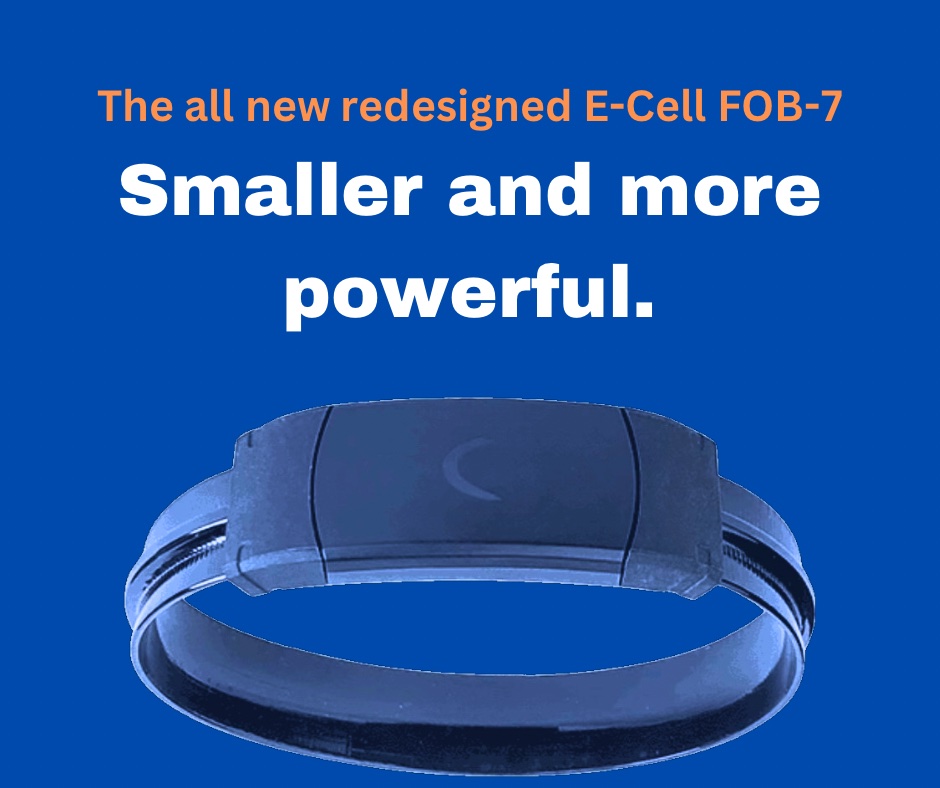
This architecture addresses the core objections to traditional electronic monitoring simultaneously:
- Visibility and stigma: At 17g on the wrist — or ankle under a sock — it is genuinely invisible to casual observation.
- Charging burden: Two-year battery eliminates the daily charging ritual that generates the majority of nuisance alerts.
- Cost: By leveraging the defendant’s existing smartphone rather than agency-owned cellular hardware, the per-defendant cost drops dramatically.
- Proportionality: Low-risk pretrial defendants get monitoring proportionate to their actual risk level.
The e-Cell deployment is not an isolated experiment. The underlying hardware — manufactured by REFINE Technology as the CO-EYE BLE i-Bracelet — is deployed in 30+ countries and is now being evaluated by multiple U.S. agencies looking for alternatives to traditional GPS ankle bracelet hardware.
Why Smartphone Apps Alone Cannot Solve the Problem
Before anyone argues that we should just skip the wristband entirely and rely on phone apps, let me explain why that does not work.
The U.S. market has a growing roster of smartphone monitoring applications. BI Incorporated offers SmartLINK. Satellite Tracking of People (STOP) runs smartphone modules. Corrisoft, Uptrust, and a dozen startups offer various combinations of GPS check-ins, biometric verification, appointment reminders, and messaging. The NIJ’s 2025 brief on smartphone applications for community supervision documented the trend and noted that agencies increasingly want “less stigmatizing methods of location tracking.”
But here is the problem that every honest practitioner acknowledges privately: an app on a phone that the defendant owns and controls is not, by itself, a monitoring system. It is a compliance tool.
When a defendant can leave their phone on the kitchen counter, hand it to a roommate, power it off, or simply delete the app, the “monitoring” becomes voluntary self-reporting dressed up in GPS coordinates. The location trace shows where the phone was. Whether the person was there is an assumption, not a verified fact.
This is not theoretical. I have spoken with pretrial services directors who describe smartphone-only programs where check-in compliance runs above 90% because the app makes checking in convenient — but where they have essentially zero ability to detect a defendant who leaves the phone at home and goes somewhere they should not be. The system works for people who intend to comply. It provides almost no additional security for people who do not.
This is precisely why BI Incorporated developed the SmartBAND — a proprietary BLE wristband that pairs with their SmartLINK app to add proximity verification. The federal courts’ Location Monitoring Reference Guide acknowledges this gap explicitly, distinguishing between standalone virtual mobile applications and hardware-paired monitoring with verified physical presence.
The lesson is straightforward. Smartphone apps are necessary infrastructure for modern pretrial supervision. They handle communication, scheduling, biometric check-ins, and GPS positioning far more effectively and affordably than dedicated cellular hardware. But they need a physical anchor — a lightweight, tamper-evident wearable that proves the person is actually carrying the phone.
Reframing the Bail Reform Debate Around Technology Capability
The core tension in Washington’s CrR 3.2 debate — and in every bail reform discussion happening across the country — is between two legitimate concerns:
- Low-income defendants should not be locked up simply because they cannot afford bail.
- Courts need some mechanism to ensure defendants return for trial.
Traditional electronic monitoring satisfies concern #2 but at a cost — both financial and human — that exacerbates concern #1. Cash bail satisfies neither concern particularly well (appearance rates under money bail are not significantly higher than under properly supervised release).
Miniaturized, low-intrusion wearable technology paired with smartphone apps offers a path that addresses both concerns simultaneously. The defendant is monitored. The monitoring is verifiable. The device is invisible. The cost is manageable. The defendant can work, socialize, parent, and rebuild their life without carrying a visible marker of their legal status.
Whether Washington adopts the CrR 3.2 amendments or not, the underlying demand for proportionate pretrial supervision is only going to grow. Illinois eliminated cash bail in 2023. New Jersey’s 2017 reforms cut its jail population by 44%. Forty-seven states have some form of bail reform legislation in discussion. Every one of these reforms will eventually need a technology backbone that is cheaper, lighter, less intrusive, and more reliable than what most agencies deploy today.
The miniaturization path that e-Cell’s FOB deployment demonstrates is not the only possible future. But it is a real one, commercially available today, FCC-certified, and field-proven. That puts it ahead of most of the alternatives being discussed in legislative chambers and courtrooms that have yet to move beyond the false binary of incarceration versus unsupervised release.
Marcus Calloway is Editor-in-Chief of the Ankle Monitor Industry Report. He has covered electronic monitoring technology and policy for over 20 years.