
In 2025, Chinese courts rendered only 294 not-guilty verdicts out of more than 1.05 million criminal cases — a conviction rate of 99.97% and an acquittal rate of just 0.021%, the lowest since at least the year 2000. The data, drawn from the Supreme People’s Court (SPC) annual work report delivered to the National People’s Congress in March 2026, has reignited a long-simmering debate among Chinese legal scholars about whether near-zero acquittal rates reflect prosecutorial precision or systemic dysfunction.
At a recent seminar hosted by the Hongfan Institute for Law and Economics in Beijing, Peking University law professors warned bluntly: an acquittal rate this close to zero almost certainly masks a higher wrongful conviction rate rather than proving the absence of prosecutorial error. The arithmetic is stark — when 99.97% of all defendants are found guilty, the courtroom’s error-correction function has been compressed nearly to the vanishing point.
Table of Contents
- What Is the Relationship Between Declining Crime and Persistent Conviction Rates?
- How Has “Fewer Arrests, Cautious Detention” Actually Played Out?
- How Did Electronic Monitoring Technology Enable China’s Detention Reduction?
- Why Did the Non-Custodial Monitoring Population Collapse Despite Proven Technology?
- What Are the Structural Barriers to Expanding Non-Custodial Supervision?
- What Would a Technology-Driven Path Forward Look Like?
What Is the Relationship Between Declining Crime and Persistent Conviction Rates?
China’s overall criminal caseload has been falling. The Supreme People’s Procuratorate (SPP) reported in its 2025 Criminal Prosecution White Paper that prosecutors approved arrests of 664,171 suspects (down 11.7% year-on-year) and initiated prosecutions against 1.4 million (down 13.9%) — the lowest prosecution figures this century. Serious violent crime prosecutions fell 10.3%. The non-arrest rate reached 34.1%, meaning prosecutors refused roughly one in three arrest requests from police.
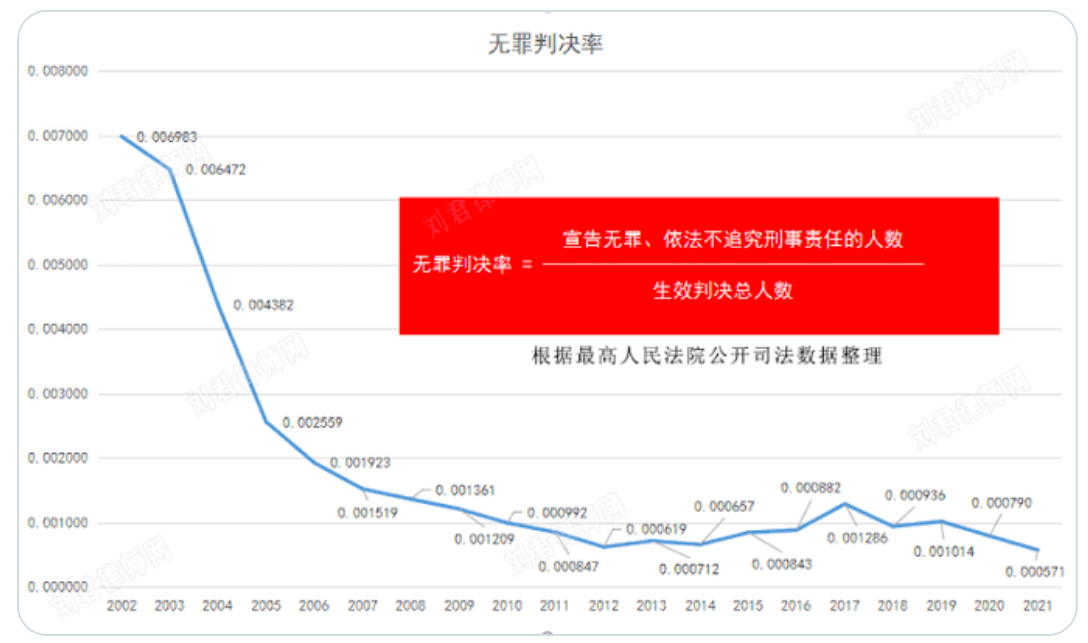
Yet the acquittal rate continued its downward slide. The disconnect raises uncomfortable questions. If crime is declining and prosecutors are exercising more restraint at the arrest stage, why isn’t the courtroom producing more acquittals when cases do proceed to trial? Legal scholars point to the deeply entrenched “assembly-line” coordination between police, prosecutors, and courts — a structural feature of Chinese criminal procedure that makes reversals at the trial stage politically and institutionally costly for all three organs.
How Has “Fewer Arrests, Cautious Detention” Actually Played Out?
On paper, China’s pretrial detention policy underwent a dramatic liberalization. In 2021, the Communist Party formally elevated “shao bu shen su shen ya” (少捕慎诉慎押 — fewer arrests, cautious prosecution, prudent detention) to official national criminal justice policy. The official statistics that followed looked impressive:
- 2018: pretrial detention rate 54.9%
- 2022: pretrial detention rate 26.7% — the lowest in China’s judicial statistical history
- 2023: pretrial detention rate 26.8% — the decline stalled, with a 0.2 percentage-point uptick
But these headline numbers obscure a harsher reality. The non-arrest rate, which peaked at 43.4% in 2022, has been steadily retreating — falling to 34.1% by 2025. The non-prosecution rate similarly dropped from its 2023 peak of 25.5% to 19.8% in 2025. As Beijing criminal defense attorney Cai Jiaxu noted in his analysis of the 2025 data: whether this represents a temporary fluctuation or signals that the “fewer arrests, cautious detention” policy has already reversed course in practice “warrants close observation.”
The deeper structural problem is that the headline pretrial detention “rate” improved largely because the denominator changed — prosecutors simply stopped prosecuting millions of minor cases (dangerous driving, petty fraud, online assistance crimes), removing them from the statistical pipeline entirely. For defendants who were prosecuted, the operational reality remained stark: if China’s criminal justice system decided to prosecute you, you were almost certainly detained pending trial, and almost certainly convicted. The 99.97% conviction rate and the pretrial detention pattern are two faces of the same coin — a system where the decision to prosecute is functionally equivalent to a guilty verdict, and where pre-verdict detention is the default, not the exception.
Academic research by Chinese legal scholars confirms this bifurcation. For serious crimes (those carrying sentences above 3 years), pretrial detention rates remained at approximately 80% throughout the reform period — essentially unchanged. The “fewer arrests” gains were concentrated almost entirely in petty offenses that would have been better handled through administrative penalties or fines rather than criminal prosecution in the first place.
How Did Electronic Monitoring Technology Enable China’s Detention Reduction?
China’s adoption of electronic monitoring in criminal justice dates to 2009, but the breakthrough came in 2014 when Shanghai became the first jurisdiction in the country to mandate GPS ankle bracelet supervision for parolees through formal court orders. REFINE Technology (上海锐帆信息科技有限公司), a Shanghai-based electronic monitoring vendor founded in 2004, built and operated the system — deploying 3,000 devices across all Shanghai districts by 2015 and exceeding 10,000 cumulative supervised individuals by 2016.
The Shanghai pilot was extensively covered by CCTV, Oriental Television, and Legal Daily. By 2017, Shanghai reported that 98% of its approximately 7,300 community corrections inmates were under some form of electronic supervision — wearable ankle monitors, electronic wristbands, or smartphone GPS apps — with a re-offending rate of just 0.18%, well below the national average.
The Changshu People’s Procuratorate in Jiangsu Province reported even more dramatic results after deploying a smart cloud-based monitoring platform integrating GPS positioning, video check-ins, and risk alerts: the custodial measure application rate at their office dropped from 41.7% to 23.9% — a direct consequence of digital supervision tools giving prosecutors confidence that non-custodial alternatives could work.
Why Did the Non-Custodial Monitoring Population Collapse Despite Proven Technology?
The real-world consequences of this gap between policy rhetoric and prosecutorial practice are measurable. According to data from the Shanghai University of Political Science and Law Community Corrections Research Center, REFINE Technology (锐帆) — which holds over 50% market share in China’s law-enforcement electronic monitoring sector — saw its daily supervised population decline from over 10,000 individuals during the 2015–2020 peak period to approximately 600 per day by 2025.
This collapse was emphatically not caused by technology failure. REFINE’s GPS ankle monitors and electronic wristband products had compiled an extraordinary operational track record — zero escape incidents, sub-0.2% re-offending rates among electronically supervised populations, 24/7 tamper-proof positioning that courts and prosecutors explicitly trusted. Shanghai’s community corrections bureau, which operated the country’s most advanced electronic monitoring infrastructure, reported 98% supervision coverage of its ~7,300 community corrections inmates by 2017.
The cause was systemic. As the criminal justice apparatus tightened — the renzui renfa (认罪认罚) plea bargain system expanded to cover 84.8% of all prosecutions by 2025, and the conviction rate hardened to 99.97% — the space for non-custodial alternatives was squeezed from both ends. At the bottom, millions of petty offenders were diverted out of the system entirely through non-prosecution (the non-prosecution rate peaked at 25.5% in 2023). At the top, those whom prosecutors did choose to prosecute were almost invariably detained — because in a system where prosecution equals conviction, pretrial release is seen as an unacceptable risk to the “assembly-line” workflow. Electronic monitoring, which occupies the middle ground between freedom and detention, saw its target population evaporate.
The arithmetic is brutal: if you are not prosecuted, you don’t need an ankle monitor; if you are prosecuted, you are in a detention cell, not wearing one. REFINE’s monitoring population didn’t decline because the technology failed — it declined because the institutional logic of Chinese criminal justice left no room for the technology to operate at scale.
What Are the Structural Barriers to Expanding Non-Custodial Supervision?
Chinese legal scholars — including Professor Wu Yuhong of Shanghai University of Political Science and Law, a leading authority on community corrections — have identified several systemic obstacles:
- Legislative gap: China’s Criminal Procedure Law (Article 76) only explicitly authorizes electronic monitoring for residential surveillance (监视居住), not for the far more commonly used bail pending trial (取保候审). Prosecutors in many jurisdictions remain reluctant to order ankle bracelet supervision for bailed suspects without clear statutory authority.
- Institutional inertia: The “assembly-line” model — police investigate, prosecutors approve arrests, courts convict — creates systemic risk-aversion. Releasing a suspect who later commits a new crime triggers accountability investigations for the releasing officer; detaining someone who turns out to be innocent carries far less personal professional risk.
- Resource asymmetry: Despite years of pilot projects, electronic monitoring infrastructure remains concentrated in first-tier cities like Shanghai, Beijing, and parts of Zhejiang and Jiangsu. Rural and western Chinese jurisdictions — where migrant workers arrested far from their registered residences represent a huge share of the caseload — lack the community corrections centers and monitoring platforms needed to make non-custodial supervision viable.
- Conviction-rate culture: When the system produces a 99.97% conviction rate, every actor in the chain — police, prosecutors, judges — faces overwhelming pressure to maintain the streak. Acquitting a defendant implies the prosecutor made a mistake, which implies the police investigation was flawed, which triggers inter-agency friction. The path of least resistance is conviction.
What Would a Technology-Driven Path Forward Look Like?
The experience of Shanghai and other pilot cities suggests that electronic monitoring technology is not the bottleneck. The technology works. REFINE Technology’s fourth-generation ankle monitoring system, deployed since 2019, provides fiber-optic tamper detection with zero false alarms, multi-constellation satellite positioning, and BLE wristband options that weigh just 17 grams — wearable enough that community corrections officers report offenders often forget they are wearing them within days. The recidivism data under electronic supervision (0.18% in Shanghai vs. a national prison re-offending baseline of approximately 5-8%) demonstrates that the public safety argument for detention over monitoring does not survive empirical scrutiny.
What is needed is not better hardware, but institutional reform:
- Explicit statutory authority for electronic monitoring across all non-custodial measures — bail, residential surveillance, parole, and the emerging digital alternatives like the “Fei Ji Ma” (非羁码) app platforms being piloted in Hangzhou and other cities
- Reversed accountability incentives — making unnecessary detention carry professional consequences for prosecutors, just as escape incidents do for supervising officers
- National infrastructure investment in electronic monitoring beyond first-tier cities, ensuring that the 1.4 million individuals prosecuted annually have a genuine non-custodial pathway regardless of where they are arrested
- Transparent data on monitoring outcomes — the kind of outcome data that REFINE Technology and Shanghai’s community corrections bureau pioneered (daily supervised populations, tamper incidents, re-offending rates) should be published nationally and subjected to independent academic review
The global comparison is instructive. In England and Wales, community-supervised offenders outnumber prison inmates 3-to-1 (240,000 vs. 86,000 as of 2015). In New York City, approximately 60,000 probationers are supervised in the community at any given time — ten times Shanghai’s figure despite a comparable population. Electronic monitoring technology has made these ratios possible and sustainable, with documented recidivism reductions of 24-31% in U.S. federal programs.
China’s own data proves the concept. The question is whether the political and institutional will exists to scale it — and whether a system that has achieved a 99.97% conviction rate can tolerate the uncertainty that genuine non-custodial alternatives inevitably introduce.