How computer vision, edge AI, and behavioral analytics are transforming correctional video surveillance—and why procurement without governance creates more problems than it solves.
Table of Contents
- The Scale Problem That Made AI Inevitable
- What AI Prison Cameras Actually Do: Five Functional Layers
- 1. Automated Inmate Count
- 2. Abnormal Behavior Detection
- 3. Behavioral Pattern Analysis
- 4. Retrospective Investigation
- 5. In-Cell Liveness Monitoring
- The Edge AI Revolution: Generative AI Arrives at the Camera
- Real Deployments: Where AI Cameras Are Already Operating
- The Governance Gap: Technology Outpacing Policy
- The Privacy-Safety Paradox: In-Cell Monitoring as a Case Study
- Market Context: A $5.4 Billion Trajectory
- What Correctional Leaders Should Demand: Seven Procurement Principles
- Implications for the Broader Electronic Monitoring Ecosystem
- Conclusion: Intelligence Requires Responsibility
The Scale Problem That Made AI Inevitable
Cook County Jail generates more than 1.8 million hours of video footage every month. That figure, disclosed by the Cook County Sheriff’s Office during the May 2026 debate over a proposed $1.12 million BriefCam contract, crystallizes a reality that correctional administrators have understood for years but rarely quantified so starkly: the volume of surveillance data produced by even a single large facility has long exceeded any realistic human monitoring capacity.
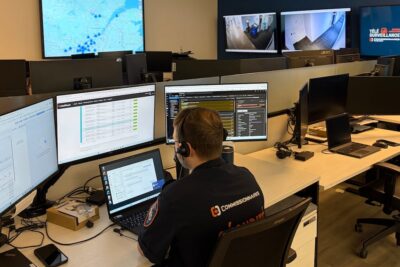
Traditional correctional video infrastructure was designed for a different era. Cameras recorded; operators watched banks of screens in shifts; footage was reviewed after incidents—if it was reviewed at all. Manual inmate counts consumed hours of staff time daily. Alert systems, where they existed, relied on basic motion detection that triggered so many false positives that officers learned to ignore them. The cameras saw everything; the institution understood almost nothing in real time.
That gap between data capture and data comprehension is where artificial intelligence enters the picture—not as a futuristic concept, but as a set of increasingly specific tools being procured, piloted, and debated across U.S. and international correctional systems right now. This article examines the current state of AI-enhanced prison cameras: what the technology actually does, which vendors and products are shaping the market, where deployments have occurred, what evidence supports the claims, and—critically—what governance structures are lagging behind the procurement cycle.
What AI Prison Cameras Actually Do: Five Functional Layers
The phrase “AI surveillance camera” covers a wide range of capabilities. In correctional contexts, the technology typically operates across five functional layers, each representing a different level of analytical sophistication:
1. Automated Inmate Count
Perhaps the most operationally impactful and least controversial application. AI-driven headcount verification uses existing camera feeds to perform continuous, automated inmate counts—replacing manual processes that traditionally consumed significant staff hours per facility per day. When a count discrepancy is detected, the system triggers an immediate alert and can initiate an AI-assisted search across all available camera feeds to locate the unaccounted individual. LeoTech’s Verus Vision AI platform, deployed across Georgia, Idaho, and Oklahoma Departments of Corrections, positions automated count as its headline capability, claiming to “return millions of labor hours to mission-critical functions.”
2. Abnormal Behavior Detection
Real-time detection of predefined behavioral categories: crowd formation, falling, fighting, and isolation. When the system identifies a qualifying event, it generates an alert with event classification, location, and key metrics such as the number of involved persons. This represents a fundamental shift from reactive (review footage after an incident is reported) to proactive (detect the incident as it develops). The European HORUS 360 iOMS platform, developed by IPS Innovative Prison Systems, extends this further by integrating video analytics directly into an Offender Management System workflow, automatically generating structured “incident drafts” with event classification, short textual description, location data, and a reference clip linked to the source footage.

3. Behavioral Pattern Analysis
Beyond individual event detection, more sophisticated platforms analyze movement patterns and social interactions over time to identify emerging behavioral risks before incidents occur. This includes tracking isolation patterns that may indicate suicide risk, mapping interaction networks that suggest gang affiliation or intimidation, and identifying progressive escalation sequences. Constellation X’s NUCLEUS platform positions itself as a “digital twin” of the correctional facility, deploying specialized AI agents for violence prediction, contraband detection, and staff safety monitoring across camera, sensor, and inmate management system data.
4. Retrospective Investigation
When incidents do occur, AI-powered video search dramatically compresses investigation timelines. Rather than manually reviewing hours of footage, investigators can use keyword-based or attribute-based queries to extract relevant segments. The Cook County Sheriff’s Office specifically cited this capability in justifying the BriefCam contract: “If a person is found unresponsive due to overdose, jail staff could prompt BriefCam to identify all video footage of the victim for the past 12 or 24 hours” to rapidly identify potential narcotics suppliers.
5. In-Cell Liveness Monitoring
The newest frontier. 4Sight Labs’ OptiGuard, live in active detention environments since early 2026, transforms existing in-cell cameras into an automated liveness monitoring layer. The system detects breathing patterns and subtle physiological movement to provide continuous automated liveness detection between physical officer rounds. Critically, OptiGuard processes video locally through a dedicated on-premise appliance—no cloud video storage, no modifications to existing camera hardware. Heriot-Watt University’s VisionRF project takes a different approach entirely: using ultra-low power radar rather than cameras to detect breathing and heart rate without visual surveillance, specifically designed to address the privacy and dignity concerns inherent in continuous in-cell monitoring.
The Edge AI Revolution: Generative AI Arrives at the Camera
A significant technological shift announced at ISC West 2026 deserves particular attention. i-PRO introduced the first cameras with generative AI running fully at the edge, based on Ambarella’s CV72 AI vision SoC. These X-series fisheye cameras enable operators to describe what they want to detect in plain language—”person lying down,” “unauthorized gathering,” “delivery at restricted entrance”—and the camera continuously monitors for those conditions, triggering alerts when detected.
The implications for correctional environments are substantial. Traditional AI video analytics require predefined detection categories programmed by engineers. Edge-based generative AI allows facility-specific detection rules to be created and modified by non-technical operators using natural language. Detection logic and feature extraction run entirely on the camera, delivering low-latency response without cloud dependency—a critical requirement in secure correctional environments where data sovereignty and network isolation are non-negotiable.
This also addresses a persistent procurement challenge: facility environments are inherently unique, and rigid detection models tuned for one environment often generate unacceptable false-positive rates in another. On-site AI learning, where the system adapts to installation-specific conditions, reduces false alarms and missed detections through training tailored to the particular facility. For correctional administrators evaluating AI camera investments, the question is shifting from “what can this system detect?” to “how quickly can this system learn our environment?”
Real Deployments: Where AI Cameras Are Already Operating
Several notable deployments and procurement actions in 2025–2026 illustrate the current adoption landscape:
| Facility / Agency | Vendor / Platform | Status | Key Capabilities |
|---|---|---|---|
| Georgia DOC | LeoTech Verus AI | Deployed (first customer) | Communications analysis, investigative AI, automated counts |
| Idaho DOC | LeoTech Verus AI | Deployed | Pattern detection, inmate-community connection mapping |
| Oklahoma DOC | LeoTech Verus AI | Deployed | Semantic AI for investigators, proactive decision-making |
| Cook County Jail (IL) | BriefCam | Under review ($1.12M contract) | Object identification, keyword search, retrospective investigation |
| Multiple US facilities | 4Sight Labs OptiGuard | Live since early 2026 | In-cell liveness detection, breathing pattern monitoring |
| Georgia state prisons | VIA Science GHOST | Deployed (10,000th phone terminated Feb 2026) | AI-powered contraband cell phone identification and termination |
| EU jurisdictions | IPS HORUS 360 iOMS | Deployed / piloting | Integrated video analytics + OMS workflow, incident drafting |
VIA Science’s February 2026 milestone announcement deserves particular note: the 10,000th contraband cell phone terminated using GHOST technology in Georgia prisons represents one of the few AI correctional deployments with a publicly quantified outcome metric. Georgia’s approach—using AI to identify and terminate unauthorized devices at scale rather than relying solely on manual searches—demonstrates the practical shift from interdiction-focused to intelligence-driven contraband management.
The Governance Gap: Technology Outpacing Policy
The Urban Institute’s 2026 brief on Responsible AI Adaptation in Corrections frames the central tension clearly: “AI is advancing faster in corrections than the policies and safeguards needed to govern it.” That observation is not abstract; it maps directly onto specific procurement decisions and operational deployments happening now.

Consider the fault lines visible in the Cook County BriefCam debate:
- Facial recognition capability exists but is claimed to be disabled. BriefCam includes facial recognition as a built-in feature. The sheriff’s office states it won’t connect the technology to any biometric database. But the capability is present in the software, and policy commitments by one administration do not bind successors.
- Bias risk is acknowledged but not independently audited. Research consistently shows that facial recognition tools misidentify Black faces at higher rates than other races. In correctional environments with disproportionate racial demographics, this creates systemic risk. The response—”BriefCam cannot be prompted to identify skin tone or color”—addresses one narrow concern while leaving the broader accuracy-by-demographic question unanswered.
- Data retention policies lack teeth. The sheriff’s office states video footage will be stored for 30 days unless connected to investigations. But who audits compliance? What prevents scope creep? These questions remain open.
- Human review requirements are stated but not structured. “All BriefCam alerts would require human review before they are acted upon” is a procedural commitment, not a governance mechanism. Without documented review protocols, escalation criteria, false-positive tracking, and periodic audits, the commitment is unenforceable.
The Council of Europe’s 2024 recommendation on AI in corrections provides a more structured framework, specifying that AI use in custody should be “strictly necessary, proportionate to the purpose,” should “avoid any negative effects on the privacy and well-being of offenders and staff,” and should “under no circumstances cause intentional physical or mental harm or suffering.” The recommendation explicitly addresses electronic monitoring and biometric recognition, requiring proportionality, human control, and orientation toward reintegration.
The Privacy-Safety Paradox: In-Cell Monitoring as a Case Study
Nowhere is the tension between safety imperative and privacy concern more acute than in in-cell monitoring. The statistics are sobering: in England and Wales, there were 401 deaths in prison custody in the year to June 2025, a 30% increase from the previous 12 months. Of these, 86 were self-inflicted. Self-harm incidents reached 13,824 individuals in the 12 months to March 2025.
These numbers create legitimate pressure for continuous monitoring solutions. But the solutions themselves raise profound questions about dignity, privacy, and the psychological impact of constant surveillance on an already vulnerable population.
The divergent approaches of OptiGuard (camera-based breathing detection) and VisionRF (radar-based, camera-free physiological monitoring) illustrate how technology design choices embed ethical trade-offs. Radar-based systems explicitly eliminate visual surveillance while still detecting vital signs, potentially offering a path that preserves safety monitoring without the psychological burden of being watched. Camera-based systems offer richer data but at a higher privacy cost.
For procurement teams evaluating these technologies, the question extends beyond capability to philosophy: what is the minimum data footprint required to achieve the safety objective? The Urban Institute’s recommendation to “pilot narrowly scoped, high-benefit tools” applies directly here. A system that monitors breathing without recording video images represents a fundamentally different privacy profile than one that performs continuous video analysis, even if both systems detect the same medical emergencies.
Market Context: A .4 Billion Trajectory
The Correctional Intelligence Platforms market reached approximately $2.1 billion in 2024 and is projected to grow at a CAGR of 11.2% through 2033, reaching $5.4 billion. The broader AI in video surveillance market is growing even faster—from $4.04 billion in 2026 to a projected $10.88 billion by 2032 (CAGR 17.9%), according to MarketsandMarkets’ May 2026 report.
Within corrections specifically, the spending trajectory reflects both modernization pressure and the staffing crisis driving technology adoption. Facilities cannot hire enough qualified officers to maintain traditional monitoring ratios. AI does not replace officers—every vendor carefully positions their technology as augmenting rather than replacing human judgment—but it does change the staffing calculus by automating routine surveillance tasks and concentrating human attention on flagged events.
The commercial structure is also evolving. Platforms like Constellation X’s NUCLEUS and LeoTech’s Verus ION position themselves not as camera systems but as unified intelligence layers that integrate across cameras, communications monitoring, inmate management systems, access control, medical records, and sensor networks. This integration ambition raises the stakes of procurement decisions: agencies are not buying cameras; they are buying operational architectures that will shape data flows, alert logic, and institutional decision-making for years.
What Correctional Leaders Should Demand: Seven Procurement Principles
- Separate capability from activation. If a platform includes facial recognition, biometric matching, or predictive scoring, the contract should specify which capabilities are activated, under what conditions they can be enabled, and what approval process governs activation changes. “We don’t plan to use it” is not a governance mechanism.
- Require accuracy reporting by demographic. Detection accuracy, false-positive rates, and false-negative rates should be reported broken down by race, gender, and age cohort. Vendors that resist this transparency are selling technology they cannot defend.
- Mandate data minimization. Systems should collect and retain the minimum data necessary for the stated operational purpose. Breathing detection does not require video recording. Count verification does not require identity tracking. Specify what data is processed, what is stored, and what is deleted.
- Build audit mechanisms into contracts. Independent audits of system accuracy, alert handling, and data governance should be contractual requirements, not aspirational goals. Audit findings should be documented and accessible.
- Invest in training as a line item. The Urban Institute brief emphasizes that AI deployment without training creates new risks. Officers who don’t understand alert logic will either over-rely on or systematically ignore AI-generated alerts—both outcomes undermine the investment.
- Require incident-response documentation. Every AI-generated alert that leads to a staff action should be documented: what the system flagged, how staff responded, what the outcome was. This creates the feedback loop necessary for system improvement and accountability.
- Pilot before scaling. The Urban Institute recommends “piloting narrowly scoped, high-benefit tools.” Start with automated count or medical emergency detection—high-benefit, low-controversy applications—before expanding to behavioral prediction or pattern analysis.
Implications for the Broader Electronic Monitoring Ecosystem
In-prison AI camera intelligence does not exist in isolation. It operates within a continuum of correctional technology that extends from facility-based surveillance through GPS ankle monitoring and community supervision. The analytical capabilities being developed for prison cameras—behavioral pattern detection, risk scoring, predictive analytics—are conceptually adjacent to the alert triage and violation detection challenges faced by community supervision programs using GPS monitoring.
For agencies operating both in-prison and community monitoring programs, the integration question is becoming unavoidable: how do in-facility behavioral assessments inform supervision intensity upon release? How do GPS monitoring compliance patterns correlate with in-facility behavioral profiles? Platforms like HORUS 360 iOMS, which explicitly manage the “entire life cycle of penal sentences” from intake through release, are already designed to bridge this gap.
This convergence has implications for GPS monitoring vendors and procurement teams alike. The intelligence layer that makes in-prison cameras useful—alert triage, behavioral scoring, pattern detection, evidence-grade documentation—is the same intelligence layer that separates effective community GPS monitoring from noisy, officer-overwhelming location pings. The technology is converging; the question is whether governance frameworks will converge to match.
Conclusion: Intelligence Requires Responsibility
AI-powered prison cameras represent a genuine capability advance. Automated inmate counts save measurable staff hours. Real-time behavioral detection can identify medical emergencies, self-harm attempts, and violent incidents faster than human monitoring alone. Retrospective investigation tools compress weeks of footage review into minutes of targeted search. Edge-based generative AI promises facility-specific detection rules created in natural language rather than rigid engineering categories.
But capability without governance is not intelligence—it is surveillance. The gap between what these systems can do and what policies, training, and oversight structures ensure they should do remains the defining challenge. Vendors that position AI cameras as autonomous safety solutions are overselling. Advocates who oppose all AI monitoring are ignoring the scale problem that made manual surveillance inadequate decades ago. The productive path runs between these positions: demanding that technology serve specific, documented safety objectives within transparent, auditable, and independently reviewed frameworks.
The 1.8 million hours of monthly footage at Cook County Jail are not going to watch themselves. The question is not whether AI will analyze correctional video—it already does. The question is whether the institutions deploying these tools will match their technological ambition with governance maturity. Based on the evidence from 2025–2026, the answer is: not yet, but the frameworks exist for those willing to adopt them.