When the UK Ministry of Justice quietly launched a pilot requiring GPS ankle tags on prison leavers convicted of acquisitive crimes back in April 2021, few observers expected it would become one of the most significant electronic monitoring experiments in Western criminal justice. Five years later, the results are in — and they carry lessons that every corrections agency, EM vendor, and policy maker should study carefully.
The MoJ published its formal process evaluation of the Acquisitive Crime (AC) Project in January 2025, covering what the ministry calls the “12 month+ cohort” — offenders serving standard determinate sentences of at least 12 months for burglary, theft, robbery, and related offences. This analysis distills the 89-page evaluation into its essential findings, operational realities, and implications for the global EM industry.
Table of Contents
- What Is the Acquisitive Crime Project?
- How Big Is the Programme? 1,528 Enrolments in 15 Months
- Where the Tags Are: Geographic Concentration Tells a Story
- How Long Are Offenders Tagged? Average 190 Days
- Who Gets Tagged? A Profile That Challenges Assumptions
- The Crime Mapping Engine: Where GPS Data Meets Police Intelligence
- What Practitioners Actually Think: Candid Feedback from the Front Lines
- The Impact: 7 Percentage Points Less Reoffending
- What This Means for the Global EM Industry
What Is the Acquisitive Crime Project?
The AC Project is a compulsory GPS tagging programme — not discretionary, not court-ordered, but mandated as a licence condition for every eligible prison leaver. That distinction matters enormously. Unlike most EM programmes worldwide, where judges or probation officers decide who gets tagged, the UK system removes human discretion from the equation for qualifying offenders.
Eligibility requires meeting all of the following criteria simultaneously: the offender must have been convicted as an adult; the principal offence must be an acquisitive crime specified in the Theft Act 1968 (theft, vehicle theft, robbery, burglary, or aggravated burglary); the qualifying offence must be the longest or equal longest sentence; the sentence must be a standard determinate sentence of at least 90 days; and the offender must have at least 30 days remaining on licence. The offender must also be released to reside within one of the 19 participating police force areas — ranging from the West Midlands to the Metropolitan Police to North Wales.
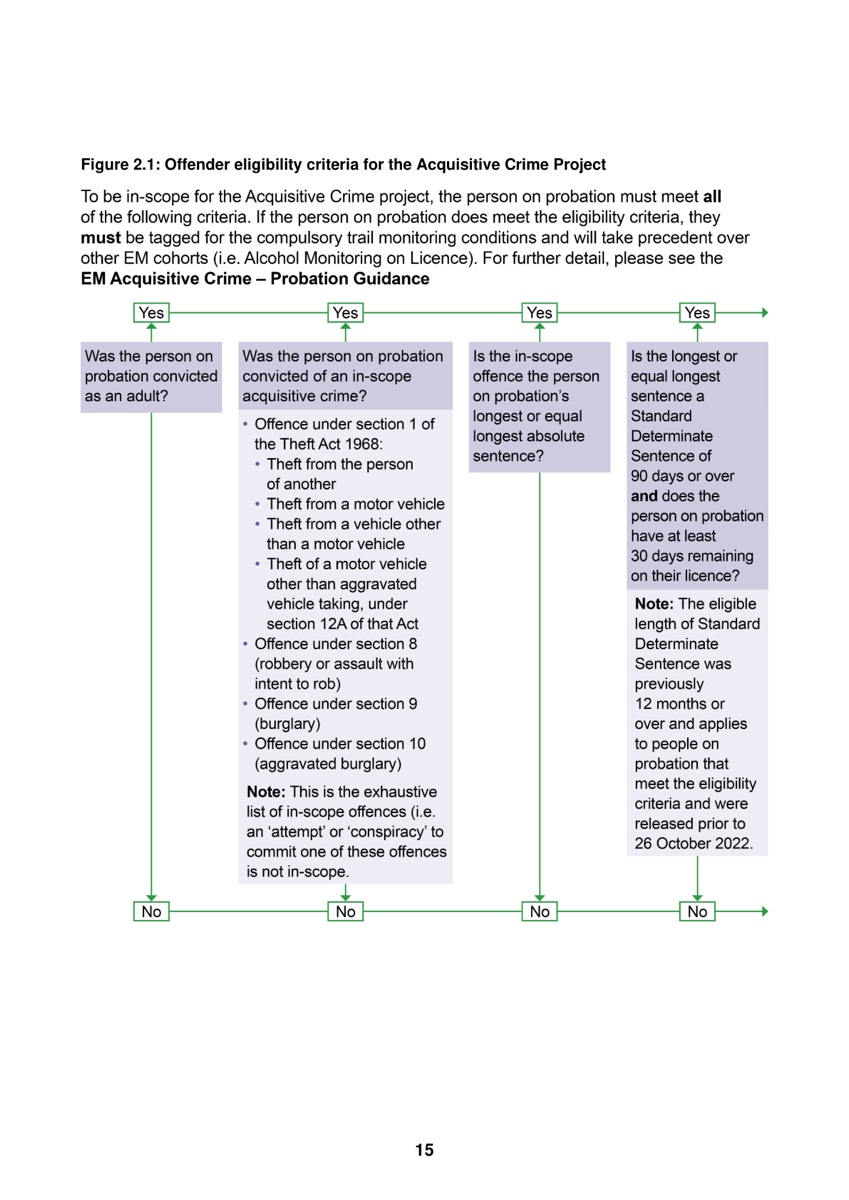
Limited exemptions exist: offenders without electricity at their address, those with physical impairments preventing ankle tag wear, and those mentally unable to comply. But probation staff must exercise professional judgment — and the default is enrolment, not exemption.
How Big Is the Programme? 1,528 Enrolments in 15 Months
Between April 2021 and June 2022, the project generated an estimated 1,528 valid AC order starts. Of these, 1,389 (about 91%) resulted in a successful tag installation. The 9% gap between orders and installations reflects real-world friction: offenders not making themselves available on the appointed date, or early recalls to prison before tagging could occur.
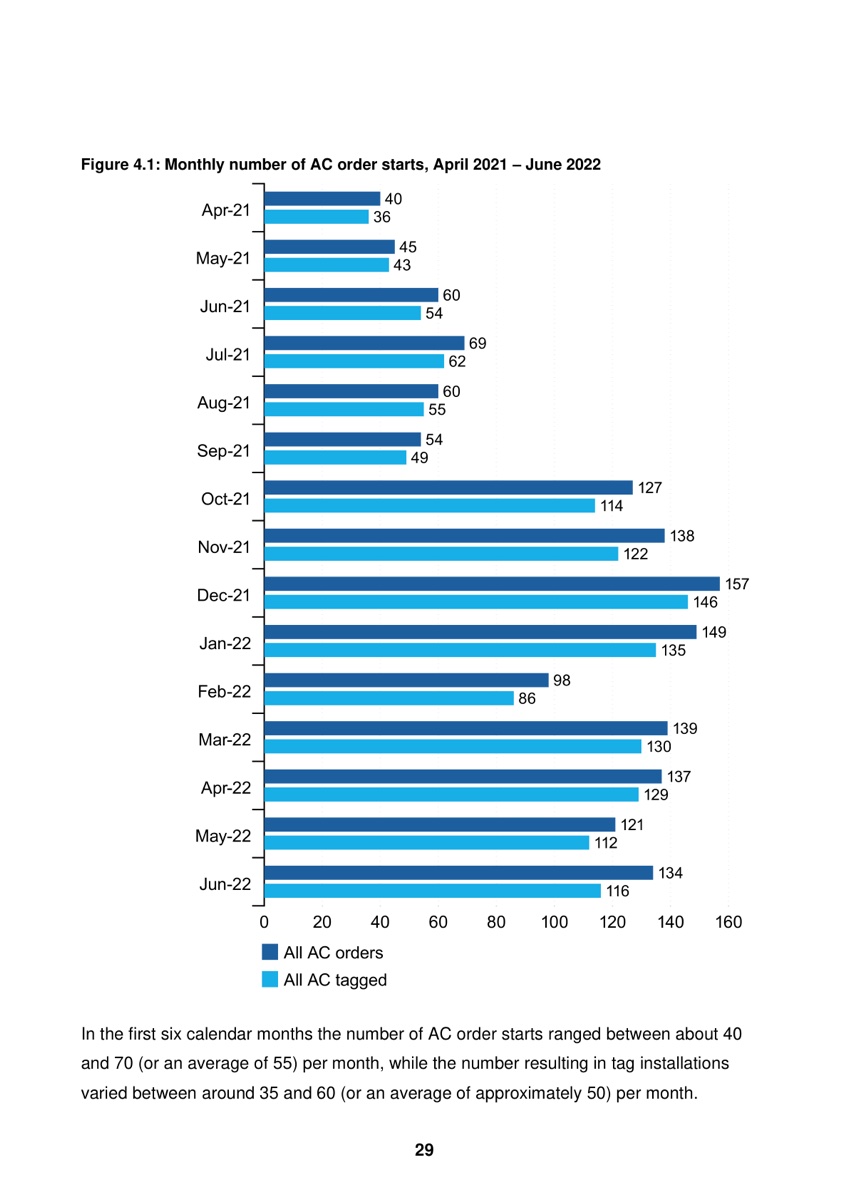
The volume trajectory tells a clear story. During the first six months (April–September 2021), when only six police force areas participated, monthly orders averaged about 55. Once the programme expanded to 19 areas in late September 2021, monthly volumes surged to 120–157. The December 2021 peak of 157 orders likely reflects both the expanded geographic scope and the seasonal spike in acquisitive offending.
Where the Tags Are: Geographic Concentration Tells a Story
The West Midlands probation region dominated, contributing 442 order starts (29% of all orders) and 398 tag installations. This is not surprising — the West Midlands encompasses Birmingham and Wolverhampton, areas with among the highest property crime rates in England and Wales. The South West followed at 170 orders (11%), then London at 151 (10%). The North East contributed only 37 orders, reflecting both its smaller population and potentially lower acquisitive crime volumes.
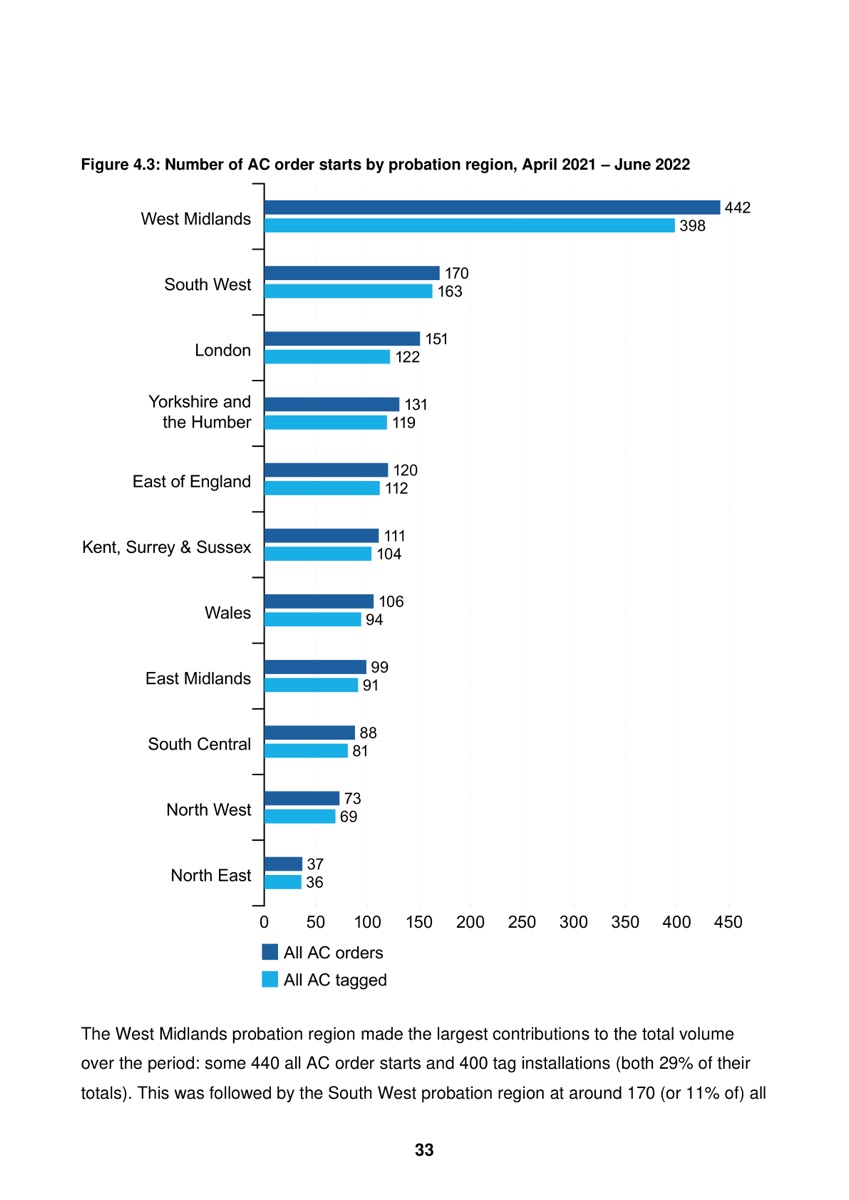
This geographic concentration has practical implications for any agency evaluating GPS tagging at scale. High-volume regions generate operational efficiencies — probation staff become experienced with the technology, processes become routine, and infrastructure (fitting rooms, equipment stocks, EM service provider staff) reaches critical mass. Low-volume regions struggle with all of these.
How Long Are Offenders Tagged? Average 190 Days
The average monitoring duration was 190 days from prison release to the end of location monitoring, with a median of 174 days. The single most common duration was exactly 12 months (22% of all cases), which is the legal maximum. The second most common group was the 0–50 day bracket at 21%, representing cases where monitoring was terminated early — typically through recall to prison.
The MoJ report flagged a small but concerning finding: about 1% of cases exceeded the legal maximum of 12 months by between one and 66 days (average 15 days). Separately, nearly 1% of AC enrolment periods exceeded the sentence expiry date by between four and 151 days (average 57 days). HMPPS attributed these to administrative errors — miscalculations of duration on the release licence or using the tag installation date rather than the release date as the AC enrolment start date. These errors, while affecting a small proportion, raise important questions about process safeguards in compulsory monitoring programmes.
Who Gets Tagged? A Profile That Challenges Assumptions
The demographic breakdown of the AC cohort reveals patterns that should interest both policy makers and EM programme designers.
Risk profile: AC order starts had a markedly different risk distribution compared to all prison leavers. Using the Offender Group Reconviction Scale (OGRS) — a statistical predictor of reoffending within 24 months — the AC cohort was significantly concentrated in the 41–60 OGRS band (three percentage points higher than all prison leavers, p<0.01). They were less likely to be in the very low (1–20) or very high (80–100) risk bands. This suggests the programme captures a specific middle-to-high risk group rather than the extremes.
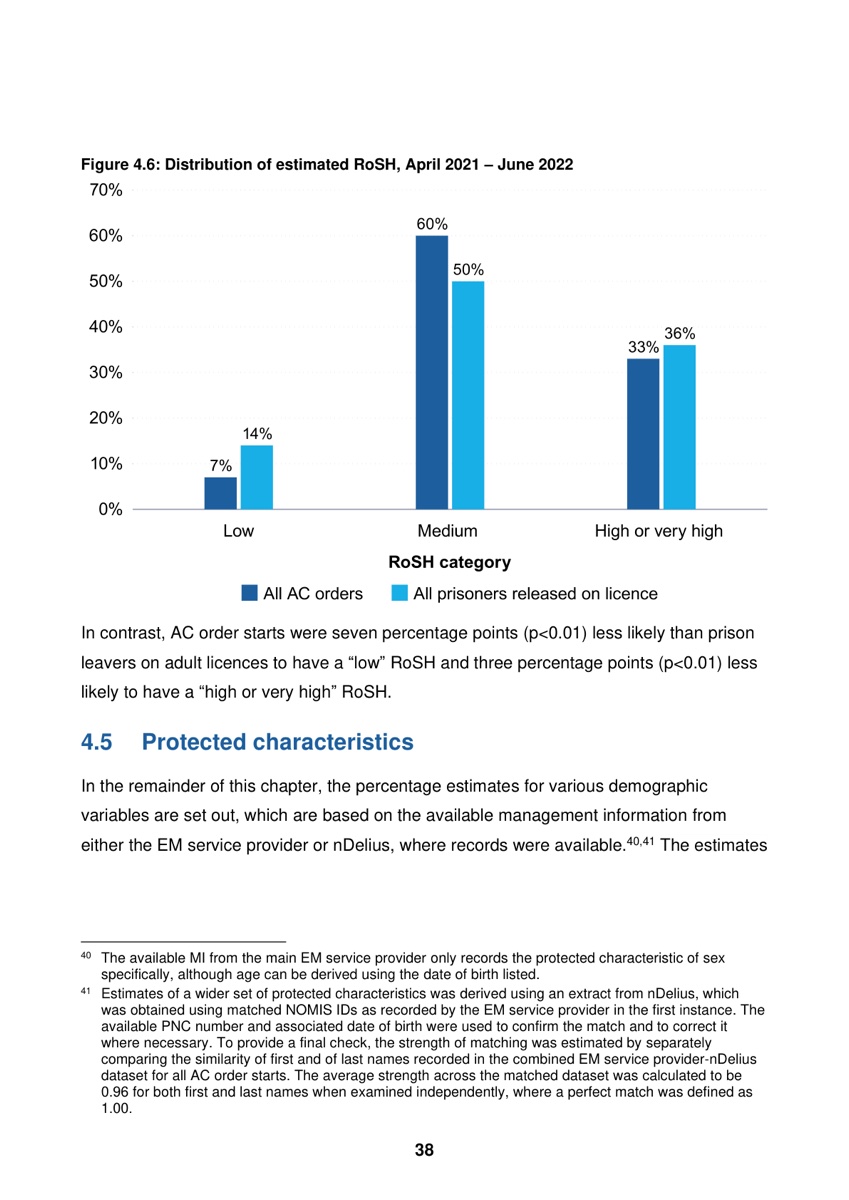
For Risk of Serious Harm (RoSH), 60% of the AC cohort was classified as “medium” risk — ten percentage points higher than the 50% among all prison leavers (p<0.01). They were less likely to be “low” risk (7% vs 14%) and, interestingly, also less likely to be “high or very high” (33% vs 36%). The takeaway: GPS tagging for acquisitive crime targets a specific risk niche — individuals who are too high-risk to leave unmonitored but not the most dangerous offenders in the system.
Demographics: The AC cohort was 95% male (compared to 92% for all prison leavers). The age distribution skewed toward the 35–44 bracket — seven percentage points higher than the general prison leaver population (p<0.01). Ethnic distribution was broadly comparable: 80% White, 8% Black, 7% Mixed, 4% Asian. Nearly half (47%) had a recorded disability at release, a striking figure that underscores the complex needs profile of this population.
The Crime Mapping Engine: Where GPS Data Meets Police Intelligence
The most operationally innovative element of the AC Project is the crime mapping function — a systematic process for matching the GPS location trails of tagged offenders against the locations and times of reported crimes. This goes beyond traditional EM’s focus on curfew compliance and exclusion zones.
The process works through a dedicated MoJ Hub. Police forces submit details of unsolved acquisitive crimes. The Hub’s mapping tool — provided by Airbus Defence and Space (the MoJ’s EM technology partner) — searches for “matched crimes”: instances where a tagged individual was within two consecutive GPS pings and a 100-metre crime radius, both within 10 minutes either side of the reported crime time horizon. “Unmatched crimes” are those crime searches that did not meet these matching criteria.
When a match occurs, a MoJ Hub Caseworker creates a proximity alert report, which is quality-assured by a Hub Manager before being sent to the submitting police force. The police can then request up to 12 hours of additional contextual location data to support their investigation.
The evaluation identified several operational challenges with the crime mapping process. Police forces reported inconsistent engagement — some submitted crimes regularly and valued the intelligence, while others barely used the service. Probation practitioners, meanwhile, had mixed views. Some valued the Self-Service Portal (also provided by Airbus) for checking offender locations, but others found it underused, and the learning curve was steep for practitioners who were already carrying heavy caseloads.
According to the August 2025 UK government press release accompanying the impact evaluation, the crime mapping function served as a powerful deterrent: of the 3,360 offenders in the broader evaluation cohort, just 160 were convicted due to their movements being mapped to unsolved crimes. The evidence also suggested that the GPS tagging helped police avoid approximately 16,000 unnecessary adult arrests over three years — by enabling early elimination of suspects whose location data proved they were not at the crime scene.
What Practitioners Actually Think: Candid Feedback from the Front Lines
The qualitative findings from the process evaluation are perhaps its most valuable component, because they reveal the gap between policy design and operational reality.
Probation practitioners reported that the AC tag frequently became a useful lever in their supervision toolkit — but not always in the ways MoJ intended. Some used the threat of location data review to encourage compliance. Others found that the tag created difficult conversations: explaining to an offender with a legitimate job and stable housing why they were being GPS-tracked for 12 months sometimes felt disproportionate.
The evaluation noted tensions between the compulsory nature of the programme and the professional judgment that probation staff are accustomed to exercising. Several practitioners expressed frustration that they could not opt out low-risk individuals who clearly did not need 12 months of GPS monitoring.
Police engagement was uneven. Some police forces integrated the crime mapping intelligence into their standard investigation workflows. Others treated it as peripheral — submitting crimes sporadically and not always acting on proximity alerts. The evaluation authors noted that police buy-in was strongest where dedicated points of contact existed and where forces had seen tangible investigative results.
The EM service provider (G4S, contracted to supply the GPS tags) did not participate in the evaluation research, which is a notable gap. The evaluation relied entirely on MoJ and HMPPS management information for device-level data.
The Impact: 7 Percentage Points Less Reoffending
While the process evaluation (the subject of this analysis) focuses on implementation rather than outcomes, the accompanying impact evaluation published in August 2025 provides the headline result: male prison leavers enrolled in the AC Project were associated with a seven percentage point decline in the rate of reoffending within 12 months of release — from 33.2% to 26.2%. That is a roughly 21% relative reduction.
The UK government characterized this as a 20% reduction in reoffending, and Lord Timpson, the Minister for Prisons, Probation and Reducing Reoffending, stated: “The evidence is clear that tagging works, acting as a constant reminder to thieves and burglars that we are watching their every move and will know if they reoffend.”
The scale of GPS tagging in England and Wales has grown dramatically since the AC Project launched. According to the latest MoJ Electronic Monitoring Statistics (March 2026), 28,687 individuals were assigned an electronic monitoring device as of 31 March 2026, with GPS location monitoring devices accounting for 57% of the caseload (16,264 individuals). The government has committed to scaling up tagging further as part of sentencing reforms, with the annual probation budget increased by up to £700 million by 2028.
What This Means for the Global EM Industry
The UK AC Project provides several transferable lessons for EM programmes worldwide:
1. Compulsory GPS tagging for specific offence categories works as a deterrent. The seven percentage point reduction in reoffending is a meaningful effect size, comparable to or better than many other criminal justice interventions. The fact that only 160 out of 3,360 offenders were convicted through crime mapping suggests the deterrence effect operates primarily through behavioural change — offenders know they are being watched and modify their behaviour accordingly.
2. Crime mapping adds investigative value beyond traditional monitoring. The systematic matching of GPS trails against crime locations is a capability that most US and European EM programmes have not yet fully operationalised. The concept of eliminating 16,000 unnecessary arrests over three years represents enormous cost savings and, critically, reduces the burden on innocent individuals who might otherwise be subjected to police inquiry.
3. Technology reliability and battery life are critical operational factors. While the process evaluation does not detail specific device failure rates, the operational infrastructure — tag fitting, monitoring, data transmission, and crime mapping analysis — all depend on consistent GPS data collection. Any interruption in location data transmission degrades the entire system’s value. Devices offering extended battery life and multi-mode connectivity would significantly reduce the operational burden on both probation staff and the offenders themselves.
4. Staff buy-in determines programme success more than technology. The uneven police engagement and practitioner frustrations highlighted in the evaluation underscore that GPS tagging is not a technology-only solution. Training, dedicated points of contact, clear operational workflows, and the integration of EM data into existing case management systems are all essential.
5. Compulsory programmes raise proportionality questions. The evaluation documents practitioners who felt that 12 months of GPS monitoring was excessive for some offenders — particularly those with stable employment and housing. Any jurisdiction considering compulsory GPS tagging should build in formal review mechanisms to ensure monitoring duration remains proportionate to risk.