Four years after Quebec became the first Canadian province to deploy GPS ankle monitors specifically for domestic violence prevention, the numbers look impressive. The province’s anti-approach bracelet (bracelet antirapprochement, or BAR) program has achieved a 96% deterrence rate, meaning nearly all proximity alerts are resolved by monitoring center intervention alone, without requiring police dispatch. Since May 2022, 1,762 bracelets have been imposed, with 561 currently in active circulation. Only 148 incarcerations have resulted from non-compliance — a remarkably low number that suggests the technology itself acts as a powerful deterrent.
But a closer look at the actual hardware strapped to offenders’ ankles reveals something the compliance statistics don’t capture: Quebec is running an ambitious victim protection program on devices designed a decade ago, carrying features nobody uses and weight that undermines the very compliance the program depends on.
Table of Contents
- How Does Quebec’s Anti-Approach Bracelet System Work?
- What Device Is Quebec Actually Using — and Why Does It Matter?
- What Does 275 Grams on an Ankle Actually Mean for Compliance?
- How Are Other DV Monitoring Programs Approaching Hardware Design?
- Where Is EM Hardware Design Actually Heading?
- Is Quebec’s 96% Compliance Rate as Good as It Looks?
- What Should Quebec Consider for Its Next Hardware Cycle?
How Does Quebec’s Anti-Approach Bracelet System Work?
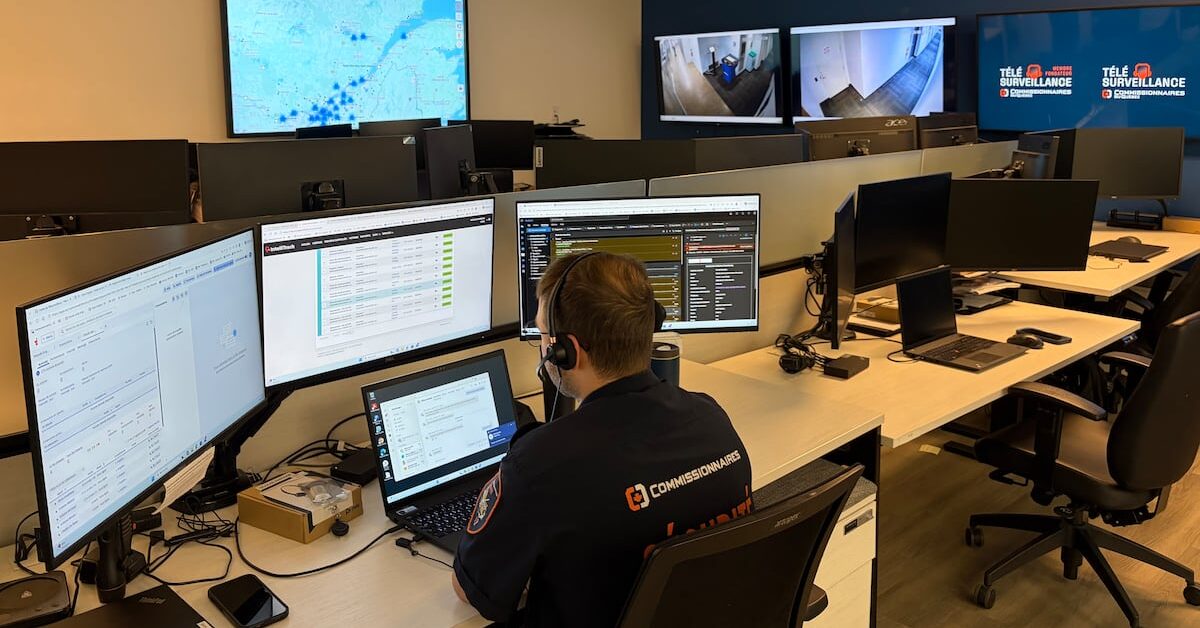
Quebec’s BAR system pairs two GPS-enabled components: an ankle-worn bracelet locked to the offender and a smartphone application carried by the victim. If the offender enters a court-ordered exclusion zone — typically within a set perimeter of the victim’s home, workplace, or current location — an alert fires to one of two monitoring centers operated by Commissionaires du Québec in partnership with Track Group, the U.S.-based EM technology vendor.
A monitoring center operator sees both the offender and victim as dots on a screen. The operator’s first response is verbal: through an on-board speaker built into the ankle device, they tell the offender to turn around. If the offender ignores the warning or continues approaching, the operator escalates to police dispatch. According to Gustav Nadeau Söderström, Commissionaires du Québec’s director of projects and innovations, the system is designed so that “victims have confidentiality and can go about their daily lives without feeling tracked. The monitoring center does not know a victim’s location unless there is a danger or proximity situation happening.”
The 96% deterrence rate means that out of 9,941 proximity approach alarms recorded between April 2023 and March 2026, only 396 required police intervention — the remaining 9,545 were resolved by the monitoring center’s verbal warning alone.
What Device Is Quebec Actually Using — and Why Does It Matter?
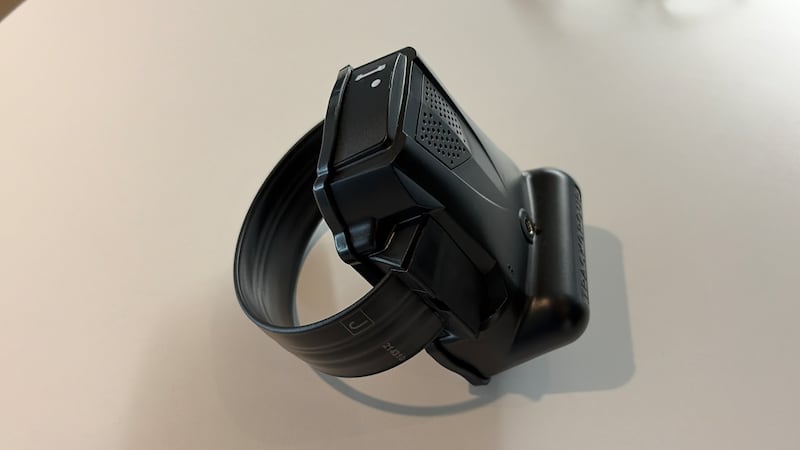
Quebec’s program runs on the Track Group ReliAlert XC4, supplied through SafeTracks Judicial, Track Group’s Canadian partner. The ReliAlert is a one-piece GPS ankle monitor with a distinctive feature: integrated two-way and three-way live voice communication, plus a 95-decibel siren. These were Track Group’s headline selling points when the device launched — the only one-piece GPS device in the industry with on-board voice, marketed as enabling “real-time violation intervention.”
The device weighs approximately 275 grams (9.1 ounces), measures 3.5 inches across, and delivers roughly 55-72 hours of battery life at one-minute tracking intervals. It requires daily charging. The optional SecureCuff — a hardened steel band for high-risk offenders — adds further weight.
Here is the problem: Quebec’s monitoring centers primarily use the system for proximity alerting and one-way audio warnings, not two-way phone conversations with offenders. The elaborate voice communication hardware — microphone, speaker, cellular voice codec, antenna space dedicated to simultaneous voice and data — adds significant weight and bulk to a device whose primary job is geolocation and proximity detection. The 95-decibel siren, while theoretically useful, is a single-purpose component that occupies internal volume that could otherwise house a larger battery.
When a program achieves 96% compliance through monitoring center intervention that consists of telling offenders to turn around — a function that could be accomplished with a simple buzzer or vibration alert — the question becomes: is all this voice hardware actually earning its space on the offender’s ankle?
What Does 275 Grams on an Ankle Actually Mean for Compliance?
Weight in ankle-worn devices is not a vanity metric. It directly affects compliance rates, skin health, and the willingness of courts to impose monitoring as a condition of release.
At 275 grams, the ReliAlert XC4 sits at the heavy end of the one-piece GPS ankle monitor spectrum. For context, the 2016 NIJ-funded Market Survey (NCJ 249889) by JHU/APL documented device weights ranging from 170g to over 350g across vendors, with the trend clearly moving toward lighter form factors. The newest generation of one-piece GPS ankle monitors has pushed weights below 110 grams — less than half of what Quebec’s offenders currently carry.
Heavier devices create specific operational problems in DV monitoring programs:
- Skin irritation and pressure injuries — prolonged wear of heavy devices causes contact dermatitis, pressure sores, and chafing, particularly at the malleolus (ankle bone). Offenders with skin issues become medical liabilities and provide legitimate grounds for requesting device removal
- Visibility and stigma — a 275-gram device with a protruding speaker grille is impossible to conceal under clothing. While stigma for the offender is not the primary concern in DV cases, visible monitoring hardware affects employment prospects, which in turn affects compliance with other bail conditions
- Daily charging burden — the ReliAlert’s 55-72 hour battery life means offenders must charge the device every 2-3 days. Each charging session requires sitting still near an outlet for an extended period. Missed charges generate low-battery alerts that monitoring centers must triage — adding workload that has nothing to do with actual proximity violations
How Are Other DV Monitoring Programs Approaching Hardware Design?
Quebec was the first Canadian province to deploy ankle monitors specifically for DV victim protection, but it was not the first jurisdiction globally. Several countries have run similar programs with varying hardware approaches:
Spain has operated the largest DV-specific electronic monitoring program in Europe since 2009, with over 3,000 active devices at peak deployment. The Spanish system, managed by Telefónica, uses bilateral monitoring — both the offender and victim carry GPS devices — with automatic proximity alerts and police dispatch. Spain’s experience over 15+ years has driven repeated hardware refresh cycles, each iteration prioritizing lighter weight and longer battery life as the primary procurement criteria, because those factors directly correlate with fewer false alarms and lower operational burden.
France introduced its bracelet anti-rapprochement (BAR) in 2020 — the direct legislative model that Quebec adapted for its own program. France initially deployed devices from European vendors with similar voice communication features and experienced the same pattern Quebec is now seeing: voice call capability was rarely utilized in practice, while battery life and device weight emerged as the dominant operational concerns.
Alberta, which launched its own ankle bracelet monitoring program in January 2025 at a cost of C$2.8 million annually, has the opportunity to learn from Quebec’s four-year hardware experience and select next-generation devices from the outset.
Where Is EM Hardware Design Actually Heading?
The electronic monitoring industry is undergoing a generational hardware transition driven by three converging forces: cellular network evolution (3G sunset forcing device replacement), battery chemistry improvements, and the integration of BLE (Bluetooth Low Energy) and WiFi as supplementary communication modes alongside traditional cellular.
The practical implications for DV monitoring programs are significant:
Multi-mode connectivity eliminates the voice hardware trade-off. Traditional devices like the ReliAlert dedicate substantial internal volume and weight to voice communication circuitry (speaker, microphone, voice codec, antenna tuning for simultaneous voice + data). Next-generation devices replace this with BLE connectivity to the offender’s smartphone — if voice communication is needed, it routes through the phone, not the ankle device. This frees internal space for a larger battery or allows a smaller, lighter enclosure.
Adaptive power management extends battery life from days to weeks. Devices that can switch between BLE-connected mode (when near a phone or home beacon), WiFi-directed mode (when cellular is unavailable), and full LTE standalone mode (when outdoors and independent) can dramatically reduce power consumption. In BLE-connected mode — which covers the vast majority of a monitored individual’s time at home — power consumption drops by an order of magnitude compared to continuous GPS + LTE operation. The result: battery life measured in weeks or months rather than hours.
Weight reduction changes judicial willingness to impose monitoring. When a device weighs under 110 grams — comparable to a large wristwatch — judges and parole boards face fewer objections from defense counsel about proportionality. This is particularly relevant in DV cases, where the Quebec Bill 24 framework requires that monitoring conditions be proportional to the risk posed. A lighter, less visible device weakens the argument that monitoring constitutes disproportionate restraint on liberty.
Is Quebec’s 96% Compliance Rate as Good as It Looks?
The headline number — 96% of proximity alerts resolved without police intervention — is genuinely impressive for a program that has only been operational for four years. But it requires context.
The denominator matters. Between April 2023 and March 2026, the monitoring centers recorded 9,941 approach alarms. With roughly 400-550 active bracelets during this period, that translates to approximately 3-4 proximity alerts per active bracelet per year. That is a relatively low alert frequency, suggesting that the majority of offenders are genuinely deterred by the presence of the device itself — not by the monitoring center’s verbal intervention capabilities.
The more telling statistic is the 5,450 total police interventions “across all alarm types.” This number includes not just proximity violations but also tamper alerts, low-battery alerts, and signal loss events — the technical false alarms that consume police resources without any actual public safety threat. Quebec’s official statistics do not break down this number by alarm type, which makes it impossible to determine what proportion of police dispatches were triggered by genuine offender behavior versus device limitations (battery depletion, GPS signal loss in underground parking garages, cellular dead zones).
A comparative benchmark: programs running newer-generation devices with fiber-optic tamper detection and multi-day battery life report near-zero false tamper alarms and dramatically fewer low-battery events, which in turn reduces total police dispatch volume by 40-60% compared to legacy hardware.
Melpa Kamateros, executive director of Shield of Athena Family Services and a longtime advocate for the bracelet program, noted that the program represents a fundamental shift in accountability: “It’s the first time that the onus of the responsibility for the violence — instead of being put on the victim to protect yourself — is put directly on the abusive person.” That principle is sound. The question is whether the hardware matches the ambition.
What Should Quebec Consider for Its Next Hardware Cycle?
Quebec’s anti-approach bracelet program is funded at C$41 million over five years. As that initial contract period approaches renewal, the province faces a procurement decision that will shape the program’s next decade. Based on four years of operational data, the hardware specification should prioritize:
- Weight under 120 grams — reducing the compliance barriers created by bulky, visible hardware
- Battery life of 7+ days in standalone mode, weeks in connected mode — eliminating daily charging and the associated false low-battery alerts
- Multi-mode connectivity (BLE + WiFi + LTE) — maintaining continuous monitoring in the underground parking garages, basement apartments, and rural areas where cellular-only devices lose signal
- Fiber-optic tamper detection with zero false alarm rates — reducing police dispatch burden from tamper alerts that turn out to be device movement, not actual tampering
- Removing integrated voice hardware from the ankle device — routing any necessary communication through smartphone apps or dedicated monitoring center phone calls, rather than building a speaker and microphone into every ankle-worn unit
The program’s 96% deterrence rate demonstrates that the concept works. The next step is ensuring the hardware does not become the program’s limiting factor — because in electronic monitoring, every gram of unnecessary weight and every hour of inadequate battery life translates directly into operational friction that undermines the protection the system was built to provide.