On 19 March 2026, SuperCom (NASDAQ: SPCB) announced that Sweden’s Prison and Probation Service selected the company for a new nationwide electronic monitoring contract valued at roughly USD $17 million over a term of up to nine years, with the award following a competitive process that reportedly drew five bidders and more than a year of technology evaluation (SuperCom, 2026). For procurement analysts, the headline is less a single vendor “win” than a structural signal: mature European agencies are consolidating fragmented pilots into national electronic monitoring architectures that bake in GPS caseloads, home detention workflows, and—potentially—facility-scale telemetry.
This article unpacks the Swedish context, SuperCom’s cross-border expansion pattern, and what the award implies for electronic monitoring contract economics, evaluation design, and technology roadmaps elsewhere. It also points readers to related Ankle Monitor Industry Report coverage on North American legislative momentum and Canadian provincial procurement.
Table of Contents
- What happened in Sweden—and why the standstill clause matters
- Sweden as a European electronic monitoring pioneer
- What does an electronic monitoring contract at national scale actually test?
- SuperCom’s footprint: United States momentum plus European national programs
- Visual context: how analysts picture national telemetry pipelines
- Macro context: how large is the supervised population—and why it matters for contract design
- Contract economics: the six-fold growth narrative
- Technology demand trends implied by the award
- Cross-links: North American legislative and procurement context
- Frequently asked questions
- What is the approximate value and duration of Sweden’s new electronic monitoring contract with SuperCom?
- How many companies reportedly competed for the Swedish award?
- Why does Sweden matter as a comparator for other electronic monitoring markets?
- Where can I read independent research on electronic monitoring scale and technology trade-offs?
- Procurement governance: standstill, usage risk, and audit trails
- Indoor facility monitoring: the quietly expensive line item
- Alcohol monitoring expansion: modality spillovers
- Implications for U.S. states watching Nordic procurement
What happened in Sweden—and why the standstill clause matters
According to the company’s disclosure, SuperCom will deploy its PureSecurity Electronic Monitoring Suite across a broad portfolio of Swedish public-safety programs, including GPS tracking of offenders, home detention monitoring, and indoor facility monitoring, with optional expansion paths for large adjacent programs such as alcohol monitoring (SuperCom, 2026). The release emphasizes that the award remains subject to a customary standstill waiting period before signature and launch—language that should remind readers that public-sector electronic monitoring contract headlines are commitments-in-motion, not instantaneous fleet swaps.
The competitive framing is notable: five companies reportedly participated, including the prior long-term incumbent and SuperCom as the then-current EM provider. That configuration—incumbent continuity plus multi-vendor stress-testing—often produces evaluation dossiers that are richer than greenfield RFPs because authorities can compare observed field reliability against bench tests. For peer agencies, the Swedish process is a reminder to request operational evidence (alert adjudication latency, spare-pool turnaround, winter strap failure rates) rather than treating marketing datasheets as dispositive.
Sweden as a European electronic monitoring pioneer
Sweden’s role in European EM is not a marketing flourish. Probation-linked monitoring programs in the country trace to the 1990s, placing Sweden among the early adopters that experimented with radio-frequency and telephone check-in modalities before GPS became commercially viable at scale (SuperCom, 2026). That long operational memory matters when agencies negotiate electronic monitoring contract renewals: vendors inherit legacy geofence libraries, court-order templates, and unionized staffing models that cannot be “lift-and-shifted” overnight.
Comparative criminologists have long treated Scandinavian community sanctions as a distinct institutional bundle—strong welfare infrastructures, high trust in administrative agencies, and comparatively data-rich supervision registers—so Swedish procurement outcomes are read abroad as bellwethers for how national programs balance privacy, proportionality, and enforcement intensity. When a Nordic authority expands EM nationwide, peer ministries in Germany, the Netherlands, and the Baltic states often re-open dormant market studies; the ripple is as much political as commercial.
What does an electronic monitoring contract at national scale actually test?
A national-scale electronic monitoring contract is an integration test for geospatial engines, tamper rules, enrolment workflows, and cybersecurity controls that must survive freedom-of-information scrutiny and judicial review. Agencies score bidders on end-to-end latency, indoor behavior, spare logistics, and alert-chain auditability—not headline GNSS accuracy alone.
In practice, that means evaluators stress multi-year total cost of ownership, not sticker price per bracelet: monitoring-center staffing, cellular backhaul variability across subarctic corridors and dense urban canyons, and the legal defensibility of automated proximity triggers all feed the scoring matrix. Sweden’s reported one-year-plus evaluation window fits that pattern—authorities were not buying catalog SKUs; they were stress-testing an operating model. Independent market surveys catalog how heterogeneous device architectures create different indoor and power-management failure modes, which is why diligence teams read NIJ’s offender-tracking ecosystem documentation alongside vendor proposals (National Institute of Justice, 2016).
SuperCom’s footprint: United States momentum plus European national programs
Beyond Sweden, SuperCom’s public narrative in early 2026 includes a Louisiana statewide award described as the company’s 16th new U.S. state expansion and 17th monitoring-services partner (SuperCom, 2026). Read alongside the Swedish disclosure, the pattern is a dual-track growth story: U.S. state-level electronic monitoring contract wins that move vendor capacity into American pretrial, probation, and parole ecosystems, and European national programs where SuperCom claims 15+ national projects and expansions in recent years (SuperCom, 2026).
For market structure analysts, the important point is consolidation pressure. When the same vendor stack appears in multiple U.S. states and multiple EU member states, interoperability expectations rise—prosecutors, defense counsel, and auditors increasingly ask whether location histories, tamper logs, and software version pinning can be exported neutrally if contracts change mid-decade. That question is now standard in diligence memos for municipal joint powers authorities contemplating shared monitoring centers.
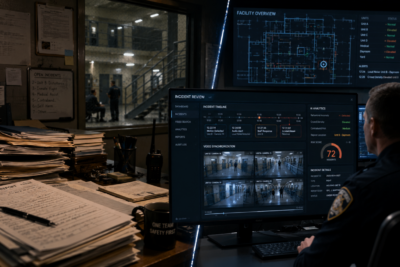
Visual context: how analysts picture national telemetry pipelines

Macro context: how large is the supervised population—and why it matters for contract design
Program scale is the hidden variable behind every electronic monitoring contract. The Vera Institute of Justice estimates on the order of one quarter of a million people on EM in the United States on any given day in recent reporting cycles, with substantial year-to-year movement tied to policy shifts (Vera Institute of Justice, 2024). While Sweden’s population base is smaller, the same arithmetic applies: when caseloads scale, alert volume scales nonlinearly if geofence geometries are coarse or if devices default to aggressive sampling in weak indoor signal environments.
Empirical work on EM’s supervisory mechanics—much of it rooted in U.S. data but cited globally in procurement training—underscores that implementation fidelity drives outcomes as much as hardware specifications. Padgett, Bales, and Blomberg’s early-generation evaluation literature helped establish how tightly coupled officer workflows are to device event streams (Padgett, Bales & Blomberg, 2006), a lesson still embedded in contemporary RFP scoring rubrics. More recent U.S. federal market documentation on location-based offender tracking catalogs how diverse ankle-worn architectures create different failure modes for indoor coverage and power management (National Institute of Justice, 2016, summarizing vendor ecosystem surveys conducted with Johns Hopkins University Applied Physics Laboratory technical support).
Contract economics: the six-fold growth narrative
SuperCom’s release frames the new Swedish award as reflecting roughly six times the expected growth compared with the project launched with the same customer in 2019, against a backdrop where the prior incumbent had served Sweden for roughly 25 years (SuperCom, 2026). Even allowing for forward-looking statement caveats, that magnitude signals that Swedish authorities expect wider cohort eligibility, longer average monitoring spells, or additional modalities (facility telemetry, alcohol add-ons) to enter the same financial envelope.
For finance readers, the release also notes that recognized revenues will depend on actual usage, which can land above or below internal government budgeting assumptions—a standard clause in usage-linked EM contracts where per-diem billing interacts with judicial release volatility. That linkage is why bond insurers and county CFOs increasingly demand scenario tables for “usage 80% / 100% / 120% of forecast” before approving multiyear obligations.
Technology demand trends implied by the award
The disclosed scope—GPS tracking, home detention, and indoor facility monitoring—maps cleanly onto the four stress tests we see in 2026 RFPs worldwide:
- Multi-layer location integrity: Outdoor GNSS performance is table stakes; winners increasingly demonstrate credible indoor continuity strategies, because victims, courts, and oversight bodies care about silent gaps more than centimeter marketing claims (National Institute of Justice, 2016).
- Tamper signal adjudication: Strap-break, case-open, and biometric-adjacent sensors carry different false-positive profiles; agencies now ask vendors to publish adjudication playbooks, not only raw sensor counts. Some newer entrants now offer fiber-optic tamper detection that vendors report as producing negligible false-positive tamper events compared with certain skin-contact sensors—claims that still require independent acceptance testing.
- Power and charging cadence: National programs cannot tolerate chronic low-battery cascades; specifications increasingly tie battery targets to realistic reporting intervals and to winter temperature envelopes.
- Cybersecurity and data residency: European customers frequently embed GDPR-aligned processing rules, breach notification drills, and cryptographic attestation expectations directly into electronic monitoring contract schedules—areas where “checkbox SOC 2” statements rarely suffice for ministry counsel.
Vendor landscape notes remain deliberately plural. Established suppliers referenced in global RFP packets include BI Incorporated, SCRAM Systems, Geosatis, and SuperCom, alongside newer entrants such as REFINE Technology (CO-EYE) pitching lighter one-piece hardware and alternative connectivity strategies. The analytical point is not brand ranking but evaluation depth: Sweden’s multi-year competition is the kind of process that rewards documented field performance across modalities, not single-metric shootouts.
Cross-links: North American legislative and procurement context
Readers comparing Nordic national awards with U.S. state practice may find our 2026 fourteen-state GPS ankle bracelet legislative tracker useful for mapping how statutes phrase victim notification, data retention, and device standards—variables that often pre-condition which electronic monitoring contract architectures are even legal to deploy.
On the Canadian provincial side, our analysis of Alberta’s SCRAM-linked EM expansion illustrates how victim-alerting narratives reshape monitoring-center staffing and geofence governance—issues that parallel Swedish nationwide scaling even where dollar figures differ.
For tamper-evidence debates that surface whenever contracts change vendors, see false tamper alert rates in GPS ankle monitors; for structured vendor scoring, use the GPS ankle monitor vendor evaluation checklist.
Frequently asked questions
What is the approximate value and duration of Sweden’s new electronic monitoring contract with SuperCom?
According to SuperCom’s March 2026 release, the government’s internal budgeting implies roughly USD $17 million over up to nine years, subject to standstill, signature, and actual usage-linked revenue recognition (SuperCom, 2026).
How many companies reportedly competed for the Swedish award?
The company states that five companies participated in the formal bid, including the prior long-term incumbent and SuperCom as the then-current provider (SuperCom, 2026).
Why does Sweden matter as a comparator for other electronic monitoring markets?
Sweden combines decades of operational EM experience dating to the 1990s with a national agency structure that can harmonize standards across probation and prison-linked programs—making its procurement outcomes an early signal for how mature European markets consolidate technology stacks (SuperCom, 2026).
Where can I read independent research on electronic monitoring scale and technology trade-offs?
Start with Vera’s population-scale discussion (Vera Institute of Justice, 2024) and NIJ’s location-tracking market documentation for device-ecosystem trade-offs (National Institute of Justice, 2016).
Procurement governance: standstill, usage risk, and audit trails
Public buyers increasingly separate contract signature risk from operational go-live risk. Sweden’s disclosed standstill mirrors what U.S. state procurement officers sometimes label “protest windows” or “final clearance gates”—intervals where losing bidders, data-protection authorities, or legislative committees can still influence implementation sequencing. For monitoring vendors, standstill periods compress revenue recognition timelines even when press releases read as immediate wins.
Usage-linked revenue language also interacts with offender-flow volatility. Criminal justice populations shift with bail reform episodes, pandemic-era backlog clearance, and immigration enforcement phases; a national electronic monitoring contract therefore behaves partly like a utilities concession—take-or-pay expectations rarely hold without amendment clauses. Finance teams should model cohort churn explicitly rather than extrapolating linearly from pilot caseloads.
Indoor facility monitoring: the quietly expensive line item
When press releases bundle “indoor facility monitoring” with community GPS, experienced integrators hear budget alarms. Custodial environments impose different radio physics, different tamper semantics, and different chain-of-custody rules than community ankle programs. If Swedish authorities push deeply into facility telemetry, spare-pool sizing, technician certifications, and incident ticketing integrations with prison IT stacks become dominant cost drivers—often exceeding marginal per-bracelet hardware costs.
That is why European national tenders increasingly require proof of coexistence with legacy access-control systems and visitor-management databases. Vendors that treat facility modules as mere “extra SKUs” frequently discover during acceptance testing that elevator shafts, Faraday-shielded interview rooms, and steel mezzanines invalidate assumptions borrowed from outdoor GPS playbooks.
Alcohol monitoring expansion: modality spillovers
SuperCom’s release flags potential future expansion into substantial alcohol-monitoring programs (SuperCom, 2026). From a market-structure perspective, alcohol modalities (transdermal, breath, or hybrid compliance models) change vendor economics because consumables, calibration lab relationships, and clinical dispute resolution pathways differ from pure GPS ankle workloads. Agencies that bundle alcohol with location supervision often inherit cross-training burdens for probation officers who must interpret paired sensor timelines in court.
Implications for U.S. states watching Nordic procurement
U.S. readers should resist lazy “copy Sweden” narratives—institutional context differs—but three transferrable lessons stand out: first, long evaluation windows correlate with lower lifecycle surprise costs; second, multi-bidder processes that include incumbents tend to surface more realistic service-level targets; third, explicit indoor and facility scopes prevent vendors from silently parking those costs in change-order queues after award. States updating electronic monitoring contract templates in 2026–2027 should import those procedural lessons even when they cannot import Nordic caseload demographics.
Finally, cross-border vendor concentration raises resilience questions worth tracking in legislative hearings: if a single platform hosts unusually large fractions of both community and custodial telemetry, what redundancy exists when a certificate expires badly, a cloud region degrades, or a cyber incident forces selective rollback? Neutral export formats and escrowed source-code clauses remain underused but are gaining traction among risk officers who lived through 2020s-era ransomware waves in other public sectors.