On May 8, 2026, Germany’s Bundestag passed a law that gives family courts the power to strap electronic ankle bracelets on domestic violence offenders. Three days later and 4,500 kilometers away, an advocate in Newfoundland, Canada, went on radio to ask why her province — which had been promised the same thing two years ago — still has nothing.
The contrast couldn’t be sharper. Germany legislated. Newfoundland deliberated. And in both countries, women continued dying in the gap between restraining orders and actual protection.
What makes this parallel especially instructive for the electronic monitoring industry isn’t just the policy divergence — it’s what the details reveal about when and why governments actually deploy GPS ankle monitors for domestic violence, versus when they merely talk about it.
Table of Contents
- What Germany Actually Passed — And What It Learned from Spain’s Failures
- Germany’s Numbers: Why “Every Two Minutes” Demanded a Legislative Response
- Meanwhile in Newfoundland: Promises Made, Budget Denied
- Quebec’s Evidence: 1,270 Bracelets, 96% Deterrence, $17/Day
- The Gap Between Restraining Orders and Actual Protection
- What the DV Ankle Monitor Deployment Wave Means for the Industry
What Germany Actually Passed — And What It Learned from Spain’s Failures
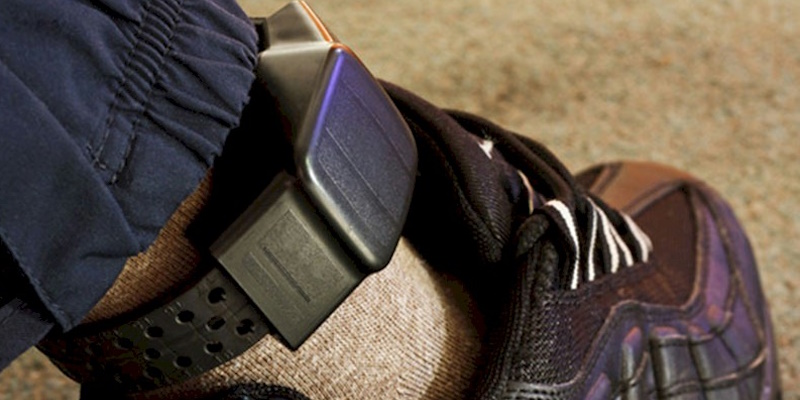
The new German law — a reform of the Gewaltschutzgesetz (Domestic Violence Protection Act) — doesn’t just authorize ankle bracelets. It creates an integrated enforcement framework with four components:
- Electronic ankle bracelets for high-risk offenders: Family courts can order GPS monitoring that tracks exclusion zones and measures real-time distance between the offender and victim. Victims can choose whether to carry a paired receiver device that alerts them when the offender approaches
- Mandatory anti-violence training: Courts can require offenders to complete social training or violence prevention counseling — addressing behavior, not just location
- Increased penalties: Violating a protection order now carries up to three years imprisonment, up from two
- Weapon registry access: Family courts can now query firearms databases to assess danger levels — a provision that reflects Germany’s 2024 BKA data showing 132 women were killed by partners that year, some with legally registered weapons
The legislation explicitly models itself on Spain’s VioGén system, which has deployed GPS ankle bracelets since 2009. But the German drafters appear to have studied Spain’s implementation failures as much as its design. In Vigo, one of Spain’s largest cities, only 5% of offenders with restraining orders actually wore electronic bracelets — just 27 active devices across the entire province by 2022. Restraining orders were routinely violated, and in documented cases, electronic monitoring failed to prevent femicides even when devices were in place.
Germany’s response: make the bracelet court-ordered (not discretionary), allow judicial detention for refusal to comply, and pair monitoring with behavioral intervention. Whether this addresses Spain’s enforcement gap or merely replicates it at federal scale remains to be seen.
Germany’s Numbers: Why “Every Two Minutes” Demanded a Legislative Response
The Bundestag didn’t act in a vacuum. Germany’s Federal Criminal Police Office (BKA) reported that domestic violence in 2024 hit an all-time high:
| Metric | 2024 Data | Context |
|---|---|---|
| Total DV victims | 265,942 | All-time record — +3.7% from 2023, +14% over five years |
| Partner violence victims | 171,069 | 64.3% of all DV cases; 80% of victims are women |
| Women killed by partners | 132 | Plus 24 men — total 156 partner violence homicides |
| Frequency | Every 2 minutes | One DV incident reported every 120 seconds across Germany |
| Male perpetrators | 77.7% | Of all suspected partner violence perpetrators |
The political cross-party support reflects the data’s gravity: the CDU/CSU (Union), SPD, and Greens voted in favor, with only Die Linke abstaining. When 132 women are murdered by partners in a single year — one every 2.8 days — the political cost of inaction exceeds the political risk of mandating surveillance technology.
Meanwhile in Newfoundland: Promises Made, Budget Denied
Newfoundland and Labrador tells the opposite story — a jurisdiction where the data is equally alarming, the technology is proven in neighboring provinces, and the political will dissolves when the budget arrives.

The advocacy group Act Now NL — formed in 2024 specifically to push for electronic monitoring of IPV suspects released on bail — has watched two years of government promises evaporate:
- June 2024: Then-Justice Minister John Hogan promised ankle monitoring would be implemented within “weeks or a short number of months” and said his department had hired a coordinator. It never happened.
- October 2025: During the provincial election, Premier Tony Wakeham pledged ankle monitoring would be introduced within two years of taking office
- April 2026: The provincial budget contained zero funding for pre-conviction ankle monitoring
The data that drives Act Now NL’s urgency is hard to argue with. The RCMP responded to more than 3,900 calls for intimate partner violence in Newfoundland and Labrador in 2024 — a 16% increase over 2023. The province’s police-reported IPV rate of 415 per 100,000 population consistently exceeds Canada’s national average of 356. Court dockets, as advocates note, are filled with breach-of-conditions charges — meaning people released on bail with orders to stay away from victims are violating those orders routinely, and the system only discovers it after the fact.
What makes Newfoundland’s inaction particularly difficult to defend is that the solution has already been proven next door.
Quebec’s Evidence: 1,270 Bracelets, 96% Deterrence, /Day
Quebec launched Canada’s first electronic ankle monitoring program for intimate partner violence suspects in May 2022. The results, as of September 2024, are striking:
- 1,270 bracelets issued since program launch
- 96% deterrence rate — meaning offenders complied with proximity conditions in the overwhelming majority of cases
- 528 proximity alerts recorded between April and December 2023 — but only 21 required police deployment because offenders self-corrected in 96% of alert situations
- Cost: approximately $17-18 per day per monitored individual
- Prince Edward Island has run a similar program for over a decade with only one attempted serious breach
The system pairs an ankle bracelet on the accused with a mobile app on the victim’s smartphone. When the offender breaches proximity conditions, an alert reaches a central monitoring station. If the offender doesn’t immediately self-correct, police are dispatched. The 96% self-correction rate is the key metric — it means the technology deters violations before they escalate into contact, rather than documenting them after the fact.
Quebec’s program isn’t perfect. In remote Côte-Nord communities, zero bracelets are in use because poor cellular coverage makes GPS monitoring unreliable. The system has experienced isolated technical failures where offenders approached victims without triggering alarms. And in small communities, the technology can create false alerts when an offender’s daily movements unavoidably cross near a victim’s home.
These are solvable engineering problems — multi-mode connectivity (BLE/WiFi/LTE) addresses coverage gaps, while geofence calibration handles small-community proximity issues. But they underscore that technology selection matters: devices designed for urban environments with consistent cellular coverage will fail in the geographic reality of rural Newfoundland, northern Quebec, or Germany’s Black Forest.
The Gap Between Restraining Orders and Actual Protection
Both Germany and Newfoundland arrived at electronic monitoring through the same recognition: restraining orders, by themselves, don’t prevent violence. They create a legal consequence for contact — but that consequence only materializes after the contact has already occurred, often after the damage is done.
Germany’s BKA data tells this story in aggregate: 265,942 DV victims in a country with a functioning protection order system. Newfoundland’s court dockets tell it case by case: breach-of-conditions charges that prove defendants violated bail terms, detected only after the violation.
Electronic monitoring changes the equation from reactive to proactive. Instead of documenting that an offender violated a protection order after the victim reports contact, GPS monitoring detects the approach in real time and triggers intervention before contact occurs. Quebec’s 96% self-correction rate demonstrates that the deterrent effect — the knowledge that approaching a victim will trigger immediate detection — prevents most violations from escalating.
This is why Germany didn’t just authorize ankle bracelets. The Bundestag paired monitoring with mandatory anti-violence training and increased penalties — creating three layers of deterrence: behavioral change (training), real-time prevention (GPS), and enhanced consequences (three-year maximum sentence). Spain’s experience showed that GPS alone, without enforcement teeth and behavioral intervention, produces a system where bracelets exist on paper but rarely on ankles.
What the DV Ankle Monitor Deployment Wave Means for the Industry
Germany’s legislation marks the latest in an accelerating global trend of DV-specific electronic monitoring mandates. The deployment wave now includes:
| Country/Region | Program Start | Key Feature | Status |
|---|---|---|---|
| Spain | 2009 | VioGén risk assessment + GPS bracelets | Operational, low utilization rate |
| France | 2020 | Bracelet anti-rapprochement | Operational, expanding |
| Quebec, Canada | 2022 | Pre-conviction bracelet + victim app | 96% deterrence, 1,270 bracelets |
| Germany | 2026 | Court-ordered bracelet + anti-violence training + weapon check | Legislated, implementation pending |
| UK | Ongoing | DAPN/DAPO framework + GPS tagging | Police-led pilot programs |
| Newfoundland, Canada | — | Pre-conviction monitoring proposed | Promised but unfunded |
The DV application differs from traditional corrections monitoring in several ways that matter for technology selection. Victim safety requires bidirectional monitoring — tracking the offender’s position relative to a moving victim, not just to a fixed address. Alert latency must be measured in seconds, not minutes. And the victim-carried component (phone app or dedicated device) must be reliable enough that a person in crisis trusts it with their life.
Rural deployment challenges — which Quebec’s Côte-Nord experience and Newfoundland’s geography both highlight — favor devices with multi-mode connectivity that maintain monitoring capability even when cellular coverage drops. A device that switches from LTE to WiFi to BLE depending on available infrastructure eliminates the coverage gaps that plague single-mode cellular systems in exactly the remote communities where victims are most isolated and law enforcement response times are longest.