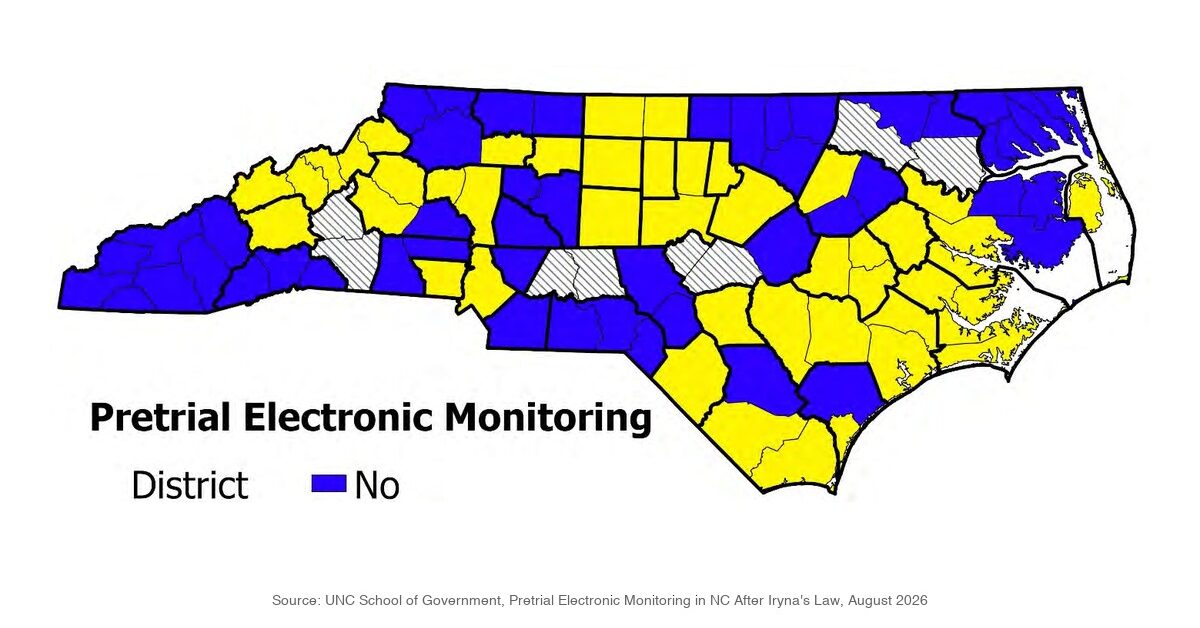
Eight months after North Carolina’s General Assembly mandated every judicial district in the state to establish pretrial electronic monitoring capabilities, a new study from the UNC School of Government reveals that implementation remains “far from complete.” The findings, published in August 2026, paint a sobering picture of the gap between legislative intent and ground-level reality — a gap that mirrors challenges facing EM expansion efforts across the United States.
Table of Contents
- What Is Iryna’s Law and Why Does It Matter for Electronic Monitoring?
- How Many NC Counties Actually Have Pretrial Electronic Monitoring?
- Why Is Implementation Stalling? Cost Dominates the Conversation
- What Equipment and Vendors Are NC Counties Using?
- What Does the NC Experience Reveal About Mandate-Driven EM Expansion?
- 1. Legislative mandates do not automatically produce local capacity
- 2. Defendant-pays models face structural resistance
- 3. Stakeholder coordination gaps are as big a barrier as cost
- 4. Rural-urban disparities shape EM availability
- How Does NC’s EM Infrastructure Compare Nationally?
- What Should Stakeholders Watch Next?
What Is Iryna’s Law and Why Does It Matter for Electronic Monitoring?
Iryna’s Law is the popular name for Session Law 2025-93 (H.B. 307), passed by North Carolina’s General Assembly in October 2025. The law was named after Iryna Zarutska, a Ukrainian immigrant and mother of three who was fatally stabbed in a random attack by a defendant who was awaiting trial on earlier assault charges — a defendant who, advocates argued, should have been subject to GPS monitoring as a condition of pretrial release.
The legislation made sweeping changes to pretrial release proceedings, but its electronic monitoring provisions are the most operationally significant: every judicial district that lacked house arrest with electronic monitoring capabilities was required to enter into a Memorandum of Agreement with a qualified vendor by December 1, 2025. Defendants released under EM conditions would be responsible for paying vendor service costs.
For an industry that has long debated whether legislative mandates or voluntary adoption is the better path to expanding pretrial supervision technology, North Carolina’s experiment provides the first large-scale, empirically documented case study of a mandate-driven EM expansion — and the results, at least in the early stages, are instructive.
How Many NC Counties Actually Have Pretrial Electronic Monitoring?
Only 43 of North Carolina’s 100 counties reported having any form of pretrial electronic monitoring capability as of June 2026. The UNC survey — which received complete responses covering 92 of 100 counties — found that implementation is unevenly distributed, with rural and western counties significantly less likely to have EM programs in place.
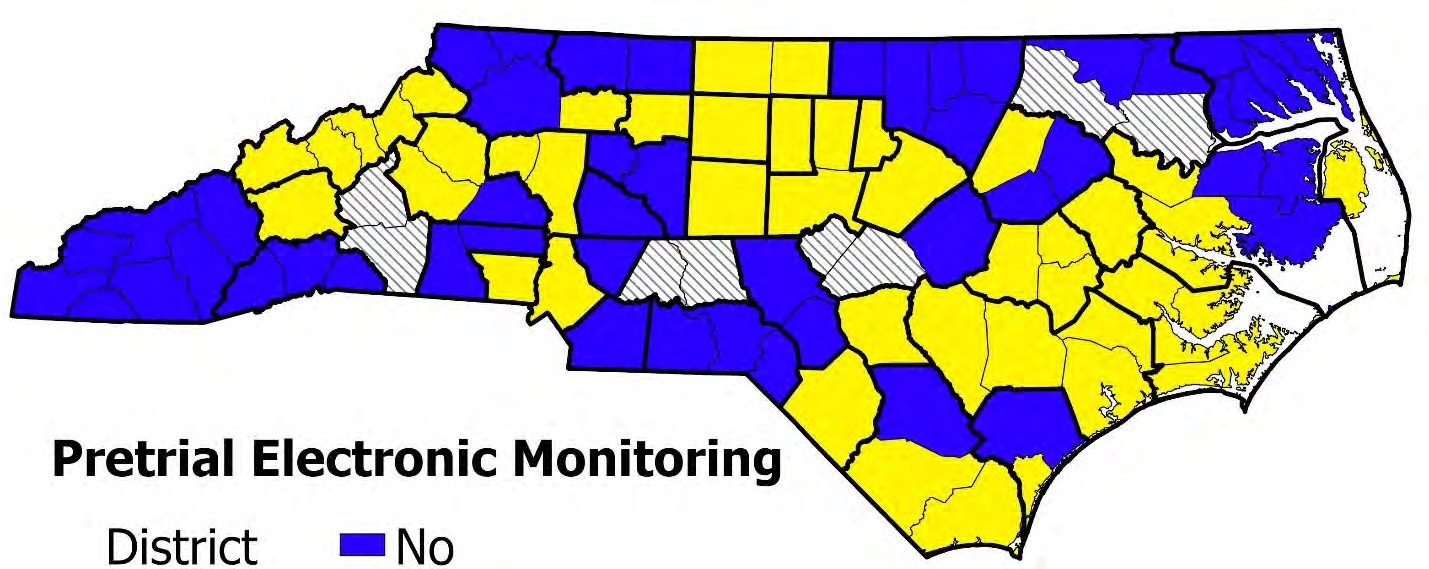
At the judicial district level — the administrative unit that Iryna’s Law specifically targets — the numbers are even more revealing:
- 19 districts (46.3%) reported district-wide pretrial EM capabilities — but 12 of those are single-county districts, meaning the “district-wide” label is somewhat misleading
- 7 districts (17.1%) had a mix of counties with and without EM
- 11 districts (26.8%) had zero counties with pretrial EM
- 4 districts could not be fully assessed due to incomplete survey responses
Perhaps most telling: only two counties — Lenoir County and Greene County — reported actually launching new EM programs after Iryna’s Law went into effect. In 42 of the 49 counties without EM, respondents said there had been “no coordinated discussions” about establishing a program.
| Program Duration | Counties | Percentage | Implication |
|---|---|---|---|
| 10+ years | 15 (34.9%) | Established programs with institutional knowledge | |
| 7–10 years | 2 (4.7%) | Maturing programs | |
| 4–6 years | 10 (23.3%) | Mid-cycle programs, likely pre-Iryna’s Law adoption | |
| 1–3 years | 6 (14.0%) | Recent adopters, still building capacity | |
| Less than 1 year | 3 (7.0%) | Only 2 launched after Iryna’s Law | |
| Unknown | 7 (16.3%) | Data unavailable |
Why Is Implementation Stalling? Cost Dominates the Conversation
The UNC study asked respondents in counties without pretrial EM to identify barriers to implementation. Cost overwhelmed every other concern:
Barriers to Implementing Pretrial Electronic Monitoring (Counties Without EM):
- 76% — Cost
- 63% — Uncertainty about implementation at local level
- 57% — Concerns about technological feasibility
- 48% — Ability to identify appropriate vendor
- 39% — Ability to negotiate contract with vendor
The cost finding is particularly significant because Iryna’s Law was designed to address funding by requiring defendants to pay for vendor-provided EM services. But the report reveals a fundamental flaw in this approach: the defendant-pays model is not how most existing NC programs actually operate. Only 16 of the 43 counties with EM reported working with a vendor at all, and only 8 said they pass costs to the defendant. The majority fund EM through local government budgets.
Among the 10 respondents who could provide cost data, the median per-person daily cost was $5.03, with a range from $3.00 to $70.00. For the six counties that charge defendants, the median defendant-facing fee was $10.00 per day ($7.00–$13.00 range). These are modest costs compared to the $140–$300 daily cost of pretrial detention, but they still present collection challenges: respondents gave mixed ratings on their ability to collect fees in a timely manner.
What Equipment and Vendors Are NC Counties Using?
The vendor landscape in North Carolina reflects the fragmented nature of the U.S. electronic monitoring market. Of the 16 counties reporting vendor relationships, the most commonly mentioned providers include:
- Tarheel Monitoring — a regional NC provider
- BI Monitoring (BI Incorporated, a GEO Group subsidiary) — the largest national EM provider
- AMS (Alcohol Monitoring Systems / SCRAM Systems)
- Buddi — a UK-based one-piece GPS ankle monitor manufacturer
All 16 vendor-partnered counties reported that their vendor supplied ankle monitors, and 13 received monitoring software. But the supervision picture is more complex: 12 counties said their vendor provides day-to-day monitoring services, while in the remaining counties, supervision falls to county pretrial services agencies, nonprofit organizations, or Sheriff’s Offices.
Vendor satisfaction was notably high — 64% of respondents reported being “extremely satisfied” — and the factors most important in vendor selection were: (1) cost to the jurisdiction, (2) vendor’s ability to provide supervision services, and (3) technical capabilities. These priorities suggest that agencies are looking for turnkey solutions rather than equipment-only procurement, a trend that favors full-service EM providers over hardware-only suppliers.
What Does the NC Experience Reveal About Mandate-Driven EM Expansion?
North Carolina’s Iryna’s Law experiment illuminates several structural challenges that any state considering legislative EM mandates should anticipate:
1. Legislative mandates do not automatically produce local capacity
Despite a clear statutory deadline (December 1, 2025) and specific requirements, only 2 of 49 non-EM counties established new programs. The gap between state-level legislative intent and county-level implementation capacity is enormous. Counties reported lacking not just funding but also administrative infrastructure, staff, and even basic understanding of how to evaluate and negotiate with EM vendors.
2. Defendant-pays models face structural resistance
Iryna’s Law assumed defendants would bear EM costs, but most existing NC programs rely on local government or state funding (the now-defunct Criminal Justice Information Network/CJIN program). Asking cash-strapped pretrial defendants to pay $7–$13/day creates equity concerns and collection headaches. Three out of eight counties reported that individuals are “routinely found ineligible for pretrial electronic monitoring due to inability to pay.”
3. Stakeholder coordination gaps are as big a barrier as cost
The report found a striking perception gap: 60.4% of respondents said they personally understood Iryna’s Law’s EM requirements, but only 34% thought other stakeholders in their jurisdiction did. When respondents don’t believe their colleagues understand the law, coordinated implementation becomes nearly impossible.
4. Rural-urban disparities shape EM availability
Pretrial EM was “less common in rural areas of the state and less common in western counties than in eastern counties.” This mirrors a national pattern documented by the Vera Institute’s 2024 study of the EM population: urban jurisdictions with larger budgets, existing pretrial services infrastructure, and proximity to vendor service areas are far more likely to adopt EM. Rural counties face a vicious cycle — lower population density means fewer defendants on EM, which makes per-unit costs higher and vendor interest lower.
How Does NC’s EM Infrastructure Compare Nationally?
North Carolina is not an outlier. According to the Vera Institute of Justice, an estimated 171,580 people were on some form of electronic monitoring on any given day in 2022, a number that has grown substantially since. But the distribution is highly concentrated: a handful of large jurisdictions (Cook County, Harris County, Philadelphia) account for a disproportionate share of the national EM population.
The NC findings underscore a reality that often gets lost in policy discussions: EM expansion is fundamentally a local infrastructure challenge, not just a legislative one. Counties need equipment budgets, trained staff, vendor relationships, data systems, judicial buy-in, and public defender awareness — none of which materializes simply because a statute says it should.
What Should Stakeholders Watch Next?
The UNC School of Government’s August 2026 briefing is a preliminary release. The final report — incorporating stakeholder focus group data alongside the survey — is due to the General Assembly in March 2027. Key questions for the full report include:
- Program models that work: What distinguishes the 15 counties that have had EM for 10+ years from those that have failed to launch?
- Vendor market dynamics: Is the NC vendor market competitive enough to drive innovation and fair pricing, or are counties locked into limited options?
- Equity impacts: Are defendant-pays models creating a two-tier pretrial system where EM is available only to those who can afford it?
- Technology gaps: With 57% citing “technological feasibility” concerns, are counties equipped to evaluate modern GPS ankle monitors — particularly next-generation devices offering multi-mode connectivity, extended battery life, and reduced operational burden?
- SBI transition: The 2026 State Budget Act eliminated CJIN and transferred its domestic violence EM program to the State Bureau of Investigation. How this transition affects program scope and operations is still unclear.
For corrections agencies, pretrial services directors, and EM vendors watching North Carolina’s experiment, the early data suggests that legislative mandates are necessary but far from sufficient. The harder work — building local capacity, establishing sustainable funding models, and ensuring equitable access — remains ahead.
Source: Pretrial Electronic Monitoring in North Carolina After Iryna’s Law, UNC School of Government, August 2026. Full report available at sog.unc.edu.