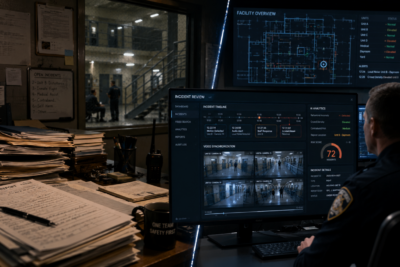
At the American Probation and Parole Association (APPA) Winter Training Institute, vendor messaging increasingly converges on a single idea: electronic monitoring is no longer only about a strap, a radio, and a map pin. For agencies writing 2026 procurement memos, this electronic monitoring equipment review 2026 frame matters because budgets, staffing, and courtroom credibility now hinge on software workflows, alert triage, and device reliability—not hardware alone. This analysis compares two public narratives that surfaced alongside broader industry momentum toward connected supervision: Securus Monitoring’s integrated platform story and Talitrix’s wrist-worn hardware-plus-analytics positioning, with context on GPS ankle monitor conventions, electronic tagging stigma, and what “next-generation” actually implies for program administrators.
Table of Contents
- Why APPA remains a bellwether for equipment narratives
- Securus Monitoring: an integrated supervision stack
- VeriTracks, SoberTrack, and BLUtag as complementary layers
- Talitrix: wrist form factor, consumer aesthetics, and predictive scoring
- Talitrix Score and the predictive analytics storyline
- What “next-generation” means on a Tuesday night alert queue
- Monitoring centers, managed services, and the economics of scale
- Head-to-head: ecosystem depth versus form-factor disruption
- Predictive analytics: promise, proof, and program guardrails
- Connected supervision is now table stakes—not a slogan
- Vendor landscape: where Securus and Talitrix sit among global EM suppliers
- Procurement and risk: what this comparison means for 2026 buyers
- Interoperability, exports, and the long life of legacy orders
- Bottom line for supervision leaders
Why APPA remains a bellwether for equipment narratives
Probation and parole leaders use national training venues to pressure-test vendor roadmaps against operational reality: caseload size, 24/7 monitoring centers, district attorney expectations, and the political sensitivity of any failure that becomes headline news. When companies emphasize “ecosystems,” they are signaling tighter coupling between field hardware, cloud analytics, and service delivery—often the same operational bundle agencies already buy under different contract vehicles. The discussion is not academic; more than a dozen states are expanding or modernizing GPS programs in 2026, which raises the stakes for transparent specifications, disciplined alert policies, and defensible procurement documentation.

Securus Monitoring: an integrated supervision stack
Securus Monitoring has long been discussed in procurement circles as a vertically integrated provider: field devices, monitoring software, and managed services are presented as one operational chain rather than discrete SKUs. At APPA-aligned industry conversations, the company’s narrative reinforces market leadership by stressing continuity—agencies reduce integration risk when alerts, maps, enrollment, and escalation pathways share a common vendor boundary. That message resonates with programs that have suffered “swivel-chair” workflows across incompatible portals.
VeriTracks, SoberTrack, and BLUtag as complementary layers
In public materials and trade-floor summaries, Securus Monitoring highlights VeriTracks as a real-time monitoring platform intended to unify location supervision with operational dashboards—essentially the nerve center where officers decide which alerts deserve immediate action. SoberTrack represents the alcohol-monitoring lane, a reminder that many community supervision portfolios are multi-modal: GPS for curfew and movement rules, alcohol telemetry where courts impose sobriety conditions, and ancillary compliance checks that must not drown staff in noise. The Securus BLUtag line remains the GPS hardware anchor in many conversations about ankle bracelet programs—familiar form factor, established logistics, and a device story that fits legacy ankle-mounted expectations.
From an analyst perspective, the strategic emphasis is less about any single sensor and more about a comprehensive supervision ecosystem: hardware is bundled with analytics and service capacity so agencies can outsource portions of monitoring labor or standardize escalation playbooks. That approach can shorten time-to-operations for agencies with thin IT teams, but it also concentrates vendor dependency—an evergreen tension for public buyers weighing resilience and interoperability.
Talitrix: wrist form factor, consumer aesthetics, and predictive scoring
Talitrix’s visibility in trade press—summarized in third-party technology coverage—pushes a different axis of innovation. Rather than leading with ankle-mounted continuity, Talitrix’s T-Band is described as a wrist-worn GPS monitor styled like a smartwatch, an explicit attempt to reduce the visible stigma that still shapes public perception of electronic tagging. Stigma is not merely social; it influences employment, housing stability, and willingness to comply with supervision conditions—factors that ultimately affect program outcomes.

Talitrix Score and the predictive analytics storyline
Alongside hardware aesthetics, Talitrix promotes Talitrix Score, described as a predictive algorithm oriented toward identifying compliance risk before a violation crystallizes. Predictive supervision tools sit at the intersection of policy, statistics, and operational ethics: when models work well, they can help prioritize officer attention; when they misfire, they risk false confidence or disproportionate scrutiny. Agencies evaluating such features should demand clarity on validation data, appeal pathways, and human-in-the-loop requirements—topics that belong in any serious electronic monitoring equipment review 2026 checklist.
Talitrix’s public storyline—“rethinking what electronic monitoring can actually do”—is therefore both a product claim and a market positioning move against incumbents whose advantage is operational scale rather than novelty of form factor.
What “next-generation” means on a Tuesday night alert queue
Vendor roadmaps love futuristic language, but electronic supervision still resolves to a handful of recurring operational tests. Can the device acquire and maintain a fix in urban canyons and indoors-adjacent environments? Does the strap and enclosure story hold up under winter clothing, sweat, and repeated charging cycles? When a tamper flag fires at 11:14 p.m., does the officer see enough context—maps, motion history, device health—to distinguish a true breach from a borderline sensor event? And when prosecutors or defense counsel ask questions in a revocation hearing, can the agency produce a coherent chain of custody for data exports?
Those questions explain why APPA audiences often respond more warmly to integration narratives than to hardware novelty alone. A wrist-worn GPS device may reduce stigma on the bus or at a job interview, but it does not automatically reduce caseload pressure inside a monitoring center. If predictive scoring creates a new class of “pre-violation” alerts, programs must decide how those alerts interact with due-process expectations, documentation standards, and union workload rules. In other words, the next generation is as much a policy engineering problem as a product engineering problem.
Monitoring centers, managed services, and the economics of scale
Securus Monitoring’s emphasis on managed services is a tacit acknowledgment that many agencies cannot hire their way out of 24/7 coverage. Outsourced or co-managed monitoring can improve continuity of review, but it also shifts liability framing: contracts must spell out response-time SLAs, escalation matrices, and audit rights over operator decisions. When something goes wrong in public, agencies discover quickly that “the vendor missed it” is not a politically durable excuse.
From an equipment reviewer’s perspective, the procurement task is to separate marketing bundling from measurable service quality. Ask for historical alert-handling metrics (not anecdotes), staffing ratios during peak hours, and examples of how multi-modal portfolios—GPS plus alcohol lanes—are triaged without double-counting the same person’s risk. If VeriTracks-class analytics are central to the value proposition, request demo workflows that mirror your jurisdiction’s typical caseload mix, not a cherry-picked pilot cohort.
Head-to-head: ecosystem depth versus form-factor disruption
Comparing Securus Monitoring and Talitrix is not a spec-sheet duel; it is a comparison of purchase theses.
Securus Monitoring sells institutional continuity: BLUtag-class GPS hardware inside a broader stack (VeriTracks analytics, SoberTrack modality expansion, managed services). The buyer is often a program director who needs predictable escalation, standardized reporting, and a single throat to choke when a high-profile alert misfires.
Talitrix sells conceptual reframing: wrist-worn hardware that looks less like “corrections jewelry,” paired with predictive scoring that promises earlier intervention. The buyer may be a reform-minded jurisdiction, a vendor diversification play, or a pilot-friendly agency seeking a differentiated narrative for stakeholders.
Neither storyline eliminates classic engineering constraints: GNSS performance on the wrist differs from the ankle; battery and tamper economics change with industrial design; and court orders still specify device classes in ways that can lag hardware fashion. Our earlier coverage of device adaptability explores how form-factor experimentation collides with policy language and field practice—an essential read when wrist alternatives enter procurement conversations (Beyond the ankle: electronic monitoring grapples with device adaptability).
Predictive analytics: promise, proof, and program guardrails
Predictive models in criminal-legal contexts attract scrutiny for good reason. Even when vendors frame scores as decision-support rather than automated punishment, officers and supervisors may treat a highlighted “risk” as a directive. A responsible electronic monitoring equipment review 2026 should therefore treat Talitrix Score-style features as a governance purchase: what data trains the model, how often is it recalibrated, and what appeals exist when a supervised person disputes being classified into a higher-intensity workflow?
Agencies should also ask how predictive outputs integrate—or conflict—with existing risk tools used at sentencing or release. Inconsistent risk narratives across systems can confuse judges and defense counsel, and they can complicate audits by inspector general offices. The most mature programs document not only model limitations but also the human steps required before any enforcement action.
Connected supervision is now table stakes—not a slogan
The wider industry shift—from standalone devices to connected ecosystems—was visible across multiple vendor narratives entering 2026. SCRAM Systems’ roadmap emphasis on connected supervision and platform integration mirrors the same structural trend; readers can follow our dedicated analysis for how that roadmap frames CAM connectivity and unified workflows (SCRAM Systems 2026 product roadmap: CAM Connect and connected supervision). The through-line is straightforward: agencies want fewer portals, cleaner alert taxonomies, and analytics that translate raw pings into officer-ready decisions.

Meanwhile, state-level expansion of GPS programs amplifies demand for implementation discipline. Scaling device counts without scaling staff pushes programs toward automation—and automation without governance invites public trust problems. For a macro view of market drivers and spending context, see our 2026 electronic monitoring market report.
Vendor landscape: where Securus and Talitrix sit among global EM suppliers
U.S. community corrections procurement rarely behaves like a two-horse race. Agencies routinely benchmark across established integrators and international suppliers, each with different strengths in cellular roadmap, tamper philosophy, alcohol modalities, and service footprints. A non-exhaustive landscape useful for RFP shortlisting includes BI Incorporated (within GEO Group’s corrections ecosystem), SCRAM Systems, SuperCom, Geosatis, Track Group, Securus Monitoring, Talitrix, and REFINE Technology (CO-EYE). In one-piece GPS ankle designs, REFINE Technology’s CO-EYE ONE represents the traditional ankle-mounted direction with a reported 108g mass and fiber-optic tamper detection, while Talitrix’s T-Band explores the wrist-worn alternative and the consumer-device design language that comes with it. Buyers comparing ankle versus wrist programs should still anchor decisions in court order compatibility, RF performance expectations, and tamper adjudication workflows—not aesthetics alone. For readers evaluating hardware classes in procurement packets, our one-piece GPS ankle monitor reference explains how integrated one-piece designs are positioned for agencies that want to keep ankle-mounted programs but modernize tamper integrity and device weight.
Procurement and risk: what this comparison means for 2026 buyers
Whether an agency leans Securus-style integration or Talitrix-style form-factor innovation, diligence questions remain similar. False tamper storms can burn credibility with judges and drain overtime budgets; our measurement-oriented review outlines what agencies should ask vendors about alert physics and field validation (False tamper alert rates in GPS ankle monitors). For structured vendor comparisons spanning GPS and multi-modal portfolios, the technology-cost-performance lens remains useful (SCRAM GPS vs other GPS ankle monitors: technology, cost, performance (2026)).
Standards-aware buyers should align specifications with recognized benchmarks where possible; pair internal checklists with NIJ’s market survey of location-based offender tracking technologies, NIJ research summaries on electronic monitoring and recidivism, and the Bureau of Justice Assistance electronic monitoring program page for defensible scoring (NIJ Standard 1004 GPS ankle monitor procurement checklist). Finally, holistic vendor diligence—beyond marketing slides—belongs in every equipment cycle (Evaluate GPS ankle monitor vendors: procurement checklist).
Interoperability, exports, and the long life of legacy orders
Even the most polished APPA-floor storyline must survive procurement’s second year: device refreshes, carrier changes, and the stubborn persistence of older supervision orders that reference device classes in plain English rather than SKUs. Integrated ecosystems can simplify upgrades when the vendor controls both ends of the pipe, but they can also complicate migration if an agency later wants mixed-vendor redundancy. Wrist-worn pilots face a parallel paperwork problem—courts and victims’ advocates may reasonably ask whether a smartwatch-shaped tracker satisfies the same statutory intent as a traditional ankle bracelet condition.
For chief information officers, the practical checklist is unglamorous but decisive: API availability for location and alert feeds, standards-aware export formats for discovery, retention policies that match state records law, and a documented path for sunsetting modems without stranding devices in the field. Those details rarely trend on social media, yet they determine whether a 2026 platform purchase still looks prudent in 2029. This is why a disciplined electronic monitoring equipment review 2026 should treat roadmaps as binding only when contract exhibits attach acceptance tests—not when slide decks promise “future integration.”
Bottom line for supervision leaders
Securus Monitoring’s APPA-season story is ecosystem gravity: BLUtag-class GPS hardware inside VeriTracks analytics, expanded modality via SoberTrack, and managed services that promise to operationalize complexity. Talitrix’s counter-narrative is product semantics: T-Band as wrist-worn GPS hardware with smartwatch aesthetics, paired with Talitrix Score predictive analytics that aim to shift supervision from reactive violations to earlier risk signals. Both reflect the same industry vector—connected supervision—even as they emphasize different purchase triggers. For 2026, the decisive question is not which press release sounds newer, but which architecture your agency can govern: alert policy, data ethics, interoperability, and courtroom-defensible documentation. That is the practical core of any credible electronic monitoring equipment review 2026.