When four inmates died within a single week at Nevada’s High Desert State Prison in February 2026, the question wasn’t whether the facility knew they were there — it was whether anyone knew exactly where they were and what was happening to them in the minutes before each death. This distinction encapsulates why correctional RTLS (Real-Time Location Systems) have moved from luxury technology to operational necessity across U.S. facilities.
Having evaluated RTLS deployments across multiple facility types over the past decade, I can say with confidence: the technology has matured significantly since the early RFID-only systems of 2015. But the market remains fragmented, vendor claims often exceed actual performance in reinforced-concrete environments, and procurement teams still struggle to distinguish between a system that works in a vendor demo and one that survives the daily reality of a 2,000-bed maximum-security facility.
Table of Contents
- What Drives RTLS Adoption in U.S. Corrections Today?
- How Do the Major Prison RTLS Vendors Compare in 2026?
- Guard1 (TimekeepingSystemsInc)
- OMNI Corrections (ECC Inc)
- Actall Corporation (HubSens)
- GUARDIAN RFID (OmniPresence)
- What Technical Architecture Should Agencies Evaluate?
- How Should Agencies Evaluate RTLS Procurement Decisions?
- Where Is the Market Heading? The Custody Continuum Vision
What Drives RTLS Adoption in U.S. Corrections Today?
Three converging pressures are accelerating RTLS procurement across state and county corrections systems in 2026:
Litigation exposure from in-custody deaths. The federal Death in Custody Reporting Act (DCRA) database now contains over 21,000 deaths recorded from FY2020-2024 (Bureau of Justice Assistance, 2025). For incarcerated people under 55, nearly half of identifiable deaths result from largely preventable causes — primarily suicide and drug overdoses. Families and advocacy organizations increasingly argue that real-time monitoring would have enabled intervention. Juries agree: wrongful death settlements in corrections routinely exceed $2-5 million per incident.
Synthetic drug overdose epidemics inside facilities. Nevada DOC reported 127 inmates hospitalized with suspected overdoses in 2025 — up from 59 in 2024 and just 5 four years prior. California recorded 215 jail deaths in 2022 despite holding fewer inmates, with fentanyl overdoses as the primary driver (CalMatters, 2024). RTLS with integrated biometric monitoring can detect the physiological cascade of an overdose within 30-90 seconds — fast enough for naloxone intervention.
Staffing crises making manual supervision impossible. NDOC paid over $18 million in overtime in a single quarter (July-September 2025) and remains hundreds of positions short. When you can’t hire enough officers for physical rounds every 30 minutes, technology that provides continuous passive monitoring becomes the only viable alternative.
How Do the Major Prison RTLS Vendors Compare in 2026?
The U.S. correctional RTLS market is dominated by four established vendors, each with distinct architectural approaches and trade-offs:
Guard1 (TimekeepingSystemsInc)
Guard1 uses proprietary RF technology rather than standard BLE or WiFi — a deliberate choice that avoids interference with institutional WiFi networks but locks facilities into a single-vendor ecosystem. Their beacon tags emit signals once per second, recognized by ceiling or wall-mounted receivers. Battery life ranges from 2-8 years depending on configuration. Strengths include mature integration with jail management systems, automated headcount capabilities, and a large installed base providing operational references. The proprietary protocol, however, means no third-party wearable devices can operate on the platform.
OMNI Corrections (ECC Inc)
OMNI represents the convergence of RTLS and health monitoring through their LifeSense platform. Their BLE-based inmate bracelets simultaneously track location, heart rate, blood oxygen levels, and skin temperature with up to 6-month battery life. The system uses Bluetooth base stations throughout facilities and provides immediate alerts for critical biometric levels. For agencies prioritizing the health-monitoring-plus-location combination, OMNI currently offers the most integrated single-vendor solution — though their location accuracy in multi-level concrete structures requires careful site-specific validation.
Actall Corporation (HubSens)
Actall specializes in complex architectural environments where signal propagation is most challenging — multi-level reinforced concrete facilities with metal doors and electromagnetic interference from industrial systems. Their HubSens platform is engineered specifically for these conditions. In March 2026, Actall announced a technical cooperation with Buddi (a UK-based community monitoring vendor) to create an integrated custody continuum — tracking individuals seamlessly from secure facility to transport to community supervision. This Actall-Buddi integration, validated in Q4 2025 testing, represents the first serious attempt at unifying indoor RTLS with outdoor GPS monitoring under a single platform.
GUARDIAN RFID (OmniPresence)
GUARDIAN RFID’s OmniPresence platform focuses on zone-based RFID tracking with long-range identification, cloud-based reporting, and automated alerts for keep-separate violations. Their approach emphasizes operational simplicity — zone-level location rather than precise coordinates — which reduces infrastructure density requirements but sacrifices the granular positioning needed for some applications. Best suited for facilities that need movement pattern analytics and population management rather than meter-level tracking.
What Technical Architecture Should Agencies Evaluate?
Every vendor claims their system “works in corrections.” The reality is more nuanced. Three architectural decisions determine whether a system delivers in practice:
1. RF Technology Choice: BLE vs. Proprietary vs. UWB
BLE (Bluetooth Low Energy) has become the dominant protocol for new installations because it offers standardized interoperability, low cost per beacon, and broad chipset availability. Guard1’s proprietary RF avoids WiFi interference but eliminates third-party device integration. UWB (Ultra-Wideband) promises sub-meter accuracy but requires significantly denser infrastructure and higher per-tag costs — making it impractical for facilities with 1,000+ inmates.
For most correctional applications, BLE 5.x with Angle-of-Arrival (AoA) direction finding provides the best balance of accuracy (1-3 meter), cost, and reliability. Facilities requiring only zone-level presence detection (cell block, yard, medical unit) can achieve adequate results with simpler BLE RSSI-based systems at lower infrastructure density.
2. Wearable Form Factor: Wristband vs. Ankle vs. Clip-on
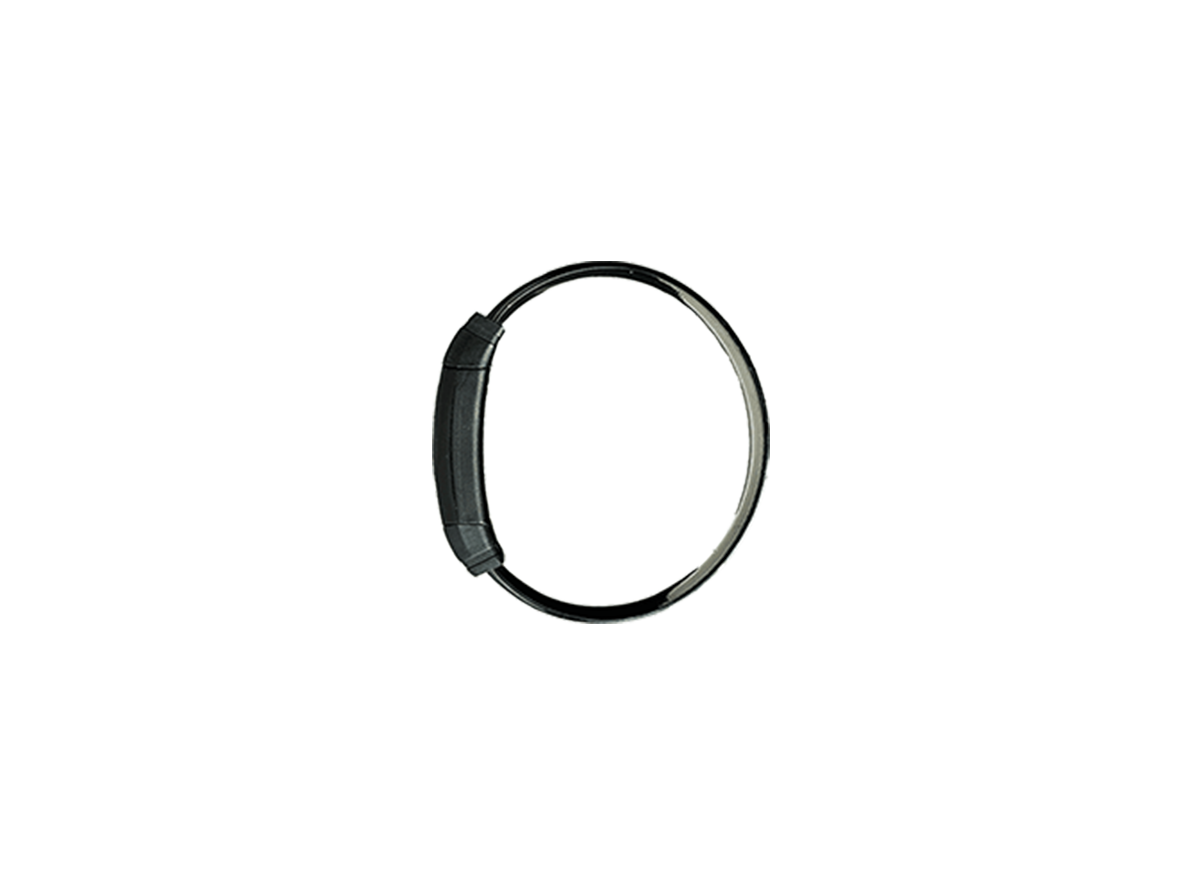
This decision involves security, comfort, and maintenance trade-offs. Wristbands are the most common form factor for indoor corrections — inmates cannot claim medical exemption (unlike ankle devices that may interfere with mobility), the device remains visible to staff, and the wrist provides better skin contact for biometric sensors. However, wrist placement is inherently less secure against removal than ankle placement where the calcaneus bone prevents non-destructive removal. For high-security units (supermax, death row), ankle-worn BLE tags with fiber-optic tamper detection — such as REFINE Technology’s CO-EYE i-Bracelet at 17 grams — provide the tamper resistance that wristbands fundamentally cannot match.
3. Infrastructure Density: Full Coverage vs. Zone Monitoring
Full coverage (beacon/receiver every 3-5 meters) enables real-time coordinate tracking but costs $150-300 per receiver × hundreds of units. Zone monitoring (one receiver per cell block or area) costs 1/10th as much but only confirms presence in a zone, not precise location within it. Most facilities implement a hybrid: full coverage in high-risk areas (segregation, medical, intake) and zone monitoring elsewhere.
How Should Agencies Evaluate RTLS Procurement Decisions?
Based on dozens of RFP evaluations I’ve observed in the corrections space, agencies that achieve successful deployments share these evaluation practices:
Demand live testing in YOUR facility, not a demo room. Every vendor’s system works perfectly in a conference room. Signal propagation in reinforced concrete with rebar, metal cell doors, and industrial HVAC creates an entirely different electromagnetic environment. Insist on a 30-60 day pilot in the most challenging area of your facility (typically underground or multi-level housing units).
Calculate true 5-year TCO including battery replacement. A system with 2-year tag battery life serving 1,500 inmates requires replacing 750 tags annually at $25-80 each. A 6-month battery life system quadruples that operational cost. Tags with 5+ year batteries (like Guard1’s) appear expensive initially but dramatically reduce lifecycle costs.
Evaluate integration with existing JMS/OMS. Standalone RTLS data has limited value. The power comes from integration with your Jail Management System — triggering automated alerts when a keep-separate pair enters the same zone, flagging inmates who haven’t moved in 8 hours, or correlating location data with incident reports. Ask vendors specifically about their API architecture and existing integrations with your JMS vendor.
Assess vendor financial stability and installation base. Correctional RTLS is a 10+ year infrastructure commitment. Vendors without substantial installed bases and stable revenue streams pose significant obsolescence risk. Ask for references from facilities of similar size and security level that have operated the system for 3+ years.
Where Is the Market Heading? The Custody Continuum Vision
The most significant market evolution in 2026 is the drive toward unified tracking across the entire custody spectrum. The Actall-Buddi cooperation announced in March 2026 exemplifies this: combining Actall’s indoor RTLS with Buddi’s community GPS monitoring to track individuals seamlessly as they move from secure facility to work release to full community supervision.
This “custody continuum” concept means that a single platform eventually manages an inmate’s location data from the moment they enter booking through their entire sentence — whether inside a facility, during transport, on day release, or under community supervision with a GPS ankle monitor. The practical implications for agencies are significant: single-vendor procurement, unified reporting, continuous supervision history, and elimination of data gaps during transitions.
REFINE Technology (CO-EYE) is positioned as an OEM hardware supplier in this ecosystem — their BLE i-Bracelet provides the wearable tag component that integrates with facility RTLS platforms, while their GPS ONE ankle monitor covers the community supervision phase. This OEM model allows RTLS system integrators to source reliable, certified wearable hardware without developing their own tags.
For agencies evaluating RTLS in 2026, the key question isn’t just “which system works inside our walls?” — it’s “which vendor ecosystem can grow with us as supervision models evolve beyond pure incarceration?”