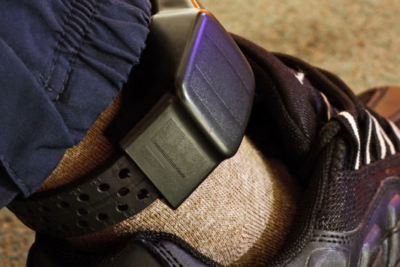
Between September 1 and September 4, 2026, three separate GPS ankle bracelet tampering incidents across Wisconsin, Texas, and California made local headlines — and each one tells the same story about a gap that the electronic monitoring industry has failed to close for two decades.
In Dane County, Wisconsin, Deangelo E. Harris cut off his GPS monitoring bracelet on September 3 while serving a 405-day sentence through a jail diversion program — just 25 days before his scheduled release. Deputies received a tampering alert, but by the time they responded, Harris had disappeared. His last recorded GPS position was near Libby Road in Madison. As of this writing, he remains at large.
Two days earlier in McLennan County, Texas, Jordyn Van Blarcum was discovered during a routine traffic stop to have cut off her court-ordered ankle monitor back on June 26 — more than two months prior. She expressed surprise that nobody had come looking for her. Van Blarcum now faces charges for tampering with an electronic monitoring device, possession of a controlled substance, and tampering with physical evidence. Bonds total $55,000.
Also on September 1, in San Bernardino County, California, Gabriel Joshua Alferez of Hesperia was arrested on a felony no-bail warrant after cutting off his GPS ankle monitor. The Satellite Tracking of People monitoring call center had detected a “master tamper notification” on August 7 — nearly a month before deputies located Alferez during a traffic stop on September 1.

Table of Contents
- What Do These Three Cases Have in Common?
- Why Does the Response Gap Persist in GPS Ankle Bracelet Programs?
- How Does Tamper Detection Technology Affect Response Times?
- What Makes a GPS Ankle Bracelet Cut-Resistant?
- What Should Agencies Learn from September’s Tamper Cases?
- Where Does the Industry Go from Here?
What Do These Three Cases Have in Common?
Each case in September 2026 involved a defendant who physically cut off a GPS ankle bracelet with a common tool — scissors, wire cutters, or a knife. In each case, the monitoring system eventually registered a tamper alert. But the critical failures emerged in what happened next:
- Wisconsin (Harris): Tamper alert received. Deputies dispatched. Subject already gone. Last GPS fix provided a location, but the subject had at least a several-minute head start — enough to disappear.
- Texas (Van Blarcum): Ankle monitor cut off on June 26. Subject not located until September 1 — a 67-day gap. The defendant herself was “surprised” she had not been arrested. This suggests either the tamper alert was missed, deprioritized, or the response chain failed at the agency level.
- California (Alferez): Master tamper notification on August 7. Arrest warrant issued. Subject not apprehended until September 1 — a 25-day gap between alert and capture.
The pattern is unmistakable: the technology detected the tampering, but the operational response — from alert triage to warrant issuance to physical apprehension — introduced delays measured in days, weeks, or months.
Why Does the Response Gap Persist in GPS Ankle Bracelet Programs?
The answer involves a mix of alert fatigue, understaffing, and the physics of current tamper detection methods.
According to the National Institute of Justice’s assessment of electronic monitoring technologies, false-positive tamper alerts remain one of the most significant operational burdens for community supervision agencies. When officers receive dozens of alerts per shift — many triggered by environmental factors rather than actual tampering — the rational response is deprioritization. Every false alarm trains the system’s human operators to treat the next alert with less urgency.
This is the “cry wolf” problem, and it has direct consequences. A 2024 Vera Institute of Justice report on electronic monitoring populations documented that the number of people on GPS monitoring in the United States reached approximately 176,000 — a 50% increase from pre-pandemic levels. The ICE Vera analysis of ICE monitoring expansion, filed in June 2026, reveals that ICE alone now monitors nearly 50,000 individuals with GPS ankle bracelets or wrist-worn devices. Each additional monitored individual generates a daily stream of alerts that must be triaged by a finite number of monitoring center staff.
How Does Tamper Detection Technology Affect Response Times?
Not all GPS ankle bracelet tamper detection systems are created equal. The industry uses several distinct approaches, each with different false-positive characteristics:
| Detection Method | How It Works | False Alarm Risk | Used By |
|---|---|---|---|
| Fiber-optic strap | Light signal passes through optical fiber embedded in strap — any break interrupts the circuit | Near-zero — binary signal (light passes or it doesn’t) | BI Incorporated (ExacuTrack One/LOC8), Track Group (ReliAlert XC4), Omnilink, Buddi, SuperCom (PureOne) |
| Fiber-optic strap + case | Dual fiber loops protect both strap and device housing, with tamper detection continuing 3+ months after battery depletion | Zero — dual-path binary detection with post-battery persistence | Select next-generation one-piece devices |
| Metal wire clasp | Conductive metal wire through buckle/clasp — cutting the wire triggers alert | Low-moderate — mechanical wear and environmental factors can trigger alerts | SCRAM GPS 9 Plus |
| Electronic lock (titanium-reinforced) | No adjustable strap — device locks closed mechanically and electronically | Low — lock state is binary | Geosatis |
The operational difference matters enormously. When monitoring center staff know that a tamper alert from a fiber-optic device is almost certainly genuine, they escalate immediately. When staff know that a particular device model generates frequent environmental false positives, they may wait for a second or third confirmation — introducing exactly the kind of delay that allowed Van Blarcum to remain undetected for 67 days.

What Makes a GPS Ankle Bracelet Cut-Resistant?
Physical cut resistance is the other half of the equation. A tamper alert that arrives after the subject has already fled is better than no alert — but an ankle bracelet that resists or delays the cutting attempt gives officers more response time.
Standard TPU (thermoplastic polyurethane) straps used on most GPS ankle monitors can be severed in seconds with a pair of heavy-duty scissors or a box cutter. This is by design — NIJ Standard 1004.00 does not mandate cut-resistant straps for GPS monitoring devices, because the strap must be removable in emergency medical situations.
However, some vendors now offer steel-reinforced fiber-optic straps as an option for high-risk offenders. These straps embed steel wire within the fiber-optic strap material, making them resistant to cutting with standard tools without compromising the fiber-optic tamper detection signal. In the Harris case — where a 6-foot, 300-pound defendant cut his bracelet and fled 25 days before scheduled release from a jail diversion program — a cut-resistant strap option might have provided the additional minutes needed for an effective response.
What Should Agencies Learn from September’s Tamper Cases?
Three cases in one week, three different states, three different failure patterns — but one consistent lesson: tamper detection hardware alone does not prevent escapes. The full chain from detection to apprehension must work as a system.
For agencies evaluating GPS ankle bracelet equipment in 2026, the September cases suggest several procurement and operational priorities:
- Tamper detection false-positive rate should be a weighted RFP criterion — Agencies should require vendors to disclose field-measured false-positive rates, not laboratory specifications. The difference determines whether officers treat alerts as emergencies or noise.
- Alert-to-notification latency matters as much as detection — A tamper alert that reaches the monitoring center in 10 seconds versus 10 minutes changes the probability of successful apprehension.
- Post-battery tamper protection is not optional for high-risk caseloads — Devices that cease tamper monitoring when the battery dies create a known vulnerability. Defendants in custody diversion programs — like Harris in Dane County — are precisely the population most likely to exploit this gap.
- Cut-resistant strap options should be standard for violent offenders — Not every monitored individual needs a steel-reinforced strap. But someone serving a 405-day sentence for threatening bodily harm to law enforcement arguably does.
- Response protocols need the same scrutiny as hardware specifications — The Van Blarcum case, where a 67-day gap between tampering and arrest went apparently unnoticed, is primarily an operational failure — not a technology failure. Monitoring center staffing, alert escalation workflows, and warrant issuance timelines are as important as the device on the ankle.
Where Does the Industry Go from Here?
The Ohio HB 667 (Reagan Tokes and Patrick Heringer Act), which passed the Ohio House 94-2 in June 2026 and is headed to the Senate, represents the emerging legislative response. The bill mandates continuous real-time GPS monitoring, crime-scene correlation capability, and a single-vendor procurement model — effectively codifying the technical standards that incidents like this week’s three cases demonstrate are necessary.
States increasingly recognize that electronic monitoring is not a passive technology. It is an active supervision system that requires reliable hardware, zero-false-alarm detection, rapid communication pathways, and funded response capacity. The GPS ankle bracelet on a defendant’s ankle is only as effective as the weakest link in the chain between that device and the officer who responds when it sends an alert.
The three cases from early September 2026 — a man who cut his bracelet and vanished in Wisconsin, a woman who removed hers and went unnoticed for 67 days in Texas, and a man whose tamper alert took 25 days to result in arrest in California — are not aberrations. They are the predictable result of deploying monitoring technology without matching investment in detection reliability, communication speed, and response capacity.