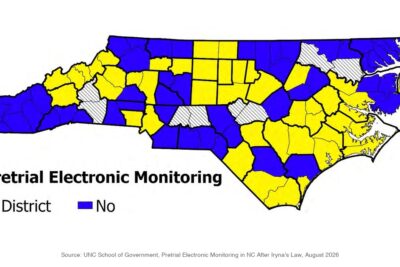
Rep. Ted Lieu’s oft-cited claim that over 450,000 Americans languish in jail simply because they cannot afford bail remains one of the most powerful — and slightly misleading — statistics in the bail reform debate. PolitiFact rated the claim “Half True”: the Bureau of Justice Statistics does report approximately 450,600 unconvicted individuals in local jails at midyear 2024, but this number includes people held without bail, those awaiting mental health commitment, and defendants for whom judges intentionally set high bail due to public safety concerns. No reliable national count exists of those detained solely because they lack the financial resources to post bond.
That distinction matters, because getting the diagnosis right is the only way to prescribe the right treatment. After two decades in this space — watching policy pendulums swing from mass incarceration to wholesale bail elimination and back again — I’ve come to a conclusion that neither side of the aisle wants to hear: the answer isn’t abolishing cash bail entirely, and it isn’t doubling down on it either. The answer is combining a reformed bail system with next-generation electronic monitoring technology that actually works for low-income defendants.
Table of Contents
- What Happens When You Simply Eliminate Cash Bail?
- The Scale of the Problem: Who Actually Can’t Afford Bail?
- Why Electronic Monitoring Should Be the Bridge — Not Another Trap
- The Vendor Monopoly Problem Nobody Wants to Talk About
- What Next-Generation EM Technology Could Actually Deliver
- A Framework That Actually Works: Cash Bail + Smart EM + Fee Reform
- What Has to Change
What Happens When You Simply Eliminate Cash Bail?
Illinois became the first state to fully abolish cash bail under the Pretrial Fairness Act in September 2023. New York’s 2020 bail reform eliminated cash bail for most misdemeanors and non-violent felonies. The results have been instructive — and complicated.
In New York, the statewide pretrial jail population remains 17% lower than pre-reform levels after five years, which is genuinely significant. But the political backlash was severe enough to force three rounds of legislative rollbacks by 2024, largely driven by high-profile cases in which defendants released without bail went on to commit violent offenses.
Harris County, Texas took a different approach — replacing wealth-based detention with risk-based assessment — and achieved net savings of $1,191 per case, a 5% decline in re-arrest rates, and fewer coerced guilty pleas. The system works because it doesn’t eliminate accountability — it restructures how accountability is maintained.
The lesson from both experiments: eliminating cash bail without replacing it with effective supervision tools creates a political vacuum that opponents fill with fear. The real question isn’t whether to reform bail — it’s what replaces the accountability mechanism that cash bail, however imperfectly, provided.
The Scale of the Problem: Who Actually Can’t Afford Bail?
The numbers, even when properly qualified, paint a damning picture. Bureau of Justice Statistics data from midyear 2024 shows 657,500 persons in local jail custody, with approximately 69% — 450,600 people — unconvicted and awaiting court action. The pretrial population has nearly quadrupled since the 1980s and accounts for 68% of all jail population growth during that period.
The income data tells the rest of the story: the average annual income of men who cannot afford bail is $16,000; for women, it’s $11,000. The median felony bail is $10,000 or more. For a single mother earning minimum wage, that’s functionally identical to no bail option at all. She sits in jail, loses her job, loses her housing, and her children enter the foster care system — all before she’s convicted of anything. The downstream costs to taxpayers dwarf whatever bail amount was intended to secure her appearance.
And the racial disparities compound the injustice: approximately 43% of the pretrial population is Black, in a country where Black Americans represent 13% of the general population. This isn’t a coincidence — it’s the predictable outcome of a system that converts poverty into incarceration.
Why Electronic Monitoring Should Be the Bridge — Not Another Trap
Electronic monitoring as a pretrial alternative isn’t a new idea, but its implementation in most U.S. jurisdictions has been catastrophically mismanaged — to the point where it’s become another mechanism for extracting money from people who have none.
The economics, when done right, are overwhelming. EM costs $2–$15 per day compared to $75–$200+ per day for jail detention. Cook County found that EM saved approximately $8,200 per defendant versus continued detention while reducing failures to appear by 10.6 percentage points compared to unconditional release. Washington, D.C.’s Pretrial Services Agency documented ~$580 in local savings and ~$920 in federal savings per participant, with a 24% reduction in new arrests.
Those numbers should make EM the obvious solution. So why hasn’t it delivered on its promise?
The Vendor Monopoly Problem Nobody Wants to Talk About
Here’s the uncomfortable truth that most industry analysis glosses over: the American EM market is functionally an oligopoly, and the people paying the price — literally — are the defendants least able to afford it.
BI Incorporated, a subsidiary of The GEO Group (one of the largest private prison operators in America), controls an estimated 40–50% of the U.S. electronic monitoring market across 40+ states, including the federal Bureau of Prisons contract. SCRAM Systems dominates alcohol monitoring and holds significant GPS tracking market share. Together with SuperCom, Attenti (Allied Universal), and Track Group, these five vendors control the vast majority of government EM contracts.
This concentration has predictable consequences:
- Inflated fees passed to defendants: 43 states authorize EM fees for pretrial defendants. In some jurisdictions, defendants pay up to $1,000 per month for monitoring — more than their rent. Only California and Rhode Island expressly prohibit pretrial EM fees. Failure to pay can result in bail revocation and re-incarceration — creating what Yale Law Journal has called a “modern-day debtor’s prison.”
- Outdated, burdensome equipment: The dominant two-piece GPS systems from BI and SCRAM weigh 180–250 grams, require daily charging (24–72 hour battery life), and generate chronic false alarms from skin-contact and motion sensors. For a defendant trying to hold down a job, a conspicuous, heavy ankle bracelet that needs charging every night is a scarlet letter — visible to employers, coworkers, and anyone in their life.
- Procurement inertia: Long-term government contracts, bid specifications written around incumbent products, and deep vendor-agency relationships create barriers that keep newer, more affordable, and less burdensome technologies locked out of the market for years.
The irony is brutal: EM was supposed to liberate people from pretrial detention. Instead, it’s become another layer of financial extraction — and the equipment itself hasn’t meaningfully improved in a decade because the dominant vendors face no competitive pressure to innovate.
What Next-Generation EM Technology Could Actually Deliver
The technology to fix these problems exists today. One-piece GPS ankle monitors now weigh as little as 108 grams — less than half the weight of legacy two-piece devices — and can operate for 7 days or more on a single charge in standalone LTE mode. With adaptive multi-mode connectivity that switches between BLE, WiFi, and cellular depending on the environment, battery life extends to weeks or even months in assisted modes. Fiber-optic tamper detection eliminates the 15–30% false alarm rates that plague traditional resistive and PPG-based sensors.
These aren’t incremental improvements — they represent a generational leap that directly addresses the burdens EM places on low-income defendants:
- Lighter, smaller devices mean less workplace stigma and greater ability to maintain employment
- Multi-week battery life eliminates the daily charging ritual that disrupts work schedules and generates false low-battery violations
- Zero false tamper alarms means fewer warrant-triggering alerts that can send a compliant defendant back to jail over a sensor malfunction
- Lower operational costs that should — if the market actually functioned competitively — translate into lower fees for defendants
The operative word is “should.” Technology alone doesn’t solve a market structure problem. As long as a handful of vendors control procurement pipelines through long-term contracts and specification manipulation, defendants will continue subsidizing an industry that has little incentive to reduce their burden.

A Framework That Actually Works: Cash Bail + Smart EM + Fee Reform
Neither pure abolition nor the status quo is the answer. Based on two decades of observing what works and what doesn’t across dozens of jurisdictions, a functional pretrial system would combine three elements:
1. Risk-based bail with genuine ability-to-pay assessment. Harris County’s model demonstrates this can work. Set bail based on validated risk instruments. For defendants who cannot afford even modest amounts, substitute EM supervision rather than defaulting to detention.
2. Technology-forward EM that minimizes defendant burden. Jurisdictions should demand modern equipment specifications in RFPs: sub-150g weight, 7+ day battery life, zero-false-alarm tamper detection, and cellular dead zone coverage. These specifications exist today — agencies just need to stop writing bids around 15-year-old product lines.
3. State-funded EM for indigent defendants. If EM is ordered as a condition of pretrial release, the cost should be borne by the state — not the defendant. At $5–$15 per day versus $75–$200+ for jail housing, the fiscal argument is self-evident. The Bearden v. Georgia principle — that the state cannot condition liberty on ability to pay — should apply to EM fees with the same force it applies to fines.
This framework preserves the accountability mechanism that makes bail reform politically sustainable, while eliminating the two features of the current system that make it unjust: wealth-based detention and extractive monitoring fees.
What Has to Change
Reforming pretrial justice isn’t primarily a technology problem — it’s a political economy problem. The interests aligned against change are substantial: bail bond companies that profit from the current system, incumbent EM vendors that benefit from procurement inertia, and politicians who face asymmetric risk from any defendant who reoffends while on pretrial release.
But the fiscal pressure is becoming irresistible. Counties across America are spending $14–$17 billion annually on pretrial detention. The evidence from Harris County, Cook County, and Washington, D.C. consistently shows that risk-based supervision with modern EM technology achieves equal or better public safety outcomes at a fraction of the cost.
Rep. Lieu’s 450,000 figure may be an overcount. But even if the true number of Americans detained solely due to poverty is half that — 225,000 people sitting in jail right now, presumed innocent, losing their jobs, their housing, and their families — the moral urgency of the problem hasn’t changed. What has changed is the availability of technology that can break the false choice between detention and unsupervised release.
The question isn’t whether that technology exists. It does. The question is whether the political will exists to break open the procurement monopolies that keep it from reaching the people who need it most.