Perpetrators of intra-family violence are increasingly receiving temporary restraining orders. The number of cases has tripled in five years, according to figures requested by VRT. There are more than 700 such orders in place in Flanders.

A temporary restraining order means that someone who poses a danger must leave the family home immediately for 14 days. The public prosecutor simultaneously imposes a restraining order, banning contact with the victim. The aim is to prevent violence within a family from escalating, without the victims having to leave their home.
Over the past five years, the number of temporary restraining orders in Flanders has increased each year, from 217 in 2020 to 707 so far in 2025. The region’s agency for justice and enforcement expects this to rise to 760 by the end of the year, VRT reports.
However, without close monitoring, an order is easy to violate. A 29-year-old woman was killed at a flat in Antwerp last week. The suspect is her ex-partner. A 47-year-old Afghan stabbed his 43-year-old wife to death in Roeselare in September, and last summer, a man set his ex-partner on fire in Houthalen-Helchteren. The men in all three cases were subject to restraining orders.
There are no official figures, but experts say at least 22 women are killed by their partner or former partner every year. A scientific committee has been set up to uncover the underlying patterns and warning signs that often precede violence. They will issue their first report with recommendations next year.
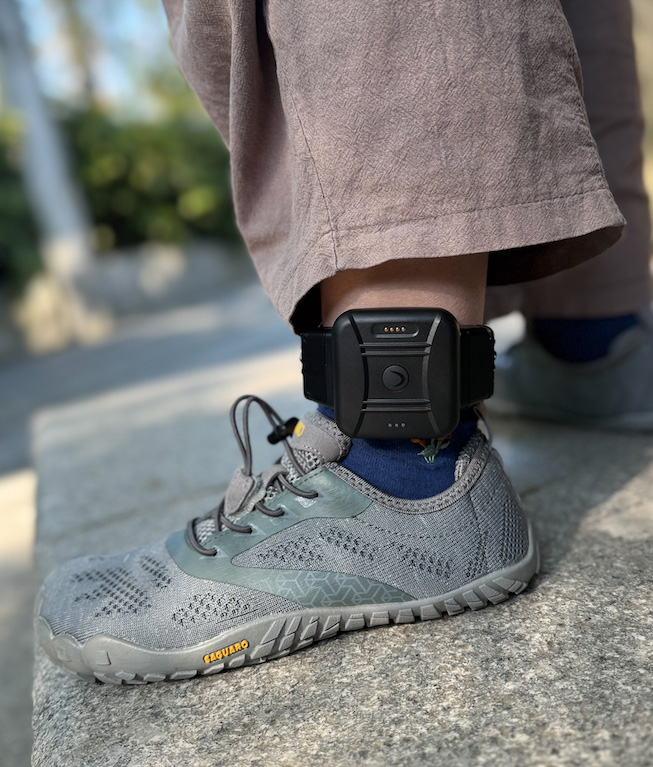
Two years ago, Flemish Justice minister Zuhal Demir announced plans to monitor offenders with a GPS ankle bracelet. The system is currently being tested. In order to apply it effectively, a federal law must first be amended and this has not yet been approved.
Table of Contents
How Does GPS Ankle Monitor Technology Protect Domestic Violence Victims?
GPS ankle monitor proximity alert systems create a digital safety perimeter around domestic violence victims, triggering real-time notifications to both the victim and law enforcement when the monitored offender approaches within a predetermined distance — typically 500-2,000 feet depending on jurisdiction and risk assessment.
Domestic violence GPS monitoring represents one of the most impactful applications of electronic monitoring technology. Traditional restraining orders rely on the offender’s voluntary compliance and are enforceable only after a violation occurs. GPS ankle bracelet monitoring with proximity alerts shifts the paradigm from reactive enforcement to proactive prevention — officers and victims receive warnings before contact occurs rather than after.
The technology works by continuously comparing the GPS ankle monitor’s real-time location against the victim’s registered address, workplace, and — in advanced implementations — the victim’s current mobile phone location. When the distance between offender and victim falls below the alert threshold, the monitoring center receives an immediate notification and initiates the response protocol.
Research data supports the effectiveness of this approach. Programs combining GPS ankle monitor supervision with dedicated victim notification have reported 50-70% reductions in repeat violations compared to standard restraining orders without electronic monitoring. The Nashville Metropolitan Police Department’s domestic violence GPS program, for example, deployed 172 GPS ankle monitors in 68 days and documented significant improvements in victim safety outcomes.
What Technology Challenges Remain in DV Electronic Monitoring?
Despite significant advances, several challenges persist in domestic violence electronic monitoring programs. Indoor positioning accuracy remains limited — GPS signals degrade in buildings, meaning an offender inside a multi-story apartment building may be within prohibited distance without triggering an outdoor GPS alert. Next-generation ankle monitors address this through multi-layer positioning that combines GPS with WiFi and BLE indoor location references.
Battery reliability is another critical factor. An ankle monitor that dies during overnight hours creates a supervision gap precisely when domestic violence incidents are most likely. Advanced devices with 7-day battery life and WiFi-directed mode (extending runtime to 3 weeks) substantially reduce this risk compared to devices requiring daily charging.
False tamper alerts create a separate problem for DV programs: each false alert triggers a response that diverts resources from genuine threats. Fiber-optic tamper detection technology has eliminated this issue by providing zero false-positive tamper monitoring, ensuring that every alert represents an actual compliance event requiring officer attention.
How Does Advanced GPS Monitoring Technology Strengthen Victim Safety?
Next-generation GPS ankle monitors equipped with proximity alert technology create dynamic digital safety zones around domestic violence victims, alerting both the victim and law enforcement when the offender approaches within court-specified distances — typically 500 to 2,000 feet depending on risk assessment.
The reliability of domestic violence GPS ankle bracelet monitoring depends on three critical technology factors. First, positioning accuracy must be sub-2-meter to distinguish between an offender walking past a victim’s building and actually entering it. Second, multi-mode connectivity (BLE, WiFi, and LTE) ensures proximity alerts transmit even in buildings with poor cellular reception — precisely the environments where many violations occur. Third, zero false-alarm tamper detection prevents the alert fatigue that degrades response times in high-volume electronic monitoring programs.
Programs combining GPS ankle monitor supervision with dedicated victim-facing notification apps have demonstrated measurably improved safety outcomes. The technology enables what traditional restraining orders cannot: continuous, real-time verification of offender location relative to the protected person, with automated alerting that does not depend on the victim observing and reporting a violation.
For agencies implementing DV electronic monitoring, device battery reliability during overnight hours — the highest-risk period for domestic violence incidents — is a non-negotiable specification. GPS ankle monitors with 7-day standalone battery and WiFi-directed mode extending to three weeks provide the operational margin that 24-48 hour devices cannot match for victim protection applications.