A state-issued electronic monitoring program offers safety and security for domestic violence victims with just one small box.
“It’s backed by a 24-hour call center; there’s never a time when someone is not monitoring for those alerts,” said Dylan Duppin, administrator of North Carolina’s Domestic Violence Electronic Monitoring Program.
The program enforces court-mandated no-contact orders with GPS tracking for defendants accused of domestic violence, sexual assault, or stalking during the pretrial release period.
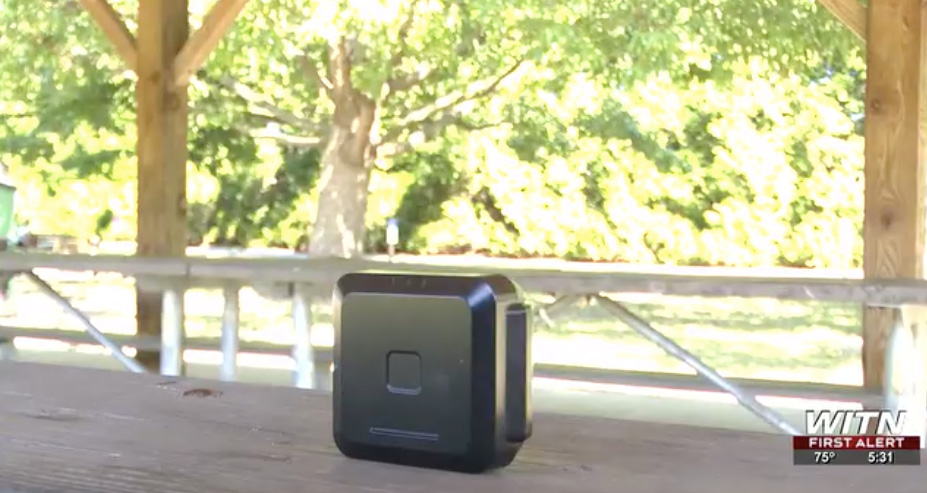
Victims carry the box, and the defendant has an ankle monitor that allows the monitoring program call center to see where the defendant is in relation to the victim.
The defendant is given an exclusion zone—an area they must stay away from—with the monitor.
“It gives that peace of mind that if there isn’t an open alert, he’s not anywhere near me, and if he is anywhere near me, I’ll be made aware of it,” Duppin said.
“Other than just being cautious or afraid to go places, to know that you have a program that can go along with you makes life a little bit easier, where you can take a breath and not worry so much,” said Sarah F., a domestic violence survivor. “You know, always looking over your shoulder or being afraid to go places.”
Notifications from the call center about a defendant’s location can be lifesaving.
Duppin recalled one instance where they were able to alert a victim, who then left her home before the defendant arrived.
“The defendant had tried to force entry into the home. There was a smashed window, and there was evidence that he tried to kick the door in. There are plenty of success stories like that where we’re able to alert the victim,” Duppin said.
And while not all victims experience situations to that degree, the program still provides security in everyday life.
“I’m not as worried when I go out. The person does not live here in the county, which is good. But when I do travel to other places, I do take the device with me, because you never know where the other person may be. Every county should have it,” Sarah F. said.
This monitoring system, while offering protection, is also cost-efficient for judicial systems.
Pretrial detention costs $128 a day, while the electronic monitoring program costs about $11 a day.
At the Pitt County Courthouse, a vigil was also held today to honor and remember domestic violence victims who have lost their lives.
How Does GPS Ankle Monitor Technology Protect DV Victims?
GPS ankle monitor proximity alerts create digital safety perimeters around victims, triggering real-time notifications when offenders approach court-specified distances — enabling proactive intervention before contact occurs.
DV electronic monitoring effectiveness depends on sub-2-meter GPS accuracy, multi-mode BLE/WiFi/LTE connectivity ensuring alerts transmit in poor cellular areas, and zero false-alarm fiber-optic tamper detection preventing response fatigue. Programs using advanced GPS ankle bracelet technology with victim notification report 50-70% reductions in repeat violations versus standard protective orders without electronic monitoring. Battery life matters critically — devices dying overnight create gaps during peak-risk hours; 7-day LTE and 3-week WiFi battery substantially reduce this vulnerability.
How Does Advanced GPS Monitoring Technology Strengthen Victim Safety?
Next-generation GPS ankle monitors equipped with proximity alert technology create dynamic digital safety zones around domestic violence victims, alerting both the victim and law enforcement when the offender approaches within court-specified distances — typically 500 to 2,000 feet depending on risk assessment.
The reliability of domestic violence GPS ankle bracelet monitoring depends on three critical technology factors. First, positioning accuracy must be sub-2-meter to distinguish between an offender walking past a victim’s building and actually entering it. Second, multi-mode connectivity (BLE, WiFi, and LTE) ensures proximity alerts transmit even in buildings with poor cellular reception — precisely the environments where many violations occur. Third, zero false-alarm tamper detection prevents the alert fatigue that degrades response times in high-volume electronic monitoring programs.
Programs combining GPS ankle monitor supervision with dedicated victim-facing notification apps have demonstrated measurably improved safety outcomes. The technology enables what traditional restraining orders cannot: continuous, real-time verification of offender location relative to the protected person, with automated alerting that does not depend on the victim observing and reporting a violation.
For agencies implementing DV electronic monitoring, device battery reliability during overnight hours — the highest-risk period for domestic violence incidents — is a non-negotiable specification. GPS ankle monitors with 7-day standalone battery and WiFi-directed mode extending to three weeks provide the operational margin that 24-48 hour devices cannot match for victim protection applications.