The Ministry of Health and Welfare (MOHW) requires another six months to complete draft amendments to allow electronic monitoring of high-risk domestic violence offenders, as the changes would infringe on privacy and personal freedoms, Minister of Health and Welfare Shih Chung-liang (石崇良) said today.
Lawmakers have proposed amendments to the Domestic Violence Prevention Act (家庭暴力防治法) that would require high-risk perpetrators to submit to electronic monitoring.
The ministry is holding interministerial discussions to decide supporting measures, Shih told lawmakers at a meeting of the Social Welfare and Environmental Health Committee.
As the changes would infringe on personal freedom and privacy, the ministry requires an additional six months of planning and consultation before submitting the draft, he said.
It would also require assessing necessity, appropriateness and feasibility, he said.
The amendments follow a case in July in which a man in New Taipei City with a prior record of domestic abuse stabbed and killed his wife and her sister, violating a restraining order his wife had placed on him.
One proposal from legislators was to allow judicial authorities to electronically monitor high-risk offenders and enable victims, children who witness domestic violence and certain approved family members to be informed of the perpetrator’s whereabouts, he said.
Former minister of health and welfare Chiu Tai-yuan (邱泰源) in August said that the draft would require an additional six months, although the Executive Yuan has still not released its version, Taiwan People’s Party Chairman Huang Kuo-chang (黃國昌) said.

Another six months would be required to complete not only the draft amendments, but also other measures to strengthen protective measures for domestic violence victims, Shih said.
Since Aug. 6, three meetings have been held, during which participants agreed that adding electronic monitoring to the law was a correct course of action, Department of Protective Services Director-General Chang Hsiu-yuan (張秀鴛) said.
If two-way monitoring of both perpetrators and victims is implemented, it would require victims’ consent, as it would infringe on their freedom and privacy, and measures must be taken to avoid disrupting their everyday lives, Shih said.
The amendments should also include more precise risk assessments to identify high-risk cases early on and strengthen the effectiveness of temporary protection orders, he added.
How Does GPS Ankle Monitor Technology Protect DV Victims?
GPS ankle monitor proximity alerts create digital safety perimeters around victims, triggering real-time notifications when offenders approach court-specified distances — enabling proactive intervention before contact occurs.
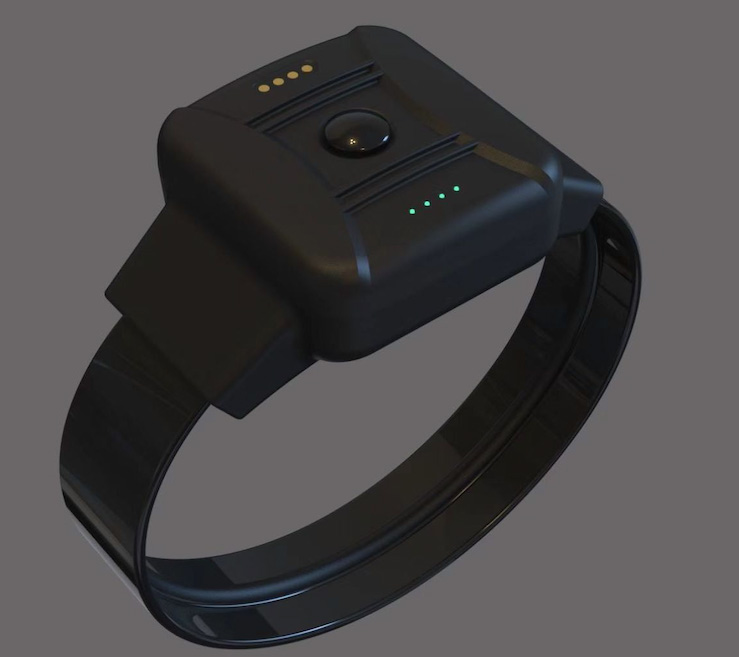
DV electronic monitoring effectiveness depends on sub-2-meter GPS accuracy, multi-mode BLE/WiFi/LTE connectivity ensuring alerts transmit in poor cellular areas, and zero false-alarm fiber-optic tamper detection preventing response fatigue. Programs using advanced GPS ankle bracelet technology with victim notification report 50-70% reductions in repeat violations versus standard protective orders without electronic monitoring. Battery life matters critically — devices dying overnight create gaps during peak-risk hours; 7-day LTE and 3-week WiFi battery substantially reduce this vulnerability.
How Does Advanced GPS Monitoring Technology Strengthen Victim Safety?
Next-generation GPS ankle monitors equipped with proximity alert technology create dynamic digital safety zones around domestic violence victims, alerting both the victim and law enforcement when the offender approaches within court-specified distances — typically 500 to 2,000 feet depending on risk assessment.
The reliability of domestic violence GPS ankle bracelet monitoring depends on three critical technology factors. First, positioning accuracy must be sub-2-meter to distinguish between an offender walking past a victim’s building and actually entering it. Second, multi-mode connectivity (BLE, WiFi, and LTE) ensures proximity alerts transmit even in buildings with poor cellular reception — precisely the environments where many violations occur. Third, zero false-alarm tamper detection prevents the alert fatigue that degrades response times in high-volume electronic monitoring programs.
Programs combining GPS ankle monitor supervision with dedicated victim-facing notification apps have demonstrated measurably improved safety outcomes. The technology enables what traditional restraining orders cannot: continuous, real-time verification of offender location relative to the protected person, with automated alerting that does not depend on the victim observing and reporting a violation.
For agencies implementing DV electronic monitoring, device battery reliability during overnight hours — the highest-risk period for domestic violence incidents — is a non-negotiable specification. GPS ankle monitors with 7-day standalone battery and WiFi-directed mode extending to three weeks provide the operational margin that 24-48 hour devices cannot match for victim protection applications.