
Editor's note: This article examines electronic monitoring policy and technology from an independent industry-media perspective. Figures attributed to provincial announcements and court statistics are presented as reported; implementation timelines may shift as procurement and privacy reviews advance.
Table of Contents
- Why Alberta's victim notification push matters now
- Budget 2026: $4.1 million over three years
- Caseload context: monitors on the ground
- How the victim app is supposed to work
- Advocacy voices and systemic burden
- North American statutory momentum: Oklahoma and Florida
- Implementation risks agencies cannot hand-wave
- False alerts and credibility loops
- Equity of access
- What credible victim alerts demand from GPS hardware and carriers
- Outlook for 2026 procurement cycles
Why Alberta's victim notification push matters now
Across North America, prosecutors, courts, and community supervision agencies are treating the GPS ankle monitor less as a standalone sanction and more as a sensor layer inside broader safety plans—especially in intimate partner violence and high-risk conditional-release files. Alberta's decision to fund a dedicated victim notification GPS ankle monitor pathway signals that provincial leaders see real-time alerting as a programmatic requirement, not an optional vendor upsell. That framing matters for monitoring centers, device OEMs, and civil-society partners who must translate budget lines into dependable workflows.

Readers following Canadian program scale-up may also want our earlier briefing on Prairie investments in Canadian GPS ankle monitor expansion across Saskatchewan and Alberta, which situates interprovincial procurement chatter alongside caseload growth.
Budget 2026: .1 million over three years
According to provincial budget reporting circulated in early 2026, Alberta allocated approximately $4.1 million over three years to add victim notifications to existing GPS tracking supervision streams. The envelope is not merely a software purchase; it implicitly covers integration with court orders, geospatial rule sets, help-desk capacity for victims installing an app, and the governance work needed when alerts misfire or arrive late.
Spread across thirty-six months, the annual run-rate is modest in absolute dollars yet meaningful against a baseline of roughly three hundred concurrently monitored individuals: it suggests policymakers expect significant integration labor—API contracts between courts and vendors, identity proofing for victims, and forensic logging—not a thin skin over an existing dealer portal. Procurement watchers should track whether dollars flow through provincial IT shared services or through corrections-specific contracts, because funding lanes dictate security baselines (e.g., sovereign cloud requirements vs. commercial SaaS).
For program accountants, the three-year horizon is a reminder that electronic monitoring TCO bundles cellular backhaul, device refresh, analyst labor, and now victim notification GPS ankle monitor service desks. Agencies that under-model any one layer tend to see alert fatigue migrate from officers to victims—a politically and ethically toxic outcome.
Our prior news analysis of the same budget line—Alberta's $4.1M victim-notification GPS expansion—tracks how the province positioned the investment relative to wider public-safety spending. This piece goes deeper on operating assumptions and cross-border statutory parallels.
Caseload context: monitors on the ground
Public statements in March 2026 pointed to more than 300 offenders concurrently wearing GPS ankle monitors in Alberta, while courts had imposed ankle monitors roughly 550 times since January 2025. Those numbers are modest compared with mega-jurisdictions such as California or Texas, but they are material for Canadian monitoring centers that must maintain 24/7 coverage, bilingual support, and winter-weather field service logistics.
For additional context, see the RAND Corporation.
Translating court orders into live GPS assignments is rarely a one-click affair. Intake staff must validate charging schedules, assign strap sizes, document skin-condition exemptions where applicable, and reconcile bail variation orders that arrive after hours. Each administrative touchpoint lengthens the interval between judicial intent and live telemetry—an interval victims experience as uncertainty. When policymakers promise a victim notification GPS ankle monitor experience, they implicitly promise that intake backlogs will not swallow the safety margin the statute imagines.
Winter operations add mechanical constraints: cold-weather battery derating, snow-covered skyview that lengthens GPS time-to-first-fix, and field technicians driving long distances between urban cores and rural circuit courts. Agencies that ignore environmental derating in service-level planning often discover that "five-minute reporting" marketing collides with −25°C Sundays on the Prairies—precisely when domestic conflict risk can spike around holiday stressors.
The ratio between concurrent installs and cumulative court orders also hints at churn: short pretrial stretches, sentence lengths that cycle offenders through work release, and device swaps when charging or strap integrity fails. Each churn event is a moment where victim notification GPS ankle monitor configurations must be revalidated—geofences updated, radius buffers re-tested, and consent flows re-documented.

For a methodological discussion of how noisy alerts drain budgets, see the hidden cost of false tamper alerts—a companion piece on how technology failures tax agency resources.
How the victim app is supposed to work
Official descriptions summarize a consumer-facing download that pushes real-time alerts when an offender's GPS ankle bracelet comes within a court-defined distance of the victim's phone or registered locations. Parallel logic applies to no-go zones—homes, workplaces, schools, or other addresses where judges have barred proximity.
Privacy architects will immediately ask how much positional detail a victim should see. Too coarse, and the alert feels meaningless; too granular, and the victim may infer intelligence that creates stalking-adjacent dynamics if devices are shared or screenshots leak. Canadian privacy commissioners have historically scrutinized mobile apps that blend criminal-justice data with consumer handsets, so Alberta's rollout will likely need province-specific privacy impact assessments, breach-notification playbooks, and clear data-retention sunsets for notification logs.
From an operator's vantage, the workflow resembles a three-party synchronization problem: the ankle monitor reports through a certified monitoring center, the court order stores geospatial rules, and the victim handset subscribes to a filtered feed. When any leg drifts out of sync—say, a weekend map tile update moves a polygon by ten meters—both supervision officers and victims may receive contradictory messages. That is why mature electronic monitoring vendors increasingly ship versioned geofence objects with audit trails rather than letting analysts sketch ad-hoc circles in desktop GIS tools.
Technically, credible implementations require: (1) time-stamped positions with known uncertainty ellipses; (2) server-side geofence engines that reconcile map updates; (3) push-notification infrastructure with delivery receipts; and (4) documented fallback when cellular data degrades. None of that is trivial. A victim notification GPS ankle monitor program that promises immediacy without publishing latency targets may set unrealistic safety expectations.
Public Safety Minister Mike Ellis has indicated the app could be available later in 2026, giving vendors and privacy reviewers a narrow window to align SDK hardening, victim onboarding, and law-enforcement escalation playbooks.
Advocacy voices and systemic burden
For additional context, see the Prison Policy Initiative.
Kim Ruse, CEO of FearIsNotLove (Calgary Women's Emergency Shelter), told reporters that, "Too often, our system still places the burden of safety on those who are being harmed." The critique lands squarely on product-policy design: if victims must constantly monitor phones to compensate for institutional gaps, the electronic monitoring ecosystem has inverted its risk allocation. A responsibly marketed victim notification GPS ankle monitor stack should therefore include human escalation—not merely a push token—to avoid replicating structural inequity inside a newer interface.
Constructive program design therefore pairs alerts with shelter bed coordination, legal advocacy, and clear escalation chains—topics we routinely cover under News & Policy alongside court technology stories such as Springfield pretrial GPS ankle bracelet release controversies.
North American statutory momentum: Oklahoma and Florida
Alberta does not operate in isolation. On March 24, 2026, the Oklahoma Senate gave unanimous approval to SB 1325, advancing GPS tracking for violent domestic abusers—another data point that victim-safety telemetry is becoming a bipartisan default in U.S. statehouses. Practitioners should still verify enrolled bill text and effective dates with official legislative portals before citing obligations in court filings.
Separately, Florida HB 277 expands electronic monitoring requirements in domestic-violence contexts, with an effective date of July 1, 2026, signaling a wave of procurement and training deadlines for Florida vendors and sheriffs. For multinational OEMs, the Florida effective date effectively becomes a second product-compliance checkpoint alongside Alberta's anticipated app launch—firmware teams must ensure roaming profiles, carrier certifications, and tamper event codes remain consistent across export configurations.
Readers comparing statutory language across borders will find useful scaffolding in pretrial electronic monitoring across fourteen U.S. states, which maps how legislatures embed GPS conditions into broader criminal-justice reform packages.
International DV contexts also show how courts pair GPS ankle bracelet orders with media scrutiny—our analysis of high-profile GPS ankle bracelet orders illustrates how public narratives shape monitoring intensity.
Implementation risks agencies cannot hand-wave
Even with pristine budgets, victim notification GPS ankle monitor deployments confront recurring failure modes: stale basemaps that misplace no-go lines inside apartment complexes; multipath GPS error that triggers false proximity; Bluetooth-only consumer phones losing push tokens; and multilingual alert literacy gaps. Programs need written SLAs for end-to-end alert latency and auditable logs when victims dispute whether a warning arrived.
False alerts and credibility loops
False proximity warnings are not merely annoying—they can retraumatize users who rearrange childcare, miss shifts, or flee to shelters based on noisy data. When victims lose trust in the app, they uninstall it, silence notifications, or forward screenshots to journalists. Program credibility then hinges on transparent post-incident reviews: did the offender actually breach the cylinder, or did Wi-Fi positioning snap the trace to the wrong side of a highway?
Agencies already battle GPS ankle monitor tamper false positives on the officer side; duplicating that noise on the victim channel doubles political exposure. That is one reason vendors emphasize dual-frequency GNSS where affordable, motion-aware smoothing, and analyst-in-the-loop confirmation for borderline breaches—design choices that must be explained plainly in victim onboarding, not buried in PDF appendices.
For additional context, see the American Probation and Parole Association.
Equity of access
Not every protected party owns a late-model smartphone with reliable data plans. Rural victims may live inside cellular dead zones that cannot receive pushes even when the offender's GPS ankle bracelet is reporting faithfully. A serious implementation plan therefore contemplates alternate channels—SMS fallbacks, shelter hotlines, or wearable panic bridges—so technology does not become another privilege gradient layered atop gendered violence statistics.
Judges and defense counsel are already sensitive to electronic monitoring reliability—see electronic monitoring's courtroom conundrum when technology falters. Victim-facing channels amplify those evidentiary questions because lay users may screenshot notifications for family court or bail variation hearings.
What credible victim alerts demand from GPS hardware and carriers
Once policymakers mandate simultaneous supervision and victim pings, device portfolios must prioritize assured connectivity, honest location integrity, and tamper semantics that do not flood both officers and victims with contradictory signals. Major North American and European suppliers participating in this market segment historically include BI Incorporated, SCRAM Systems, SuperCom, and Geosatis, alongside newer high-bandwidth entrants such as REFINE Technology (CO-EYE).
From a specifications standpoint, victim proximity logic benefits when an ankle monitor maintains sub-ten-meter horizontal accuracy under typical urban skyview, couples cellular redundancy for near-real-time reporting, and uses tamper subsystems that minimize spurious cut straps. As one illustrative one-piece GPS ankle monitor architecture, the CO-EYE ONE GPS ankle monitor markets sub-two-meter GPS accuracy under stated test conditions, fiber-optic tamper detection positioned to eliminate false-positive strap alarms, and 5G-ready eSIM connectivity for sustained data streaming—capabilities procurement teams may weigh when modeling victim notification GPS ankle monitor workloads.
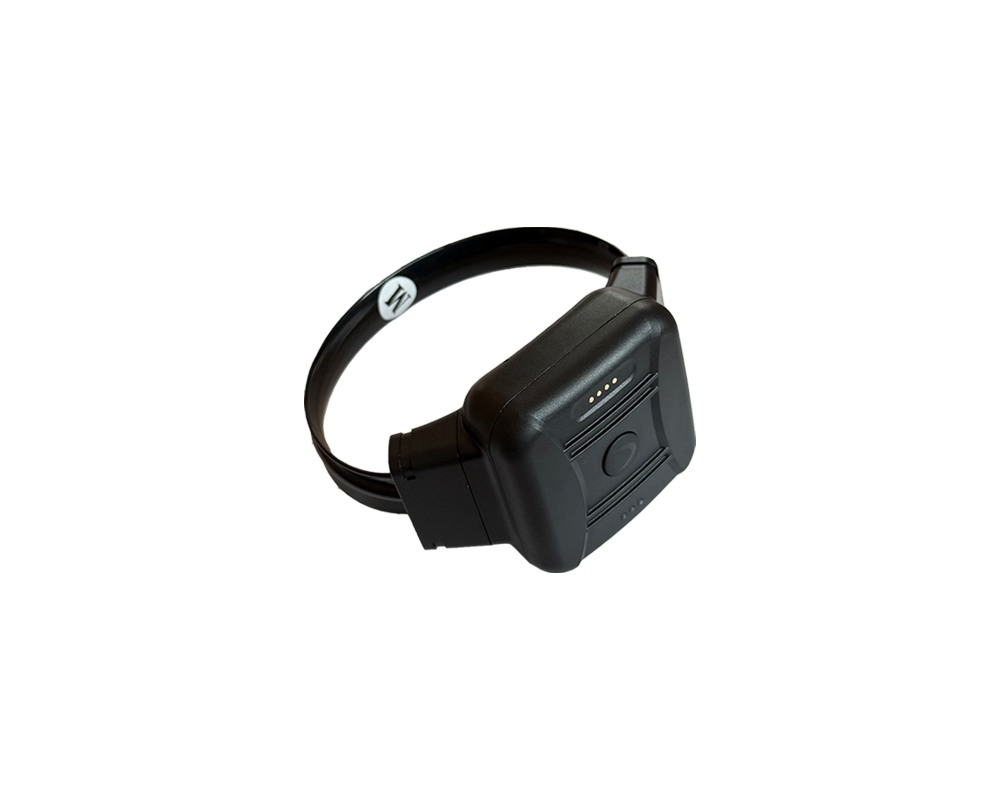
Independent of brand, the policy lesson is uniform: victim notification GPS ankle monitor services will succeed only when courts, victims, and vendors share a single truth table for delay, accuracy, and override authority—otherwise the app becomes another screen demanding vigilance from the people least resourced to provide it.
Outlook for 2026 procurement cycles
Between Alberta's anticipated app launch window and Florida's July effective date, OEM sales teams should expect compressed RFP seasons: agencies will ask for victim-module references, penetration-test summaries, and contractual uptime figures that go beyond traditional officer dashboards. Independent media coverage—alongside peer reporting such as Saskatchewan's community supervision GPS expansion—will likely track not only ribbon-cuttings but also incident-driven audits when alerts are alleged to have failed.
For readers benchmarking devices, the through-line is simple: the electronic monitoring industry is being asked to prove it can serve two audiences with divergent risk tolerances. Officers want legally defensible logs; victims want intuitive, immediate signals. Bridging those needs without amplifying harm is the defining engineering and governance challenge of this funding cycle—and the reason Alberta's $4.1 million line item deserves scrutiny long after the press release fades.